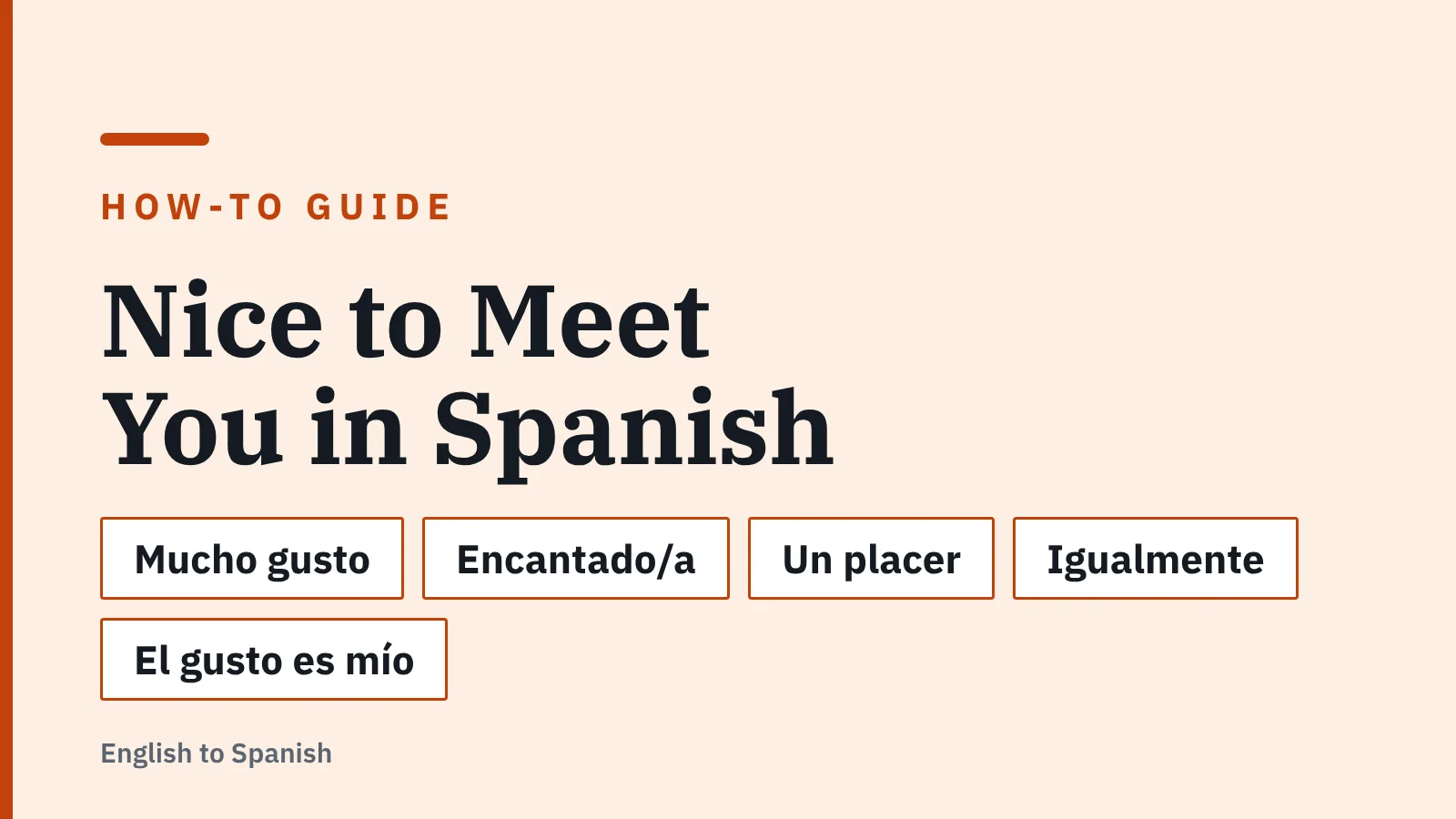
The short answer to how to say nice to meet you in spanish: mucho gusto fits every country and situation, encantado or encantada sounds warm and polished, and un placer suits business introductions.
Quick Steps
Five actions you can use before your next introduction:
- Say mucho gusto if you only want to memorize one phrase — it is understood in every Spanish-speaking country.
- Say encantado (male speaker) or encantada (female speaker) when the meeting is warm, social or semi-formal.
- Say un placer or es un placer in business settings: client meetings, conferences, interviews.
- Answer someone else’s greeting with igualmente or el gusto es mío rather than repeating their words.
- At the end of the conversation, move the phrase into the past: fue un placer or encantado de conocerte.
Each one is three words or fewer, which matters because an introduction gives you barely a breath of airtime. Practice saying all five out loud once. Your mouth needs the rehearsal more than your memory does.
Why "Nice to Meet You" Has No Single Spanish Translation
English packs politeness, warmth and timing into one fixed formula. Spanish splits that job across several phrases, and each one carries a different level of formality and a different grammatical shape. Translating word for word produces bueno conocerte, which no native speaker says.
The spread matters because the language is not small. The Instituto Cervantes 2024 yearbook states that the Spanish-speaking community with native command of the language is approaching 500 million people. A greeting that works in a Bogotá office and a Montevideo kitchen has to flex.
Three things change the phrase you choose:
- Formality — a job interview and a friend’s barbecue are not the same room.
- Your gender — encantado and encantada agree with the speaker.
- Timing — the greeting at hello is present tense; the one at goodbye is past tense.
Get those three right and you sound like someone who has had this conversation before. Get them wrong and the meaning still lands, but the seams show. Nobody will correct you out loud, which is exactly why the habit sticks.
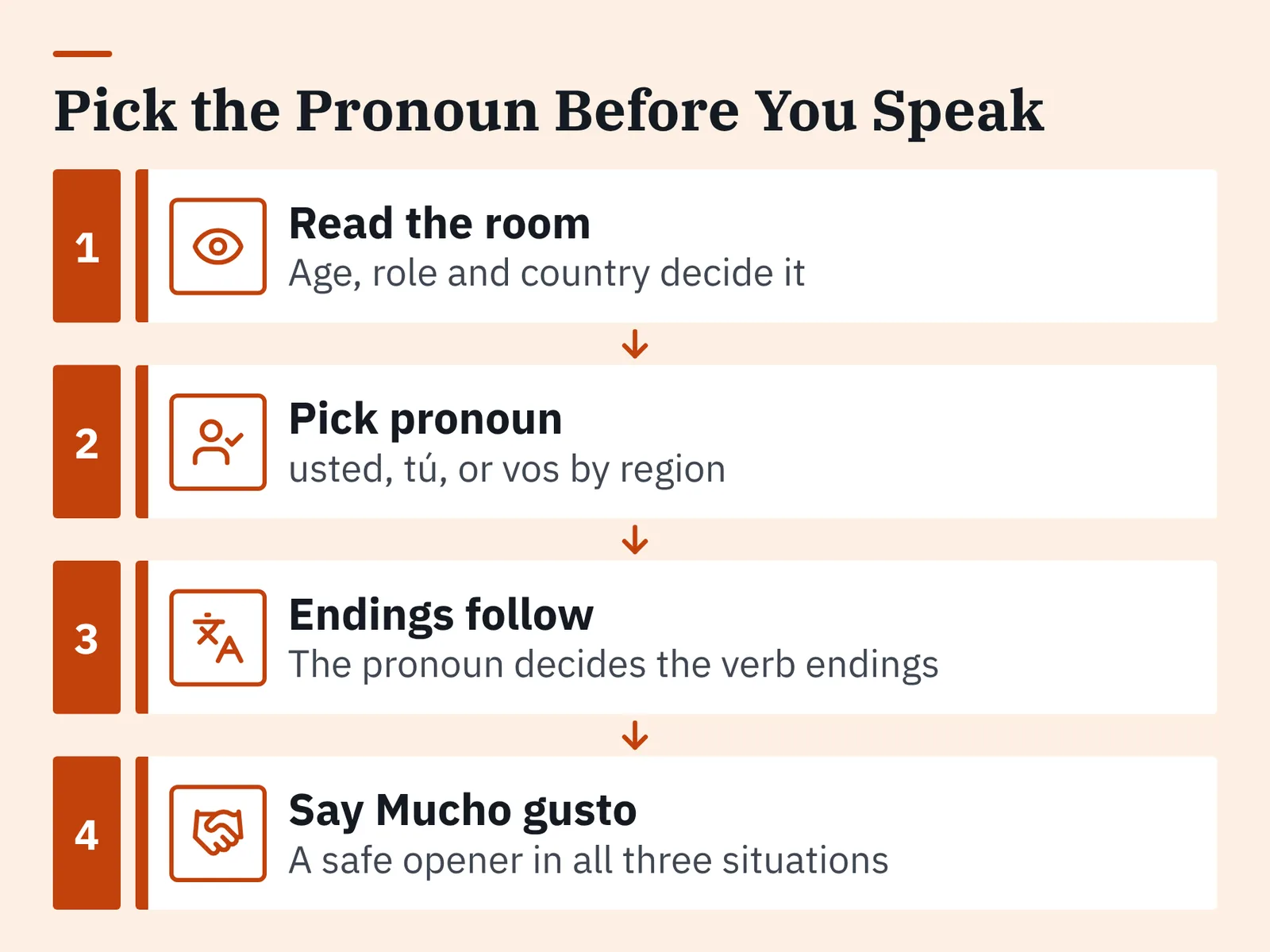
Step 1 — Read the Room: Decide Between usted, tú, and vos
Time: 10 seconds, before you open your mouth. Prep: know which country you’re in.
Pick the pronoun first, because it decides the verb endings in everything you say next. Use usted with anyone older, anyone in a professional role, and anyone who used it with you first. Use tú with peers, classmates, friends of friends and most people under about thirty in casual settings.
Voseo is the third option and it is regional, not optional slang. The RAE defines voseo as using the pronoun vos to address a single person, a characteristic feature of Spanish especially in the Río de la Plata and Central American areas. You do not have to produce vos yourself — understanding it when it comes at you is enough.
The opposite case is just as useful. The Real Academia Española’s Diccionario panhispánico de dudas identifies almost all of Mexico, the Antilles, most of Peru and Venezuela, and Colombia’s Atlantic coast as areas of exclusive tuteo, meaning tú and not vos.
| Situation | Pronoun | Safe opener |
|---|---|---|
| Client, manager, official, older stranger | usted | Mucho gusto. / Un placer. |
| Peer at a party, classmate, cousin’s friend | tú | Mucho gusto. / Encantado. |
| Buenos Aires, Montevideo, San José café | vos (expect it) | Mucho gusto — reply naturally |
If you are writing rather than speaking and need one neutral standard, the reasoning in this guide to choosing a Latin American Spanish standard for translations will save you a round of edits.
Step 2 — Choose Your Phrase: Mucho gusto, Encantado/a, or Un placer
Time: one minute to learn. Prep: none.
Mucho gusto is the workhorse. It is short, gender-neutral, and acceptable in a boardroom or a bus queue. The RAE’s Diccionario del estudiante records both mucho gusto and tanto gusto in its entry for gusto as exchanges used when people are introduced.
Encantado and encantada sound a shade warmer and more cultivated. In Spain you will hear them constantly; across much of Latin America they read as polished rather than everyday. Un placer is the most formal of the three and the most natural in business.
| Phrase | Literal sense | Best fit | Gender change? |
|---|---|---|---|
| Mucho gusto | Much pleasure | Anywhere, any formality | No |
| Encantado / encantada | Delighted | Social, warm, Spain especially | Yes |
| Un placer / es un placer | A pleasure | Business, conferences, clients | No |
| Tanto gusto | So much pleasure | Introductions, less common than mucho gusto | No |
Spanish learners are not spread evenly, which affects whose Spanish you hear most. According to the Observatorio Global del Español at the Instituto Cervantes, 78% of all Spanish learners are concentrated in the United States, the European Union and Brazil.
Pick one phrase as your default and one as your backup. Two is enough to cover every introduction you will have this year.
Step 3 — Match the Ending to Your Gender and the Region You’re In
Time: 30 seconds. Prep: know which form applies to you.
Encantado and encantada agree with the person speaking, not the person being greeted. A man says encantado to a woman. A woman says encantada to a man. This trips up English speakers constantly because English adjectives never do this work.
Longer versions exist and they follow the pronoun you chose in Step 1:
- Encantado de conocerte — tú, casual.
- Encantado de conocerlo / conocerla — usted, formal, matching the listener’s gender.
- Mucho gusto en conocerte — tú, slightly fuller than bare mucho gusto.
- Es un placer conocerlo — usted, business.
Region shifts the frequency, not the grammar. Spanish is a native language across 21 countries in Europe, the Americas and Africa, according to the Instituto Cervantes 2025 demographic report, and every one of them understands all four forms above.
Caribbean Spanish moves fast and clips endings, so mucho gusto often arrives as two syllables that sound closer to mu’cho gu’to. The phrase is the same one; only the delivery is faster.
Step 4 — Respond When Someone Greets You First (Igualmente, El gusto es mío)
Time: 20 seconds. Prep: one memorized reply.
Repeating the exact phrase back sounds like an echo. Spanish has dedicated responses, and using one signals that you have heard the other person rather than recited a line.
- Igualmente — "likewise." The shortest and most common reply. Works everywhere.
- El gusto es mío — "the pleasure is mine." Slightly warmer, slightly more formal.
- Encantado / encantada — fine as a reply too, if it matches your gender.
- Lo mismo digo — "same here." Casual, friendly, common in Spain.
The pairing matters more than the words. If someone says mucho gusto, answer igualmente; if someone says un placer in a meeting, answer el gusto es mío. Match their register and you never sound mismatched.
Small courtesy phrases cluster together in real conversation, so the greeting usually arrives within a minute of a thank-you. The alternatives collected in this piece on saying you’re welcome in Spanish beyond de nada pair naturally with the replies above.
Step 5 — Close the Introduction: Switching to the Past Tense at Goodbye
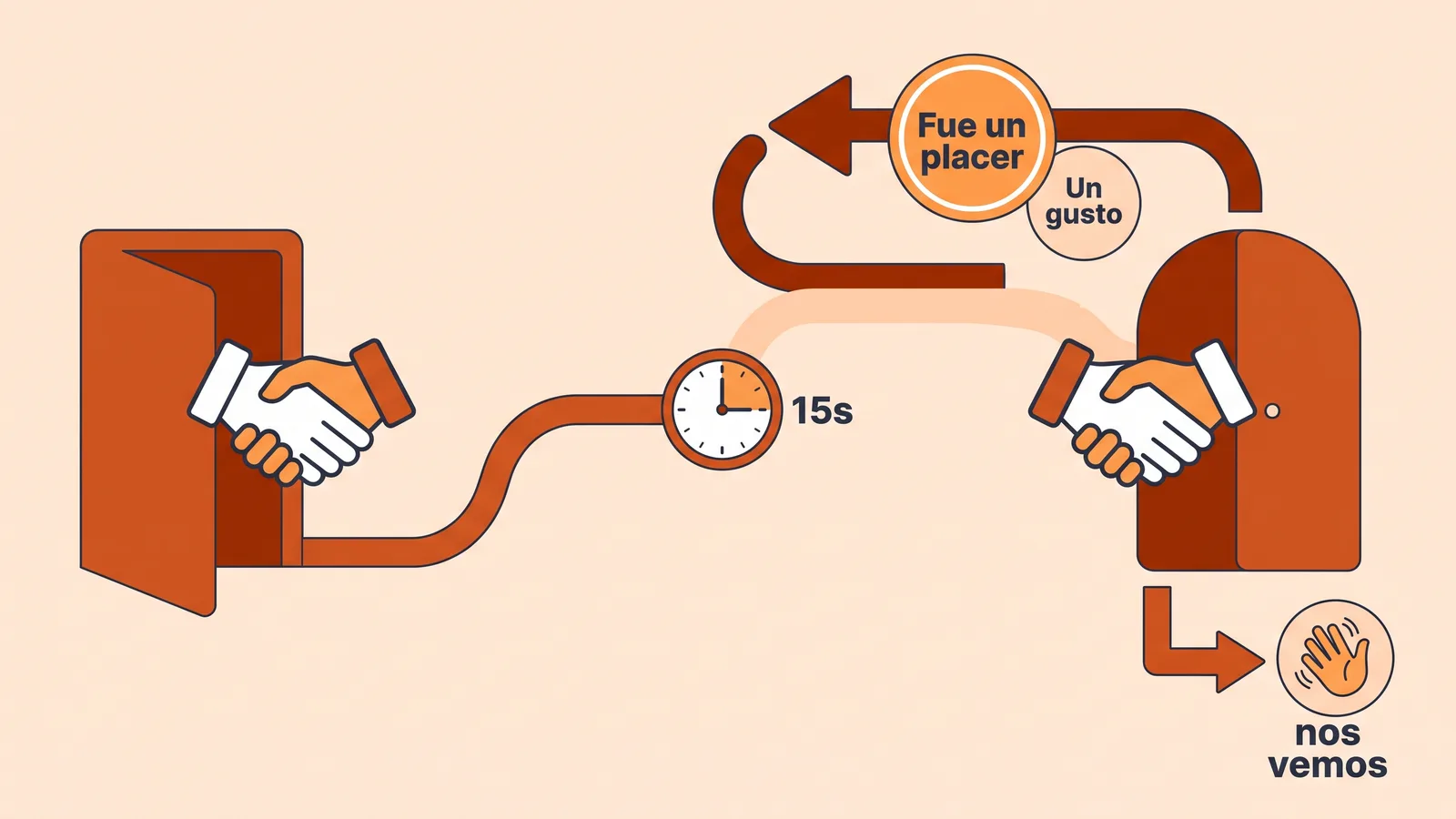
Time: 15 seconds. Prep: one past-tense form.
The meeting is over, so the pleasure is finished. Spanish marks that with the preterite, and skipping the shift is one of the clearest tells that a speaker learned the phrase from a textbook list.
Use one of these as you shake hands and step away:
- Fue un placer — "it was a pleasure." Neutral, works in every register.
- Mucho gusto en conocerte — still acceptable at goodbye, slightly informal.
- Encantado de haberte conocido — "delighted to have met you." Warm, a little bookish.
- Un gusto — clipped and friendly, common across Latin America.
Add a forward-looking line if there will be a next meeting: nos vemos, hasta pronto, que tengas buen día. Three words of closing beats a long sentence delivered badly.
If the conversation got ahead of your Spanish, the exit lines in this guide to saying you don’t speak Spanish politely keep the ending friendly rather than abrupt.
Quick Checklist Before Your Next Spanish Introduction
Run this list once in the thirty seconds before you walk in:
- ☐ Pronoun chosen: usted for professional or older, tú for peers.
- ☐ Default phrase ready: mucho gusto.
- ☐ Gender ending correct if you use encantado or encantada.
- ☐ One reply memorized: igualmente or el gusto es mío.
- ☐ Goodbye line ready: fue un placer.
- ☐ Name said slowly, then the phrase — not both in one rush.
The odds of needing this are higher than most English speakers assume. According to USAFacts, drawing on U.S. Census Bureau American Community Survey data, about 44.9 million people age 5 and older speak Spanish at home in the United States, roughly 1 in every 7 people in that age group.
Treat the checklist as a warm-up, not a script. Say the six items under your breath in the elevator and the phrase comes out without a pause.
Common Mistakes English Speakers Make (and Easy Fixes)
The failure that comes up most often: a male speaker saying encantada because he copied it from a woman in a class recording. The listener understands, smiles, and says nothing. The habit survives for years.
Fix: say your own form out loud ten times, alone, until it is muscle memory — encantado if you are male, encantada if you are female.
Other frequent slips:
| Mistake | Why it sounds off | Fix |
|---|---|---|
| Bueno conocerte | Word-for-word from English; not a Spanish formula | Mucho gusto |
| Repeating mucho gusto back | Sounds like an echo | Igualmente |
| Encantado with a stranger in a formal office | A notch too warm for the setting | Un placer |
| Using tú forms with a client | Over-familiar in professional Spanish | Encantado de conocerlo |
| Present tense at goodbye | The meeting is over; the tense should be too | Fue un placer |
Exposure fixes all of this faster than drills. The U.S. Census Bureau reported that in the 2018–2022 American Community Survey, Spanish accounted for 61.1% of people who spoke a language other than English at home in the U.S., so real practice is usually closer than a language app.
Related reading: for the clipped Caribbean endings described in Step 3, the pronunciation notes in this walkthrough of translating English into Dominican Spanish without slips are worth a read, and the polite interruptions explained in this breakdown of saying excuse me in Spanish without sounding rude come up in exactly the same moments as introductions.
Frequently asked questions
Is mucho gusto formal or informal?
Mucho gusto is neutral, which is why it works in both. You can say it to a hiring manager in Madrid and to a friend’s roommate in Guadalajara without adjusting anything, since it carries no gender ending and no pronoun.
Should I say encantado or encantada?
The ending matches you, the speaker, not the person you are greeting. A man says encantado even when meeting a woman, and a woman says encantada even when meeting a man — this is the single most common ending error English speakers make.
What do I say back when someone says mucho gusto first?
Say igualmente for a short, universally understood reply, or el gusto es mío when you want a slightly warmer and more formal register. Lo mismo digo is a casual alternative heard often in Spain; repeating mucho gusto back sounds like an echo.
Does the phrase change in countries that use vos?
The greeting itself does not change — mucho gusto is identical everywhere. The RAE describes voseo as using vos to address one person, characteristic especially of the Río de la Plata and Central American areas, so expect vos in the conversation that follows rather than in the greeting.
How do I say nice to meet you at the end of a conversation?
Switch to the past tense: fue un placer is the safest option in any register, and encantado de haberte conocido works when the meeting was friendly. Keeping the present tense at goodbye is a clear marker of textbook Spanish.
Sources
- CVC. Anuario 2024. 20 claves del español en el mundo
- CVC. Anuario 2025. Demografía del español en el mundo 2025
- El español: lengua para el mundo 2024 — Observatorio Global del Español (Instituto Cervantes)
- How many people are Spanish speakers at home? — USAFacts (U.S. Census Bureau ACS data)
- Most Americans Speak Only English at Home or Speak English "Very Well" — U.S. Census Bureau (CB23-208)
- voseo — Diccionario panhispánico de dudas, 2.ª edición (RAE)
- voseo — Glosario de términos gramaticales (RAE)
- gusto — Diccionario del estudiante (RAE)
AI tools helped write this guide. The English to Spanish Editorial Team published it after checking every figure against the sources linked above.