Beginners should start with Easy Spanish Step-by-Step, add Practice Makes Perfect: Complete Spanish Grammar for drills, read Short Stories in Spanish, keep 501 Spanish Verbs on the desk, then move to Breaking Out of Beginner’s Spanish and Butt and Benjamin.
How we compared
Six titles were judged on five axes: entry level, what the book makes you actually produce, whether audio ships with it, verified length as a workload signal, and how it fits a normal week. The US Foreign Service Institute classes Spanish as a Category I language, estimating roughly 24–30 weeks or 600–750 class hours to reach S-3/R-3 professional proficiency. Books alone move slower than supervised class hours, so the honest question is which one keeps you turning pages past week three.
Format matters more than reputation here. A reference grammar and an exercise workbook can both be excellent and still waste your evening if you picked the wrong one for your level.
| Book | Level | Main job | Audio | Verified length |
|---|---|---|---|---|
| Easy Spanish Step-by-Step | Absolute beginner | Ordered grammar course | Not verified | Not verified |
| Practice Makes Perfect: Complete Spanish Grammar, Premium 4th Ed. | Beginner to intermediate | Drills, 350 exercises across 26 units (McGraw Hill) | App audio, answers to 200+ exercises (McGraw Hill) | 416 pages (Waterstones) |
| Short Stories in Spanish for Beginners | High beginner to intermediate | Reading stamina | Not verified | Not verified |
| 501 Spanish Verbs, 9th Ed. | All levels | Conjugation reference, 501 verbs (publisher) | Not verified | Not verified |
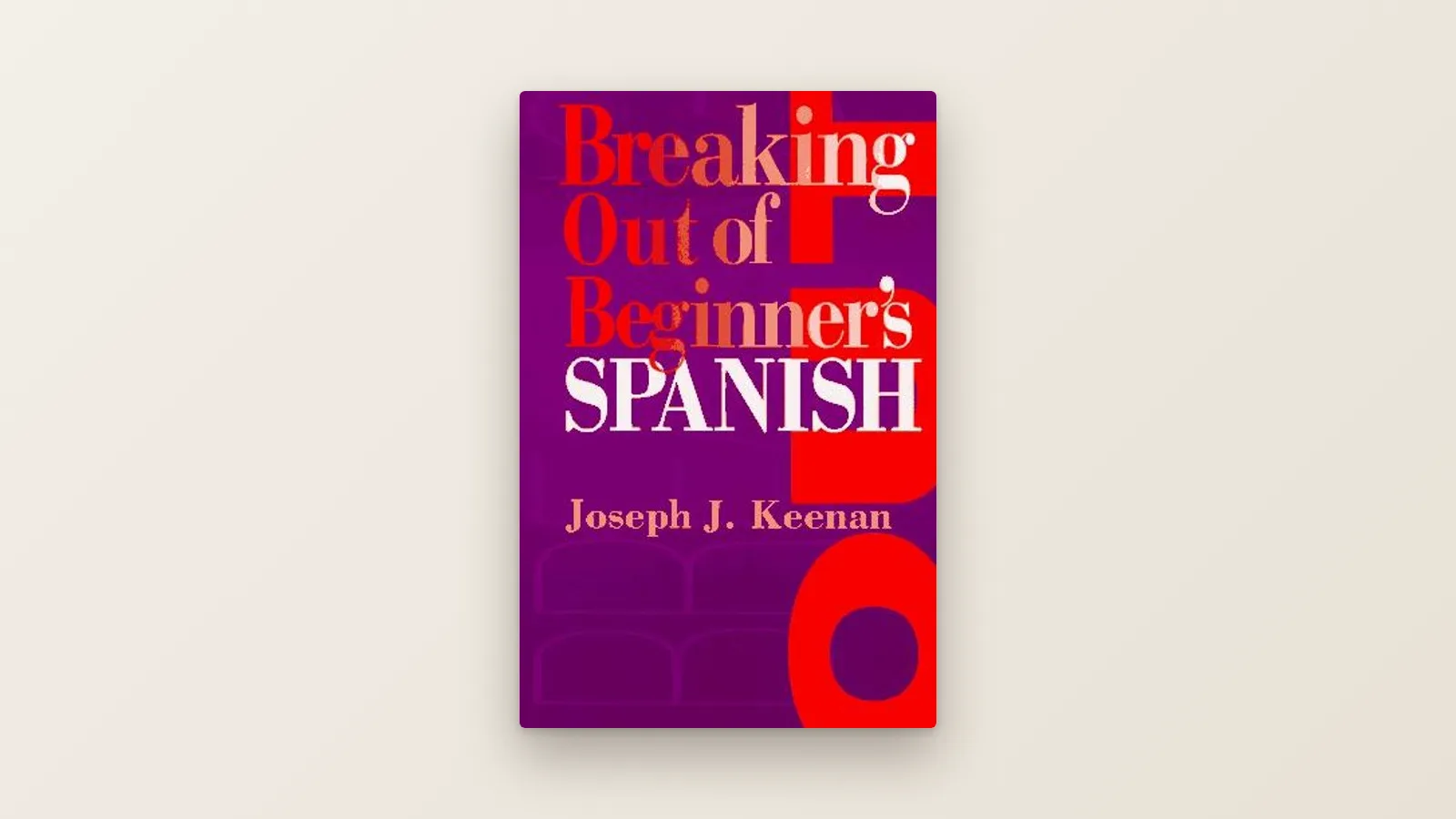
| Breaking Out of Beginner’s Spanish | Intermediate | Register, idiom, naturalness | Not verified | 240 pages (University of Texas Press) |
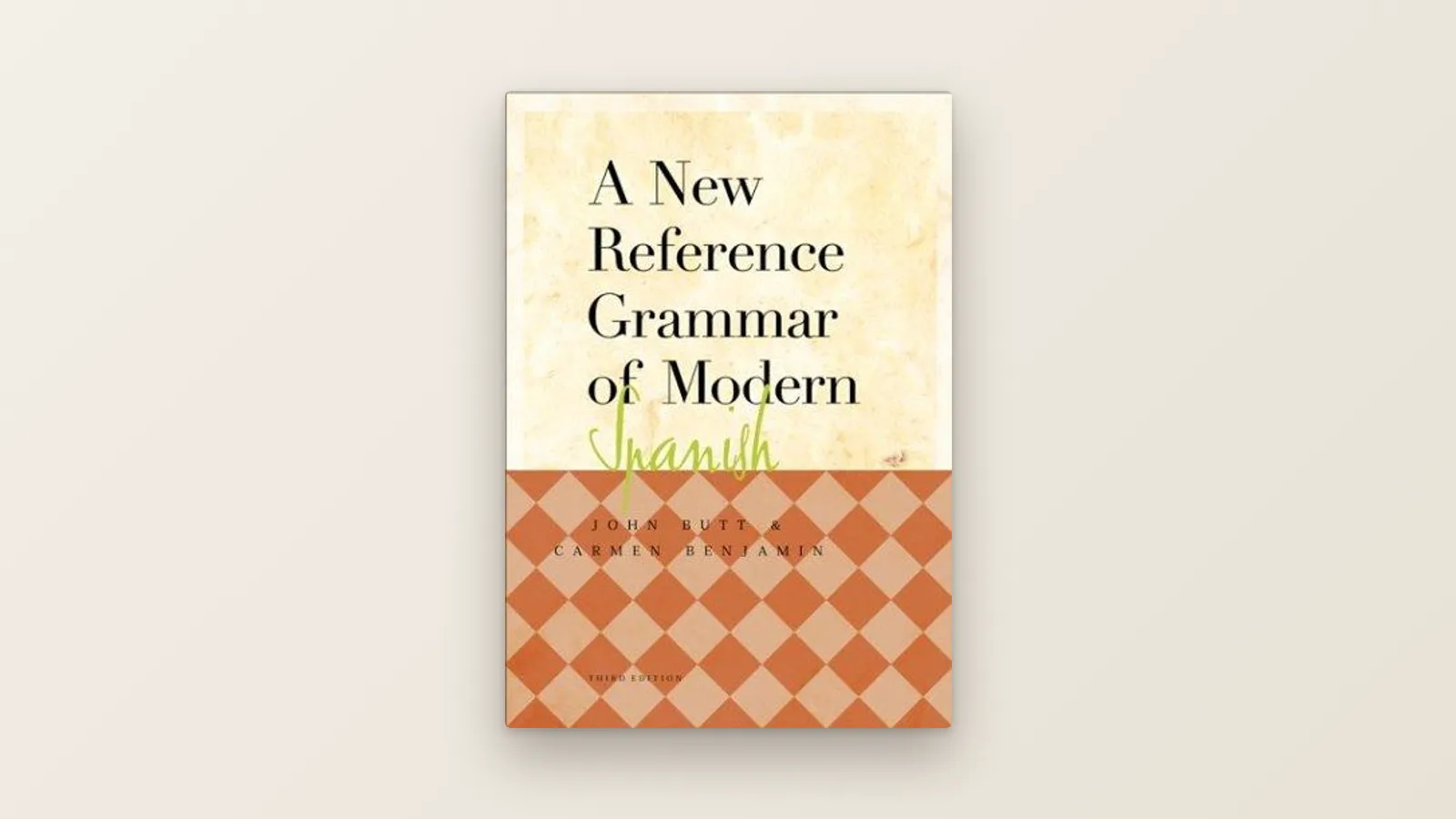
| A New Reference Grammar of Modern Spanish, 6th Ed. | Advanced, translators | Rule lookup | Not verified | 620 pages (Routledge) |
What we checked, and what we did not
Every number above comes from a publisher or retailer listing: Routledge for Butt and Benjamin, McGraw Hill’s own description for the Premium Fourth Edition, Waterstones for its page count and July 2020 publication date, University of Texas Press for Keenan, and the publisher description for 501 Spanish Verbs. No book here was tested in a classroom, no audio quality was assessed, and nothing was read cover to cover by this team.
Prices were deliberately left out because they swing by retailer, edition and format. Do the conversion yourself before buying: divide the cover price by the 350 exercises McGraw Hill advertises, or by the 501 conjugation charts the 501 Spanish Verbs publisher lists, and a workbook that looks expensive often lands below a slim paperback per unit of practice.
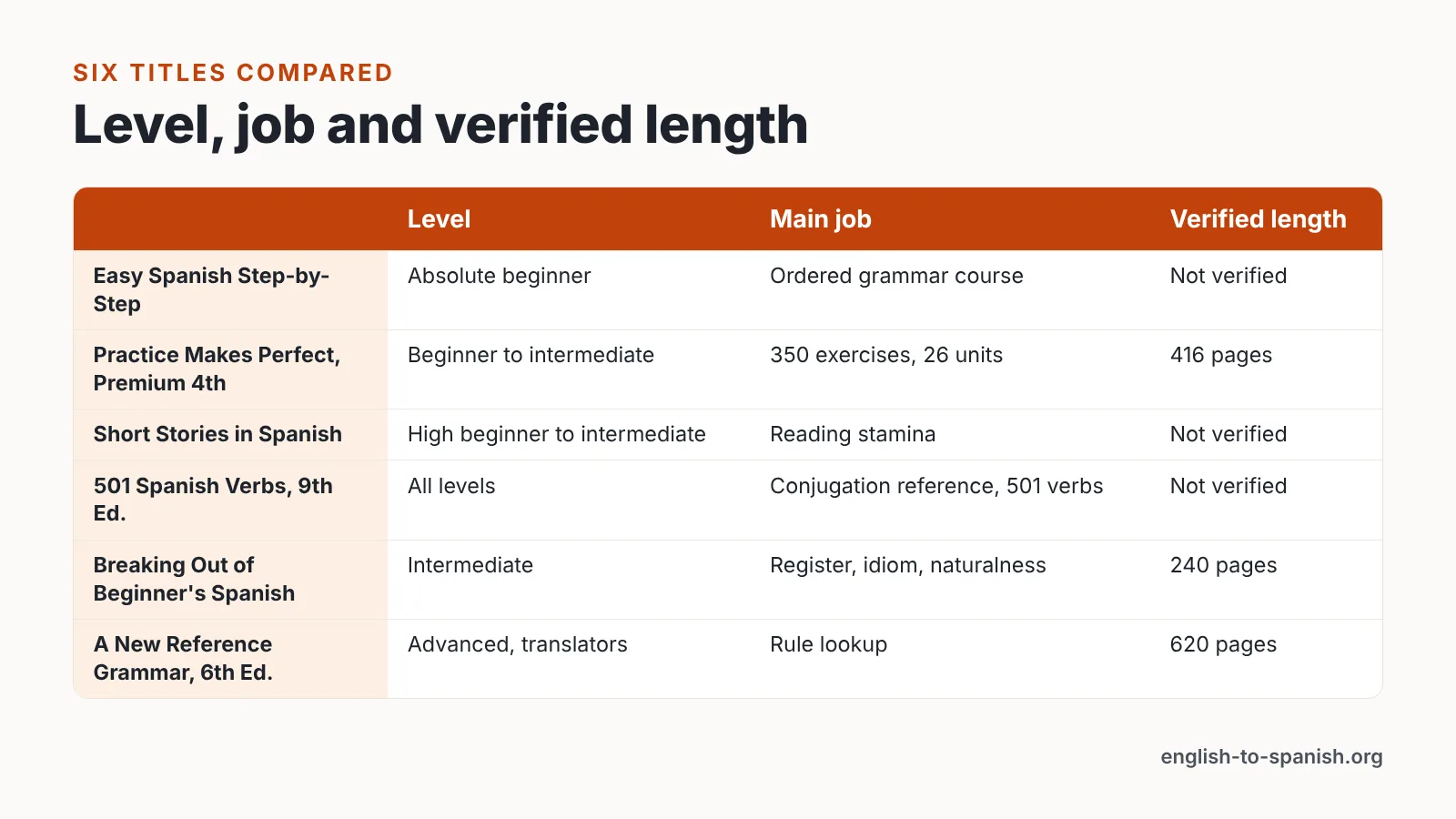
1. Easy Spanish Step-by-Step
Barbara Bregstein’s McGraw Hill course runs on a strict sequence and asks you never to skip ahead. You begin with cognates and the present tense, then add object pronouns, the preterite, the imperfect, and finally the subjunctive. Each stage brings vocabulary sets and short exercises that recycle what came before.
The pacing is the reason to buy it. Nothing shows up before you have the parts to understand it, so you rarely hit a page that silently assumes a tense you have never met. Short reading passages at the end of units show the grammar doing real work instead of sitting in a table.
The trade-off: long stretches of English explanation. You get the rule, then the drill, which suits readers who want to understand before they practice and irritates people who prefer to absorb patterns first.
Who it’s for: absolute beginners who want one ordered path from zero to the subjunctive without assembling a syllabus themselves.
Skip it if: you already use preterite and imperfect without stopping to think — the first half will read like revision you don’t need.
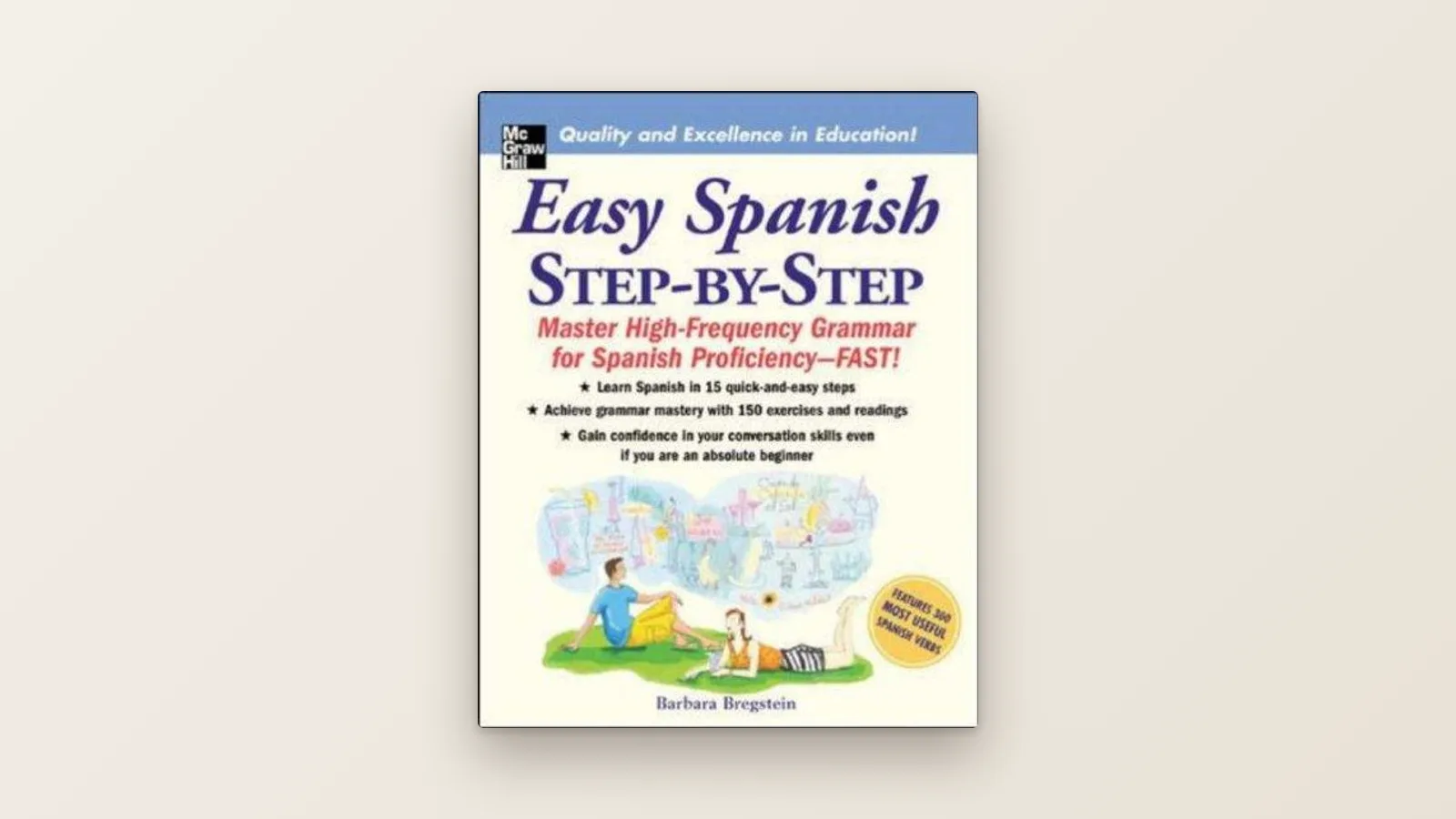
2. Practice Makes Perfect: Complete Spanish Grammar, Premium Fourth Edition
McGraw Hill’s Practice Makes Perfect: Complete Spanish Grammar, Premium Fourth Edition contains 350 exercises spread across 26 grammar units. That density is the point. You are not reading about ser and estar, you are choosing between them forty times until the choice stops feeling like a decision.
The Premium Fourth Edition adds app-based audio that includes recordings of the answers to more than 200 of the book’s exercises, according to McGraw Hill. Hearing a correct answer spoken immediately after you write it closes a gap most workbooks leave open. Your pronunciation drifts less when the model arrives within seconds.
It is a 416-page paperback published on 28 July 2020 by McGraw-Hill Education under ISBN 9781260463156, as listed by Waterstones. Treat it as a gym, not a teacher: explanations are brief by design.
Who it’s for: learners who understand the rules but produce them too slowly in conversation.
Skip it if: you have never studied Spanish grammar at all — the units assume you can already parse a simple sentence, and you’ll spend your time decoding instructions instead of practicing.
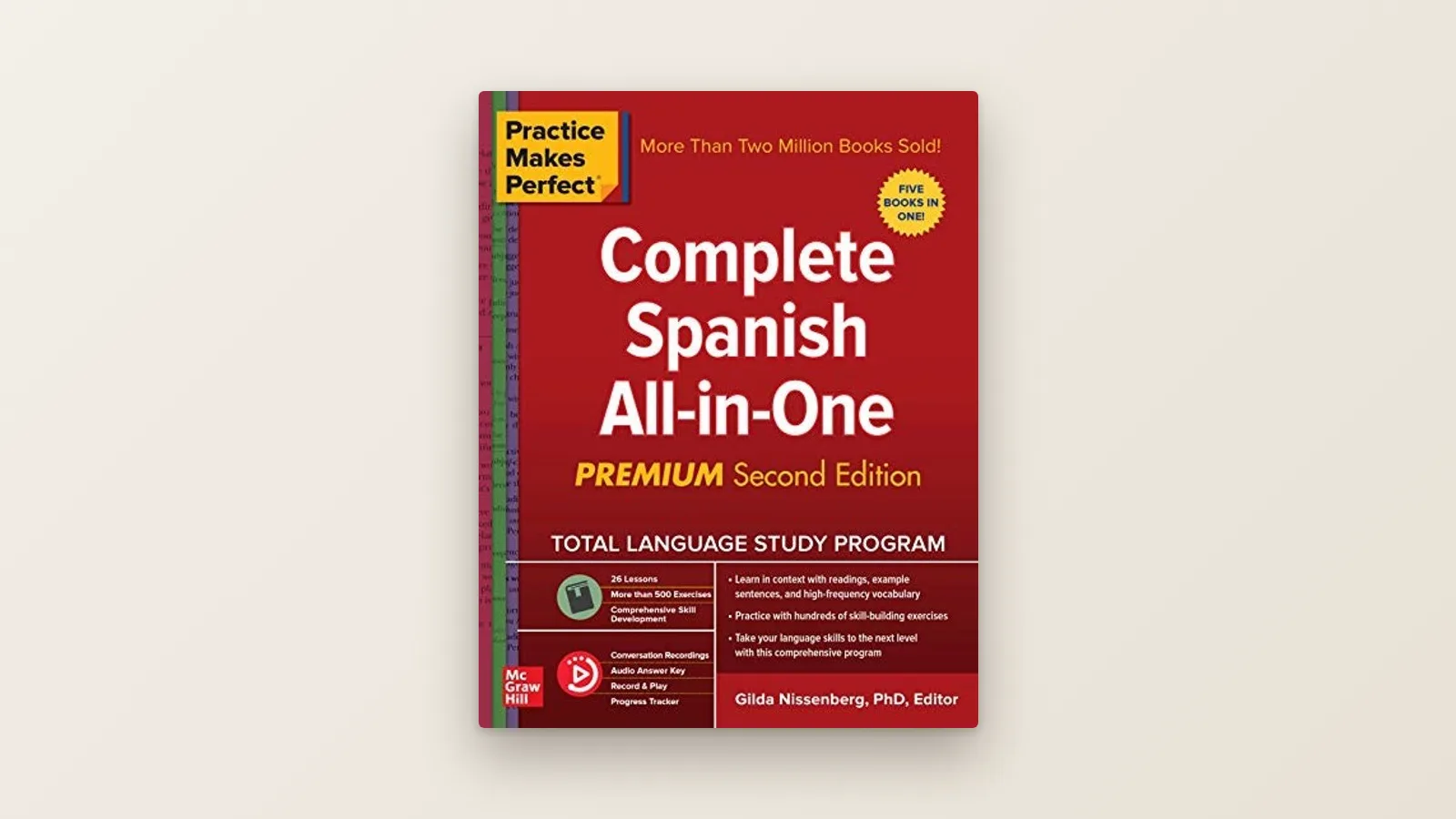
3. Short Stories in Spanish for Beginners
Graded readers solve a problem drill books cannot touch: stamina. Olly Richards builds each story with controlled vocabulary, a glossary of harder words, plot summaries and comprehension questions, so you finish a narrative instead of abandoning page two of a novel. Finishing something in Spanish changes how you feel about reading it.
Read it the lazy way on purpose. Push through a chapter without stopping, check the glossary afterward, then reread the same chapter the next morning. Speed on the second pass is the clearest progress signal you will get at this stage.
The stories also feed your other books. Phrases you meet in a mystery or sci-fi chapter give the grammar workbook something concrete to attach to, which is why the two pair well in the same week.
Who it’s for: learners who know the present and past tenses and need volume of input rather than more rules.
Skip it if: you are at week one — with no tense knowledge, you’ll translate word by word and the glossary becomes the whole book.
4. 501 Spanish Verbs, Ninth Edition
The ninth edition of 501 Spanish Verbs gives learners one-page conjugation charts for 501 common Spanish verbs in all tenses and moods, according to the publisher’s description. One verb, one page, every form in sight. That layout is why the book survives on desks long after the course that recommended it ended.
Use it as a lookup tool, not a study plan. When a sentence stalls because you cannot recall the first-person preterite of poner, you open the page, write the form, and move on. Reading verb tables front to back is a reliable way to quit in a fortnight.
The value grows once you start writing Spanish — emails, messages, journal entries — because production exposes gaps that recognition hides. Irregular stems are where English speakers lose most ground.
Who it’s for: anyone writing or speaking Spanish regularly who needs a fast, complete conjugation check.
Skip it if: you want structure and feedback — it has no syllabus, no exercises to grade yourself against, and no explanation of when to choose one tense over another.
5. Breaking Out of Beginner’s Spanish
University of Texas Press publishes Joseph J. Keenan’s Breaking Out of Beginner’s Spanish as a 240-page book, with the current edition under ISBN 9780292761933 dated January 2015. It addresses the stage where your grammar is correct and your Spanish still sounds translated. Keenan writes about register, idiom, false friends, pronunciation habits and the small courtesies that textbooks flatten.
The tone is conversational and opinionated, closer to advice from a long-term resident than to a course. You read a chapter in one sitting, then catch yourself fixing a habit the next day.
Much of the material leans toward Mexican usage, which is a strength if that is your region and a caveat if your Spanish is aimed at Madrid or Buenos Aires. Note the differences rather than ignoring them; both varieties are standard in their own territory.
Who it’s for: intermediate learners who can read a page of Spanish but keep getting answered in English.
Skip it if: you are still building the present tense — the book assumes you already know the rules it is helping you bend.
6. A New Reference Grammar of Modern Spanish
The sixth edition of Butt and Benjamin’s A New Reference Grammar of Modern Spanish runs to 620 pages and carries a 2019 copyright from Routledge. It is the book you consult when a usage question has no clean answer elsewhere: subjunctive after expressions of doubt, leísmo, the placement of clitics with compound verbs, regional variation between Spain and Latin America.
Entries are organized for lookup and written for people who are comfortable with grammatical terminology. Examples are drawn from real usage, and differences across varieties are flagged rather than smoothed over, which matters if you translate for a specific market.
Nobody learns Spanish from it, and that is not a flaw. Keep it beside you while you edit, and it answers in a minute what forums argue about for days.
Who it’s for: advanced learners, translators and teachers who must justify a choice, not just make one.
Skip it if: you want practice — there are no exercises, and a beginner reading 620 pages of reference material will learn terminology instead of Spanish.
Which one fits you
The Instituto Cervantes yearbook Spanish in the World 2024 reports that Spanish passed 600 million speakers, including almost 500 million native speakers and more than 24 million students of the language. Your reading list should reflect which of those people you plan to talk to. A translator serving Spanish clients and a traveler heading to Oaxaca need different second books.
| Your situation | Start with | Add next |
|---|---|---|
| Never studied Spanish | Easy Spanish Step-by-Step | Practice Makes Perfect: Complete Spanish Grammar |
| School Spanish, gone rusty | Practice Makes Perfect, Premium 4th Ed. | Short Stories in Spanish for Beginners |
| Read slowly, freeze when speaking | Short Stories in Spanish for Beginners | Breaking Out of Beginner’s Spanish |
| Conjugations collapse under pressure | 501 Spanish Verbs, 9th Ed. | Practice Makes Perfect, Premium 4th Ed. |
| Sound correct but stiff | Breaking Out of Beginner’s Spanish | A New Reference Grammar of Modern Spanish |
| Translating or teaching professionally | A New Reference Grammar of Modern Spanish | 501 Spanish Verbs, 9th Ed. |
Buy two books, not six. One that makes you produce language and one that answers questions is the whole kit for the first several months, and the pairing changes as your level does.
Set a schedule you can keep on a bad week. Twenty minutes of exercises on weekdays and one story chapter at the weekend beats a three-hour Sunday session you cancel twice a month. Progress in Spanish is counted in sessions, not intentions.
Frequently asked questions
What is the best Spanish book for a complete beginner?
Easy Spanish Step-by-Step, because it fixes the order of grammar: cognates and present tense first, then object pronouns, past tenses and the subjunctive, with exercises that reuse earlier material so nothing arrives before you can handle it.
How long does it take to learn Spanish from books?
The US Foreign Service Institute classes Spanish as a Category I language, estimating roughly 24–30 weeks or 600–750 class hours to reach S-3/R-3 professional proficiency. Self-study without a teacher typically takes longer than those supervised hours.
Do I need both a grammar workbook and a verb book?
They do different jobs. McGraw Hill’s Practice Makes Perfect: Complete Spanish Grammar, Premium Fourth Edition contains 350 exercises across 26 units for practice, while the ninth edition of 501 Spanish Verbs offers one-page charts for 501 verbs as a lookup reference.
Which book stops me sounding like a textbook?
Breaking Out of Beginner’s Spanish by Joseph J. Keenan, a 240-page book from University of Texas Press, covers register, idiom, false friends and courtesy habits. Its examples lean toward Mexican usage, so note regional differences if you are aimed at Spain.
Is a full reference grammar worth buying as a learner?
Only once you are advanced or translating professionally. The sixth edition of Butt and Benjamin’s A New Reference Grammar of Modern Spanish runs to 620 pages with a 2019 Routledge copyright, and it contains no exercises at all.
Sources
- A New Reference Grammar of Modern Spanish – 6th Edition – Routledge
- Practice Makes Perfect: Complete Spanish Grammar, Premium Fourth Edition – Apple Books (publisher description)
- Practice Makes Perfect: Complete Spanish Grammar, Premium Fourth Edition – Waterstones
- 501 Spanish Verbs Ninth Edition (publisher’s description)
- Breaking Out of Beginner’s Spanish – University of Texas Press
- Breaking Out of Beginner’s Spanish – Combined Academic Publishers (University of Texas Press)
- FSI Language Difficulty Ranking
- Spanish to Exceed 600M Speakers This Year – Language Magazine
- Global Spanish speakers hit 600 million for first time, 2024 study finds – The Olive Press
AI tools helped write this guide. The English to Spanish Editorial Team published it after checking every figure against the sources linked above.