Beyond "de nada," Spanish speakers say "no hay de qué," "con gusto," "es un placer," "a ti," "no te preocupes," "para eso estamos" and, in Colombia, "a la orden" — each one carrying a different level of warmth and formality.

Why "de nada" is only the starting point for saying "you’re welcome" in Spanish
"De nada" is the safe default, and it is never wrong. It translates literally as "of nothing" — a polite shrug that waves the favor away. Native speakers reach for a dozen other replies depending on who thanked them, for what, and how formally.
English does exactly the same thing without anyone noticing. You say "no problem" to a roommate, "my pleasure" to a customer, and "sure" to the coworker who passed you a pen. Spanish sorts those same moments along two axes: formality and warmth.
The Instituto Cervantes yearbook "El español en el mundo 2024" reported that Spanish speakers passed 600 million people worldwide for the first time in 2024. Those speakers are spread across the Spanish-speaking world, and each place has its own courtesy reflexes. A phrase that sounds friendly in Bogotá can sound oddly formal in Buenos Aires.
Treat "de nada" as your floor, not your ceiling. The five steps below take you from one memorized phrase to a reply that fits the room, the country and the channel you are writing in.
Step 1 — Decide the register: casual, neutral or formal
Time: about five seconds, in the moment. What you need: the pronoun the other person just used with you.
Listen to how they thanked you. If they said "gracias" with tú or vos forms — "gracias por ayudarme, ¿tienes un minuto?" — you are in casual or neutral territory. If they used usted, or addressed you as señor or señora, answer in the formal register and keep it there.
Age and role decide the rest. A grandmother, a client, a police officer and a hotel receptionist get formal replies; a classmate, a cousin and a barista your own age do not.
| Register | Who it is for | Go-to replies |
|---|---|---|
| Casual | Friends, siblings, classmates, coworkers you joke with | "nada", "no te preocupes", "cuando quieras", "para eso estamos" |
| Neutral | Strangers your age, shopkeepers, taxi drivers | "de nada", "no hay de qué", "con gusto" |
| Formal | Clients, elders, officials, anyone you call usted | "es un placer", "con mucho gusto", "a usted", "para servirle" |
In the 2024 Duolingo Language Report, Spanish was the most-studied language in 33 countries, behind English in 135 countries — meaning plenty of the learners you meet abroad are also guessing at register. Getting it slightly too formal is the forgivable error. Too casual with a client is the one people remember.
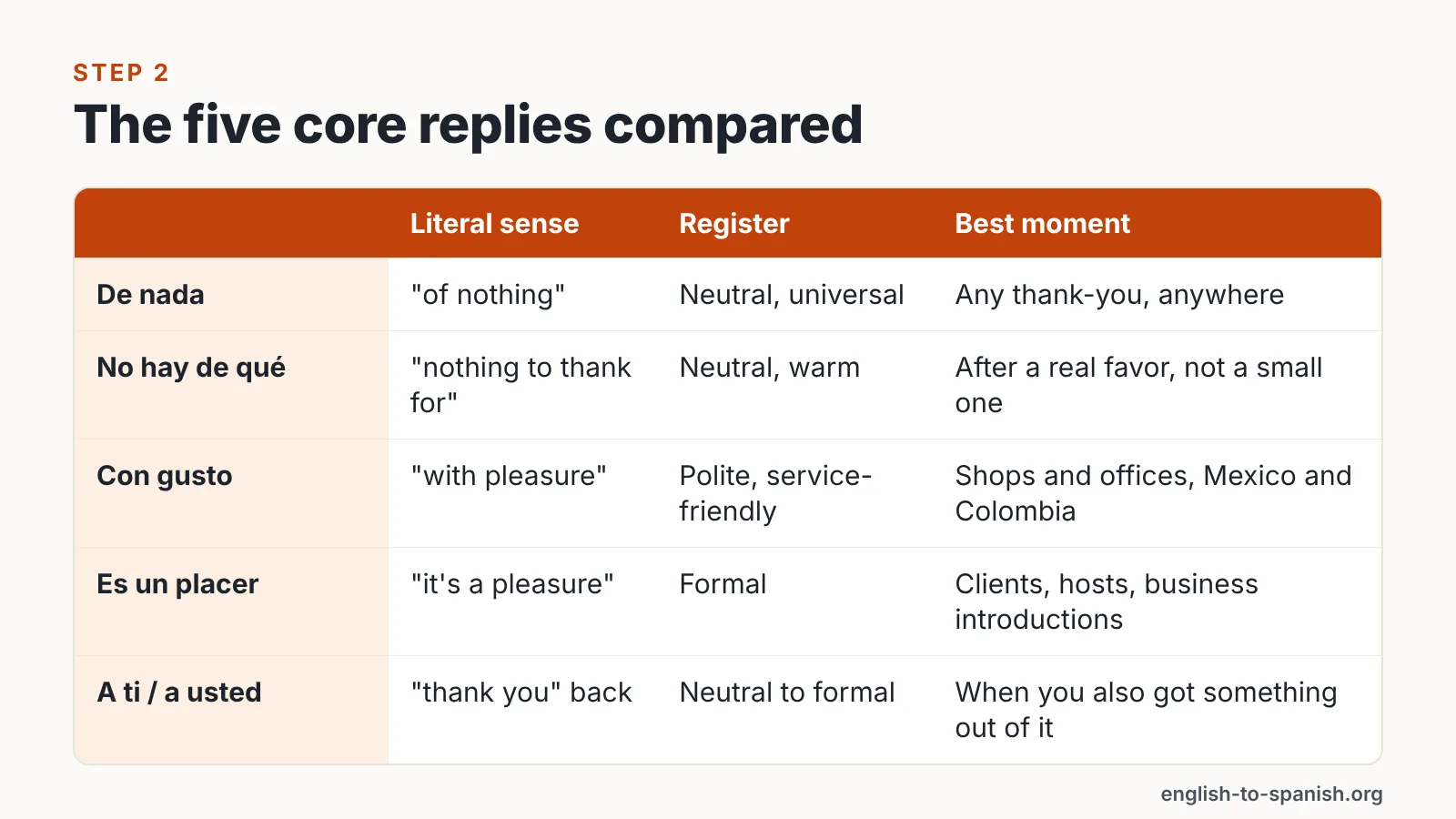
Step 2 — Learn the five core replies (de nada, no hay de qué, con gusto, es un placer, a ti)
Time: fifteen minutes to memorize, a week to use without thinking. What you need: five phrases, said out loud.
These five cover roughly every situation you will meet. Learn them as a set, not as isolated vocabulary, so the right one surfaces automatically.
| Reply | Literal sense | Register | Best moment |
|---|---|---|---|
| De nada | "of nothing" | Neutral, universal | Any thank-you, anywhere |
| No hay de qué | "there’s nothing to thank for" | Neutral, warm | After a real favor, not a small one |
| Con gusto / con mucho gusto | "with pleasure" | Polite, service-friendly | Shops, offices, Mexico and Colombia especially |
| Es un placer / un placer | "it’s a pleasure" | Formal | Clients, hosts, business introductions |
| A ti / a usted | "thank *you*" | Neutral to formal | When you also got something out of it |
"A ti" is the one English speakers skip, and it is the most useful. It bounces the thanks back: a customer thanks you for the sale, you answer "a usted" or "gracias a usted por su confianza." In voseo countries such as Argentina and Uruguay, it becomes "a vos."
LanguageTool’s Spanish-language guide documents 15 alternative ways to say "de nada" when someone thanks you. Casual extras like "para eso estamos" and "cuando quieras" are worth adding, but you do not need all fifteen. Five solid replies plus two casual extras will carry you through a trip, a job and a family dinner.
Step 3 — Adapt to the country you’re speaking in (Mexico, Colombia, Spain, the Southern Cone)
Time: ten minutes of listening per country. What you need: your ears, in a shop or a taxi.
Regional courtesy is the fastest way to sound local. Mexico is the country with the most Spanish speakers, with more than 120 million of the 600 million people who speak the language worldwide, according to the Instituto Cervantes yearbook — so Mexican usage is the variety most learners hear first.
- Mexico: "de nada" and "no hay de qué" everywhere; "con mucho gusto" in shops and offices; "para servirle" from older speakers and service staff, said warmly rather than stiffly.
- Colombia: "con gusto" and "a la orden" dominate retail and street commerce; in Medellín and the coffee region "con mucho gusto" doubles as a greeting.
- Spain: short and casual wins — "nada, nada", "de nada", "no hay de qué". "Faltaría más" adds polite emphasis after a favor someone felt bad asking for.
- Southern Cone: Argentina and Uruguay use "de nada" and "no, gracias a vos"; Chile leans on "de nada" and "no te preocupes". "No, por favor" works as a modest brush-off of thanks.
None of these are exclusive. Say "de nada" in Santiago and nobody blinks; say "a la orden" in Bogotá and you sound like you have been there a while.
Step 4 — Say it naturally: pronunciation, stress and tone
Time: five minutes of repetition out loud. What you need: a quiet room and a recording app.
Stress carries more weight than individual sounds. Say de NA-da, with the punch on the middle syllable and both vowels short and clean. The d in "nada" is soft between vowels, closer to the th in "this" than to the hard d in "dog."
"No hay de qué" runs together as one unit: no-ai-de-KÉ, with the accent landing hard on qué. Treat it as a single word and it will sound right; separate the four words and it sounds like a classroom drill.
"Con gusto" keeps a light g, and the u is pronounced — kon GOOS-to. "Es un placer" links across the words, e-sun-pla-SER, with a single tapped r at the end rather than the English retroflex r.
Tone matters as much as the sounds. These phrases are said quickly, at low volume, with a falling pitch — they are throwaway courtesy, not an announcement. Record yourself saying all five replies, play it back, and cut your speed in half if you sound like you are reciting.
Step 5 — Choose the right reply in writing: emails, WhatsApp and customer service
Time: two minutes before you hit send. What you need: the last message the other person wrote.
Writing removes tone of voice, so the phrase has to do all the work. Match whatever the other person used: if their email says usted, your reply says "a usted" and "es un placer," never "nada."
- Formal email: "Gracias a usted por su confianza." / "Es un placer poder ayudarle. Quedo a su disposición."
- Work email, colleague: "De nada, cualquier cosa me avisas." / "Con gusto."
- WhatsApp, friends: "¡De nada! 😊" / "nada nada" / "¡para eso estamos!"
- Customer service reply: "Con gusto, estamos para servirle." / "A la orden" in Colombia; "Con mucho gusto" in Mexico.
About 44.9 million people in the United States, or 1 in every 7 people aged 5 and over, speak Spanish at home, according to USAFacts analysis of U.S. Census Bureau data — so a bilingual support inbox is a normal workplace reality, not an edge case. Pick one register per thread and hold it. Switching from usted to tú mid-conversation reads as careless unless the other person switches first.
Quick checklist: picking the right "you’re welcome" in under 10 seconds
Run these five questions in order. They resolve almost every case before the pause gets awkward.
- Did they use usted? Yes → "con mucho gusto", "es un placer", or "a usted." No → continue.
- Is this a friend or someone your age? Yes → "nada", "no te preocupes", "cuando quieras." No → continue.
- Was the favor genuinely big? Yes → "no hay de qué" or "para eso estamos." No → "de nada."
- Did you also benefit — a sale, a trade, a shared ride? Yes → "a ti" (or "a vos" in Argentina and Uruguay).
- Are you in a shop in Colombia or Mexico? Yes → "con gusto" or "a la orden."
When the clock runs out and nothing fits, say "de nada." It is understood everywhere Spanish is spoken.
Common mistakes English speakers make when saying "you’re welcome" in Spanish
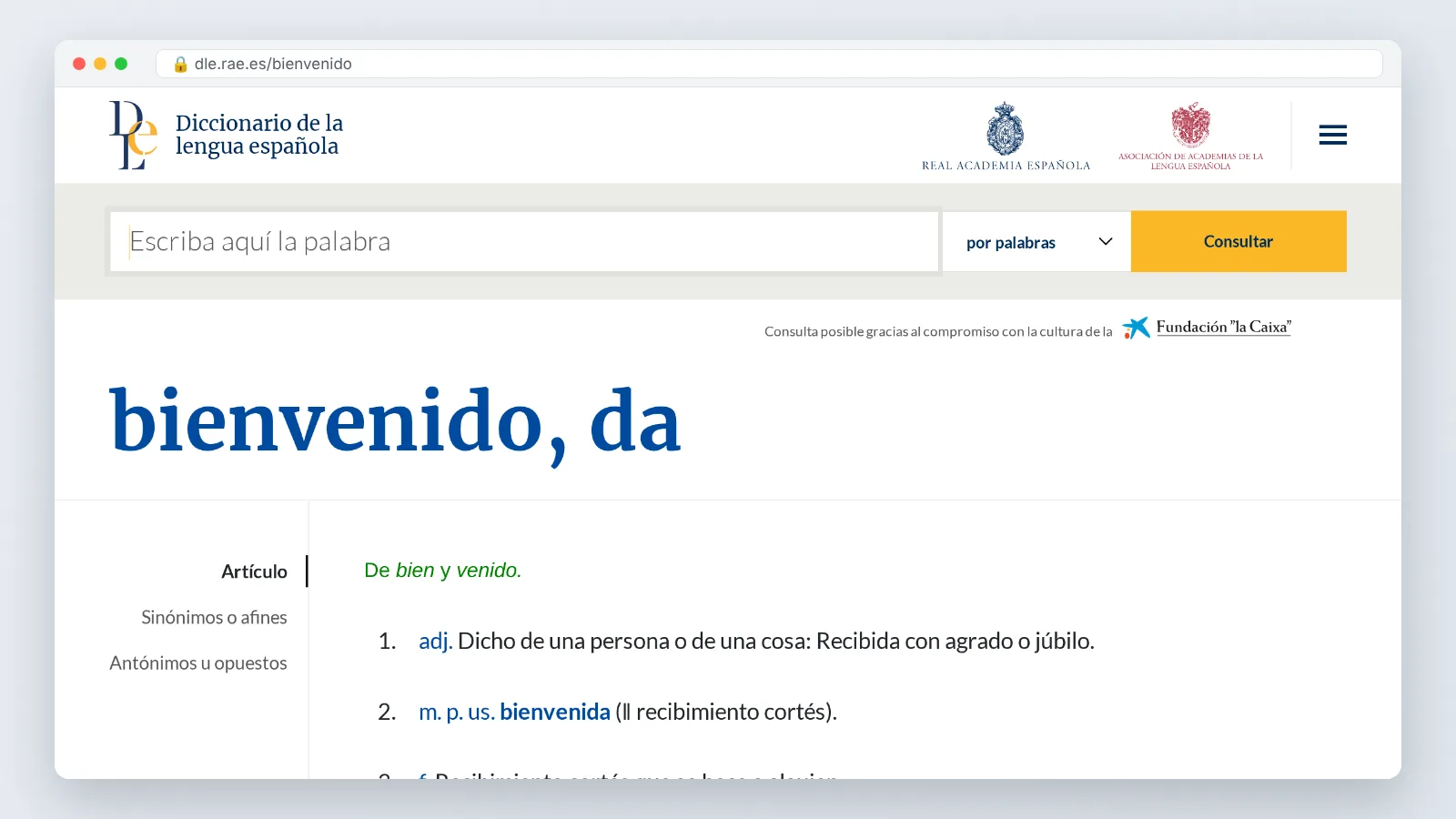
The failure case that gives you away instantly: answering "gracias" with "bienvenido." English fuses "welcome to my house" and "you’re welcome" into one word; Spanish does not. "Bienvenido" only welcomes someone to a place, so the fix is to drop it from your thank-you responses entirely and default to "de nada."
Second, "no problema" is not Spanish. The correct forms are "no hay problema" or "ningún problema," and both sound casual rather than polite.
Third, do not over-formalize. Answering a friend’s small thank-you with "es un placer" lands the way "it is my sincere pleasure" would in English — technically correct, socially odd.
Fourth, keep your pronouns aligned. Saying "a ti" to someone you have been calling usted mixes two registers in three words; use "a usted" instead.
Fifth, do not assume the language stands still. It is actively revised: the Real Academia Española released update 23.8 of the Diccionario de la lengua española on 10 December 2024, incorporating 4,074 changes, and published online version 23.8.1 on 15 December 2025. Everyday usage shifts too, and the best check is still how the people around you actually answer "gracias."
Frequently asked questions
Is "de nada" ever rude or too informal?
No. "De nada" is neutral and works with your boss, a stranger or a child in any of the Spanish-speaking countries. It only feels thin in high-stakes formal settings, where "es un placer" or "con mucho gusto" sounds more attentive to a client or an older person.
What is the difference between "no hay de qué" and "de nada"?
Both brush off the thanks, but "no hay de qué" carries more warmth and suits a real favor — a ride to the airport, help moving, covering a shift. "De nada" fits everyday small things like passing the salt or holding a door.
How do people say "you’re welcome" in Mexico specifically?
Mexicans use "de nada", "no hay de qué" and, very often in shops and offices, "con mucho gusto" or "para servirle." Mexico has more than 120 million of the world’s 600 million Spanish speakers, according to the Instituto Cervantes yearbook, so this usage is widely heard.
Can I say "bienvenido" to mean "you’re welcome"?
No, and this is the most common English-speaker error. "Bienvenido" welcomes a person to a place, an event or a team. Answering "gracias" with it sounds like a mistranslation; use "de nada", "con gusto" or "a ti" instead.
How many ways to say "you’re welcome" should I actually learn?
Five core replies cover almost everything: de nada, no hay de qué, con gusto, es un placer and a ti. LanguageTool’s Spanish-language guide documents 15 alternatives in total, but the extra ten are flavor rather than necessity for most conversations.
Sources
- El español supera por primera vez los 600 millones de hablantes y consolida su influencia en cine, música y videojuegos — Instituto Cervantes
- CVC. Anuario 2024. Presentación. Carmen Pastor Villalba — Centro Virtual Cervantes
- El anuario «El español en el mundo 2024» radiografía el estado de la lengua en los países de América Latina — Instituto Cervantes
- La RAE presenta las novedades del «Diccionario de la lengua española» («DLE»), junto a una nueva imagen, en su actualización 23.8 — RAE
- La RAE presenta las novedades del «Diccionario de la lengua española» en su versión 23.8.1 — RAE
- The 2024 Duolingo Language Report Presents Global Learning Trends — Duolingo Blog
- How many people are Spanish speakers at home? — USAFacts (U.S. Census Bureau ACS data)
- 15 formas alternativas y originales de decir “de nada” cuando te den las gracias — LanguageTool Insights
AI tools helped write this guide. The English to Spanish Editorial Team published it after checking every figure against the sources linked above.