Use "disculpe" to get a stranger’s attention, "con permiso" to move past someone or leave a table, and "perdón" after you have already bumped, interrupted or failed to hear what was said.

Excuse me in Spanish: three phrases, three different jobs
English makes one phrase do three jobs. Spanish splits the work by timing: one phrase opens a request, one asks for physical space, one repairs something that has already happened.
Native speakers do not agonize over the choice because each phrase is anchored to a moment. "Disculpe" comes before you ask. "Con permiso" comes before you move. "Perdón" comes after the foot has been stepped on.
| Situation | Say this | English feel |
|---|---|---|
| Stopping a stranger to ask something | Disculpe / Disculpa | "Excuse me, sorry to bother you" |
| Squeezing past people on a bus or in a crowd | Con permiso | "Excuse me, coming through" |
| Standing up to leave a table or a meeting | Con permiso | "Excuse me for a moment" |
| You bumped someone, sneezed or interrupted | Perdón / Perdone | "Sorry, excuse me" |
| You did not catch what someone said | ¿Perdón? / ¿Cómo? | "Sorry?" |
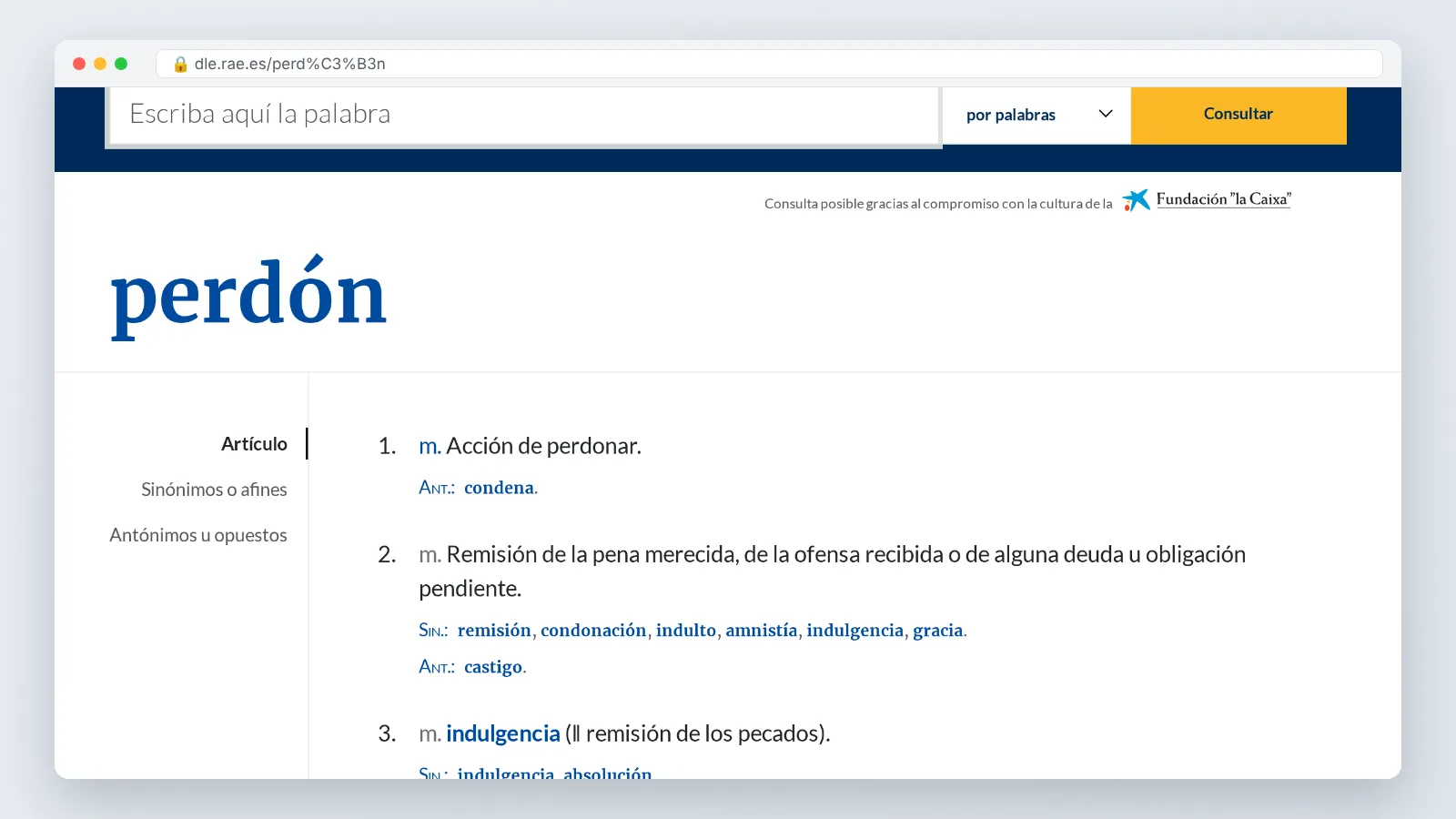
The Real Academia Española presented version 23.8 of the Diccionario de la lengua española on Tuesday 10 December 2024, and that dictionary carries the entries for perdón, disculpar and permiso that sit under all three phrases. Reading those three entries side by side shows the pattern quickly: one is about pardon, one about excusing a fault, one about permission. That is the whole system in miniature.
All three are polite. The mistake is almost never rudeness — it is aiming the wrong phrase at the wrong moment, which lands somewhere between odd and comic.
Step 1 — Decide what your "excuse me" is really doing: getting attention, passing by, or apologizing
Time needed: about two seconds. What you need: one silent question — has it already happened?
Answer that question and the phrase chooses itself:
- Nothing has happened yet, and you want something from a person → disculpe / disculpa
- Nothing has happened yet, and you want their physical space → con permiso
- It already happened — contact, interruption, a sneeze, a missed sentence → perdón / perdone
English speakers stumble because "excuse me" in the United States is mostly a social lubricant with no fixed direction. You say it to a waiter, to a man blocking the dairy aisle, and to the woman whose cart you just clipped. Spanish treats those as three separate acts.
There is a second sorting question for trickier moments: are you asking permission, or admitting fault? Asking permission to pass, to speak, to step away from the table all point to con permiso. Admitting fault points to perdón.
Practice the sorting on your own day before you travel. Walk through a morning — café, metro, shop, hotel desk — and label each small interaction with one of the three. By the third repetition the choice stops feeling like grammar and starts feeling like reflex.
Step 2 — Use "disculpe" (or "disculpa") to get a stranger’s attention
Time needed: five seconds per use. What you need: eye contact and a slightly raised, calm voice.
Disculpe is the usted form, used with strangers, older people, officials and anyone in a service role you have not met. Disculpa is the tú form, for peers, classmates, children and friends of friends. Pronounce them dees-KOOL-peh and dees-KOOL-pah, with the stress on the middle syllable.
Full sentences that work anywhere in the Spanish-speaking world:
- Disculpe, ¿dónde está el baño? — Excuse me, where is the restroom?
- Disculpe, ¿me puede ayudar? — Excuse me, can you help me?
- Disculpe la molestia, ¿esta silla está ocupada? — Sorry to bother you, is this seat taken?
- Disculpa, ¿tienes un minuto? — Excuse me, do you have a minute? (to someone your age)
To check whether a phrase is really current rather than textbook Spanish, the Real Academia Española’s CORPES XXI corpus reached more than 445 million word forms in version 1.4, which makes it the largest searchable record of how contemporary speakers actually write and talk. Searching disculpe there returns dialogue from across the Americas and Spain, not just one country’s habit.
One caveat worth carrying: in much of Latin America, disculpe doubles as a genuine apology. Hearing a Mexican colleague say "disculpe, llegué tarde" is normal. The attention-getting use is simply the most frequent one for travelers.
Step 3 — Use "con permiso" to move past someone or leave the table
Time needed: one second, said before you move. What you need: a small gesture — a hand near the shoulder height, a half-turn of the body.
Con permiso means "with permission," and that is exactly its job: you are requesting space you do not yet have. Say it while stepping off a packed bus, cutting through a doorway, reaching across someone at a buffet, or standing up mid-meal to take a call.
Use it in these moments:
- Edging past seated diners in a narrow restaurant
- Getting out of an elevator when people are standing in front of the door
- Crossing in front of someone’s line of sight at a counter
- Leaving the dinner table before everyone has finished
- Entering a room where people are already talking
The reply tells you it worked. People answer with pase, adelante, or in Mexico and parts of Colombia the old-fashioned propio, which roughly means "you don’t need to ask." Shortening it to just permiso is extremely common and perfectly polite.
The corpus behind this kind of usage check is unusually broad: CORPES XXI is compiled from written and spoken texts from Spain, the Americas, the Philippines and Equatorial Guinea at a rate of 25 million word forms per year, according to the Real Academia Española. Regional spoken formulas like con permiso show up there precisely because the spoken material is included.
Skipping this phrase is the single most visible tourist habit. Pushing silently through a crowd reads as rude in a way that bad grammar never does.
Step 4 — Use "perdón" (or "perdone") when you have already bumped, interrupted or mis-heard
Time needed: immediate — within a second of the event. What you need: a quick look at the person, nothing more.
Perdón is the all-purpose repair word. It covers the elbow in the ribs, the interrupted sentence, the sneeze, the wrong floor button, the drink you knocked. It works with strangers and friends alike, in Madrid and in Lima.
The longer forms add warmth or formality:
- Perdone — usted form, common in Spain: Perdone, no le vi.
- Perdona — tú form: Perdona, te interrumpí.
- Perdóneme / Perdóname — stronger, for a real mistake
- ¿Perdón? with rising intonation — "Sorry, what was that?"
That last one deserves care. Said gently, ¿Perdón? means you missed the words. Said flatly or sharply, it can read as a challenge, the Spanish equivalent of "excuse me?" with an edge. ¿Cómo? or ¿Cómo dice? is the safer request for a repeat.
The reference entries behind these words keep moving: the Real Academia Española’s December 2024 update published 4,074 changes — additions, amendments and deletions of entries and senses — on dle.rae.es. Checking the current entry for perdón takes under a minute and settles arguments about shades of meaning.
Step 5 — Adjust for formality and region: usted vs. tú, and local preferences
Time needed: one decision per conversation. What you need: a quick read of age, role and setting.
The usted/tú split changes the ending, not the strategy. Keep the job of the phrase fixed and swap the form.
| Register | Get attention | Pass by | Apologize |
|---|---|---|---|
| usted (strangers, elders, staff) | Disculpe / Perdone | Con permiso | Perdón / Perdóneme |
| tú (peers, friends, kids) | Disculpa / Oye | Permiso / Con permiso | Perdón / Perdona |
The scale of the language is the reason regional habits matter: Instituto Cervantes reported in its 2024 yearbook that 600 million people speak Spanish worldwide, with Mexico alone accounting for more than 120 million speakers. Mexican and Central American Spanish uses con permiso constantly, including when entering a room or ending a conversation.
Spain leans more on perdone and perdona for both attention and apology, and you will hear ¿me dejas pasar? where a Mexican speaker says permiso. Argentina and Uruguay use vos, which does not change disculpe but turns the familiar form into disculpá and perdoná.
Default to usted with anyone you have just met. Dropping to tú after an invitation costs nothing; starting too casual with a hotel manager does.
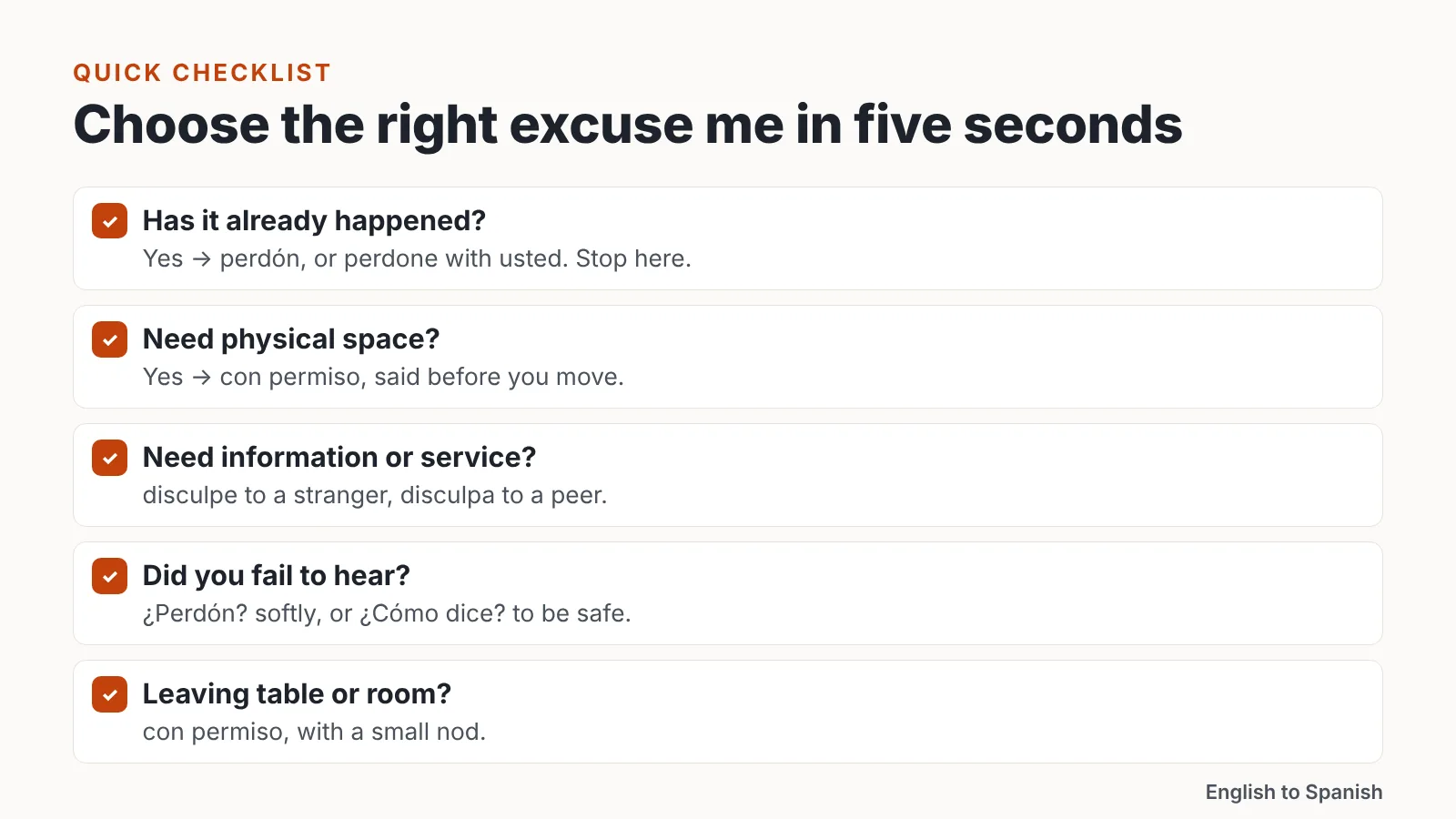
Quick checklist: choose the right "excuse me" in five seconds
Run this list in order. It takes one pass.
- Has it already happened? Yes → perdón (or perdone with usted). Stop here.
- Do you need physical space? Yes → con permiso, said before you move.
- Do you need information or service? Yes → disculpe to a stranger, disculpa to a peer.
- Did you fail to hear? → ¿Perdón? softly, or ¿Cómo dice? to be safe.
- Are you leaving the table, the room or the call? → con permiso, with a small nod.
Five questions, three core phrases. Memorize the order rather than the translations, because the order is what native speakers are running.
Keep a verification habit for anything you are unsure about. The Real Academia Española announced the newest online version of its academic dictionary, 23.8.1, on 15 December 2025, so the definitions you check today are current rather than inherited from a decade-old phrasebook.
One more field test: say the phrase out loud before you need it. Con permiso in particular has to arrive a half-second ahead of your shoulder, and that timing only comes from rehearsal.
Common mistakes English speakers make with perdón, disculpe and con permiso
The failure that happens most often is reaching for lo siento to stop a stranger. Lo siento means "I feel it" — it belongs to bad news, condolences and real regret, so using it to flag down a waiter sounds like you are about to report a death. Use disculpe for attention and save lo siento for genuine sympathy or a serious mistake.
Other patterns worth correcting:
- Saying perdón before moving through a crowd. You are apologizing for something that has not happened. Con permiso is the request; perdón is the repair afterward if you still make contact.
- Using disculpa with an older stranger. The tú form reads as overly familiar. Disculpe is the safe default with anyone you have not been invited to address informally.
- Translating "excuse me" as excúseme. It exists, but it sounds stiff and foreign in everyday speech almost everywhere.
- Sharp ¿Perdón? when you missed a word. Flat intonation turns a request into a confrontation. Soften the tone or switch to ¿Cómo?
- Staying silent when leaving a table. Standing up mid-meal without con permiso reads as abrupt at a family lunch in Mexico, Colombia or Spain alike.
The repair for all of these is the same: name the moment first, then pick the word. Before, before, after.
Frequently asked questions
Is "perdón" or "disculpe" more polite?
Neither is more polite — they do different jobs. "Disculpe" asks for attention or a favor before anything happens, while "perdón" repairs something that already occurred, such as a bump, an interruption or a missed sentence.
Can I just say "lo siento" instead of "excuse me"?
No. "Lo siento" expresses real regret or sympathy and sounds strange when you are flagging down a waiter or passing someone in a doorway. Keep it for condolences, cancellations and mistakes that genuinely cost someone something.
What is the difference between "con permiso" and "permiso"?
They mean the same thing and both request space before you move. "Permiso" is the shortened spoken version heard constantly in Mexico, Colombia and Central America; "con permiso" sounds slightly more complete and works everywhere, including formal settings.
Does "disculpe" work in both Spain and Latin America?
Yes. Instituto Cervantes reported in its 2024 yearbook that 600 million people speak Spanish worldwide, and "disculpe" is understood across that whole range, though Spain reaches for "perdone" and "perdona" more often in the same situations.
How do I say "excuse me?" when I did not hear someone?
Use "¿Perdón?" with gentle rising intonation, or "¿Cómo?" and "¿Cómo dice?" with someone you address as usted. A flat or sharp "¿Perdón?" can sound like a challenge rather than a request to repeat.
Sources
- La RAE presenta las novedades del Diccionario de la lengua española (DLE), junto a una nueva imagen, en su actualización 23.8 — Real Academia Española
- La RAE presenta las novedades del «Diccionario de la lengua española» en su versión 23.8.1 — ASALE
- El anuario «El español en el mundo 2024» radiografía el estado de la lengua en los países de América Latina — Instituto Cervantes
- El español supera por primera vez los 600 millones de hablantes — El Español / El Cultural
- El español en el mundo 2024. Anuario del Instituto Cervantes
- CORPES XXI — Real Academia Española
- RAE (@RAEinforma) — anuncio de la versión 1.4 del CORPES XXI
AI tools helped write this guide. The English to Spanish Editorial Team published it after checking every figure against the sources linked above.