Children’s Spanish learning at home works best as one fixed 15-minute daily block in Spanish, plus one live speaker each week — parents narrate routines, add audio and books, and check comprehension monthly.
Quick steps
- Choose one daily slot you already control — breakfast, bath time, the drive home — and declare it the Spanish block.
- Narrate that exact routine in Spanish with 10 to 15 fixed phrases, repeated the same way every day.
- Put one Spanish show or audio story inside your household screen limit, never on top of it.
- Book one live Spanish speaker every week: a tutor, a neighbor, a grandparent on a video call.
- Review progress once a month against comprehension, not against cute performances for relatives.
Those five actions are the whole system. The sections below explain what each one realistically produces, where non-fluent parents hit a ceiling, and how one example family ramped from nothing to a stable half hour a day over twelve weeks. Nothing here requires you to already speak Spanish well. It does require you to pick a slot and defend it on bad days, which is the part most families lose.
What a Spanish-speaking home delivers for an English-speaking family — and what it doesn’t
A daily parent-led block buys three things reliably: an ear trained on Spanish sounds, a working vocabulary tied to real objects your child touches, and the absence of fear when a stranger speaks Spanish. Those are not small. They are also not fluency.
According to USAFacts, about 44.9 million people in the United States spoke Spanish at home in 2024, or 1 out of every 7 people age 5 and up. Your child will meet those speakers. The goal of the home block is that they answer instead of freezing.
What the home block produces:
- Comprehension of routine commands and questions before production.
- Clean-ish pronunciation of vowels, because imitation starts early.
- Comfort switching into Spanish with a familiar adult.
What it will not produce on its own:
- Age-appropriate grammar across topics you never discuss at home.
- Vocabulary for school subjects, feelings, or conflict unless you deliberately add it.
- Immunity to your own errors — a child copies the accent and mistakes they hear most.
Treat the parent block as the engine and outside speakers as the correction mechanism. Families that skip the second part usually plateau around household nouns.
How much Spanish does a child actually need to hear?
In research on simultaneous bilingual children in Canada reported in the GALANA proceedings, roughly 40% exposure to a language was enough for children to score within monolingual norms on mean length of utterance. That is a demanding target for a household where both parents work in English.
A study of 155 bilingual children aged 14 to 48 months, with target-language exposure ranging from 10% to 100%, found that both age and amount of experience independently predicted word learning, according to the journal Cognition. More hours help at every level, which is the useful part for a family starting at near zero.
Count these as exposure:
- Live speech directed at your child, including your own imperfect Spanish.
- Audio stories and songs they are actually attending to.
- Video calls with a relative who speaks only Spanish to them.
Do not count these:
- Spanish playing in another room while your child plays in English.
- Flashcard drills with no sentence around the word.
- Your silent reading of Spanish while your child watches.
If you cannot reach a large share of waking hours, trade volume for consistency and for speakers who are not you. Thirty protected minutes beats two chaotic hours on Saturday.
Meet the Delgado-Price family: two non-fluent parents, one 4-year-old, 30 minutes a day
Example: the Delgado-Price household is an illustrative composite, not a measured case study. Maya took four years of high-school Spanish and can order food and describe a room. Ben speaks none and pronounces gracias with a hard s.
Their daughter Nora is four, in an English-only preschool, and sleeps at 7:45 p.m. sharp. Weeknights are the only reliable territory, and only the stretch between coming home and dinner. Weekend mornings collapse without warning.
Their constraint list looked like this: no Spanish-speaking relatives, no bilingual preschool within driving distance, one working car, and a budget that could absorb a subscription and a weekly tutor but not a private immersion school.
Maya made one decision that changed the trajectory: she stopped trying to teach Spanish and started doing a chore in Spanish. Nora chops nothing, but she hands over carrots, counts them, and hears the same twelve phrases every evening. Ben’s role was smaller and non-negotiable — he plays the audio story in the car and says four phrases he practiced, badly, without apologizing for his accent in front of Nora.
Before and after: from random app streaks to a repeatable daily Spanish block
| Before | After the ramp | |
|---|---|---|
| Trigger | Whenever someone remembered | Dinner prep, every weeknight |
| Parent Spanish time | Scattered app sessions, often skipped for weeks | 15 minutes of narration, daily |
| Child’s input | Watching a parent tap a phone | Hearing Spanish aimed at her, plus 15 minutes of audio or show |
| Live speakers | None | One tutor call per week |
| Review | None | Monthly checkpoint on a kitchen calendar |
The before column is the common failure pattern: a streak counter rising while the child hears almost nothing. A parent’s app progress is not exposure for the child unless the parent speaks out loud, to the child, in sentences.
The after column is deliberately boring. Same slot, same script, same tutor time each week, with the weekend treated as a bonus rather than a requirement. Boring is what survives a sick week and a work deadline.
The reproducible routine: a 15-minute daily script and a 12-week ramp
Run the script in the same order every day so your child predicts it and starts finishing your sentences.
The 15-minute script
- Minutes 0–2, greeting and weather. Three fixed questions, same wording, answered in Spanish by you if nobody else does.
- Minutes 2–8, narrate the chore. Name what your hands are doing, hand things over, count out loud. Kitchen nouns carry this block, and a list of the kitchen words you’ll actually reach for every evening is worth taping inside a cabinet door.
- Minutes 8–12, one book or one song. Repeat the same book for a full week before swapping.
- Minutes 12–15, two questions with real stakes. "¿Más?" and "¿Cuál quieres?" work because the answer changes what happens next.
The 12-week ramp
- Weeks 1–3: greeting plus narration only. Keep your first script under roughly 120 words and do not add vocabulary.
- Weeks 4–6: add the book slot and start the audio in the car.
- Weeks 7–9: add the weekly live speaker and let your child answer in English without correction.
- Weeks 10–12: add one choice question per day where a Spanish answer is the fastest route to what they want.
Write the script on an index card. A script you improvise is a script you abandon.
Choosing and budgeting the toolkit: apps, shows, audio and books
According to ZERO TO THREE, the American Academy of Pediatrics recommends that children aged 2 to 5 use screens no more than one hour a day, and only with high-quality programming. A Spanish cartoon lives inside that hour, not beside it.
A meta-analysis in JAMA Pediatrics found that only 35.6% of children aged 2 to 5 met the guideline of no more than one hour a day of screen time, so the realistic question is which hour you already allow, not whether to add a new one.
| Tool | What it does for a 3–6 year old | Budget guidance |
|---|---|---|
| Parent app | Builds your phrase bank, not the child’s | Share a household plan; the Super Duolingo Family Plan costs about $119.99 per year and covers up to 6 users, per DealNews |
| Spanish shows | Prosody and high-frequency phrases | Free with existing streaming; swap the audio track on shows they know |
| Audio stories | Exposure with no screen cost | Library apps first; buy only what gets replayed |
| Picture books | Repeatable vocabulary you can narrate | Library, then secondhand; one book per week |
| Tutor | Correction and real conversation | The one line worth paying for weekly |
For a wider shortlist, the roundup of resources that hold up for beginning English speakers is a reasonable starting point. Some parents also record short clips for a child — tools such as AI Studios offer text-to-speech voiceovers in 150+ languages and accents on paid plans and voice cloning from a short recording, which a family can use to make a named-for-your-child bedtime clip. Treat any such clip as part of the screen hour.
This is general information, not medical advice; your pediatrician’s guidance for your child comes first.
Finding real Spanish speakers: communities, tutors, playgroups and video calls
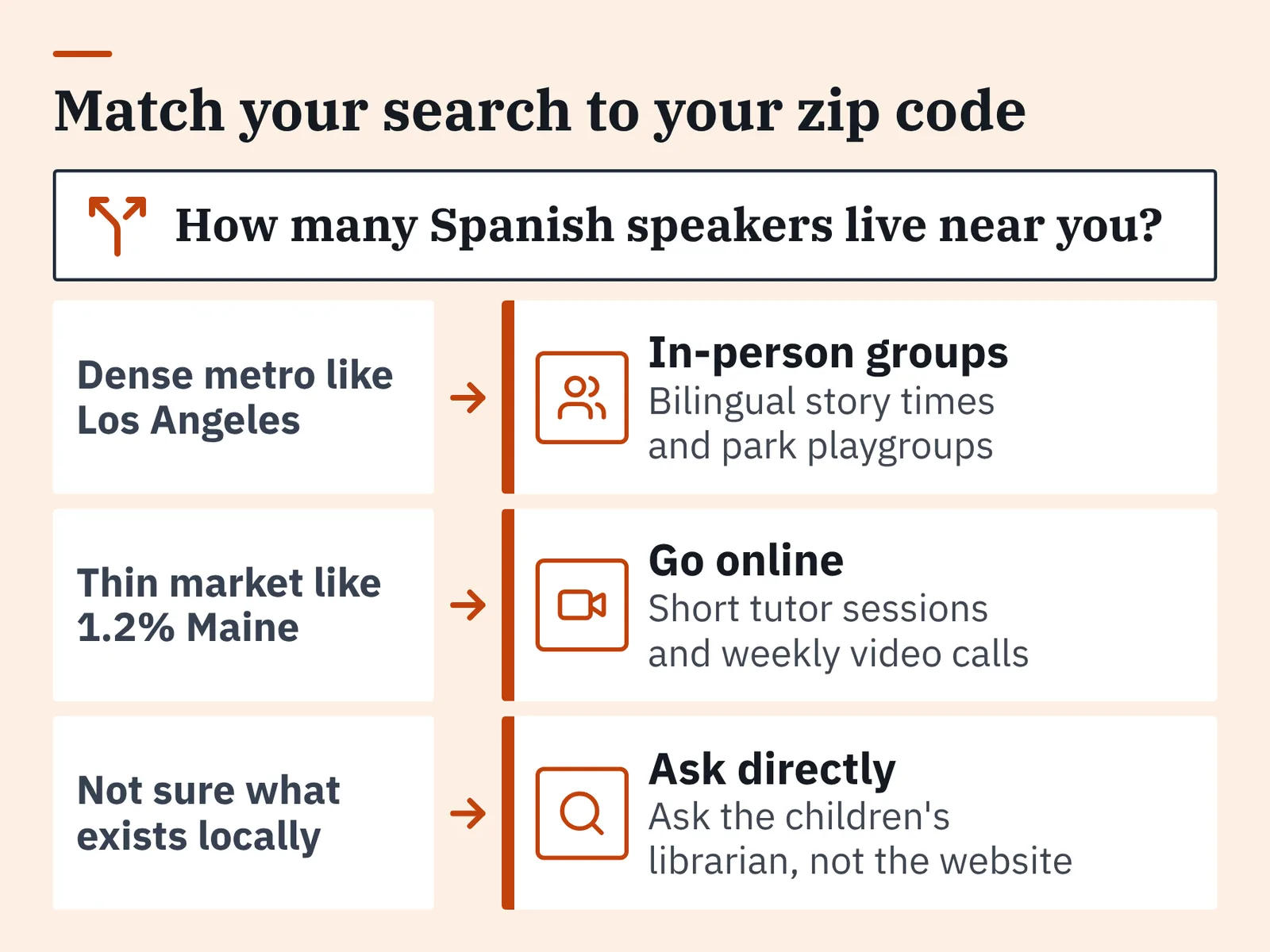
According to USAFacts, the share of residents who speak Spanish at home ranges from 1.2% in Maine to 28.8% in California, so a family’s local Spanish-speaking community varies enormously by state. Your search strategy should match your zip code, not a generic checklist.
USAFacts also reports that from 2019 to 2023 the Los Angeles-Long Beach-Anaheim metro area had the largest population speaking Spanish at home, with 4.2 million speakers. Dense metros give you bilingual story times and park playgroups; thin markets push you online.
Where to look, in order of effort:
- Public library: ask the children’s librarian directly for bilingual story time, not the website.
- Neighborhood parents: a weekly park meetup with one Spanish-speaking family beats a monthly class.
- Online tutors: book 25- or 30-minute sessions; a four-year-old does not last an hour.
- Relatives and friends abroad: a standing weekly video call, same day, same time.
- Community centers and churches that run children’s programming in Spanish.
You will be the adult who understands least in the room. Learning a polite way to say you’re still learning the language removes most of the awkwardness in the first five minutes, and your child watches how you handle it.
Measuring progress: monthly checkpoints, warning signs, and when to bring in help
Check one thing per month, written on paper, same day each month.
- Month 1: does your child follow the routine commands without an English translation?
- Month 2: do they respond — in any language — to a question they have not heard before in that exact wording?
- Month 3: do they produce two or three words of Spanish spontaneously outside the block?
- Month 6: can a tutor or a Spanish-speaking adult get a response without you interpreting?
Warning signs worth acting on: your child only answers when you prompt the first syllable, comprehension stalls at the same twenty phrases for two months, or the block has been skipped more days than it has run.
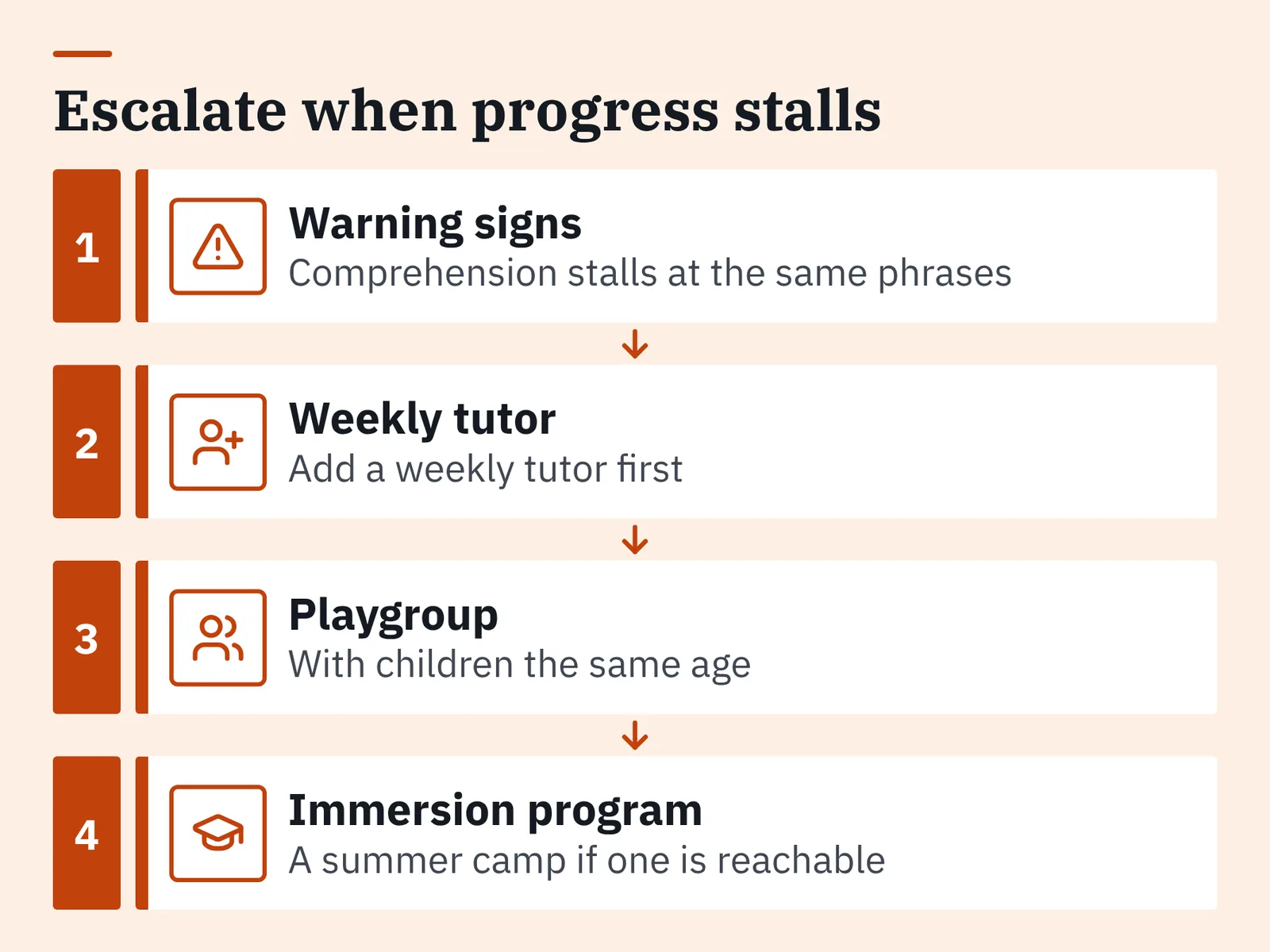
Escalate in this order — add a weekly tutor, then a playgroup with children the same age, then a summer camp or immersion program if one is reachable. Adults running a parallel plan for themselves will find the hour-based pacing in an honest timeline for reaching conversational Spanish useful for setting their own expectations.
Keep the record short. A single index card per month tells you more about the habit than any streak counter.
Frequently asked questions
Do I need to speak Spanish well to teach my child at home?
No. A parent with high-school Spanish can run a 15-minute narration script using 10 to 15 fixed phrases, as long as a weekly tutor or Spanish-speaking adult provides correction your own accent cannot.
How much Spanish exposure is actually enough?
In research on simultaneous bilingual children in Canada reported in the GALANA proceedings, roughly 40% exposure was enough to score within monolingual norms on mean length of utterance — a high bar for an English-speaking household, which is why outside speakers matter.
Does Spanish screen time count against our screen limit?
Yes, treat it that way. According to ZERO TO THREE, the American Academy of Pediatrics recommends children aged 2 to 5 use screens no more than one hour a day with high-quality programming, so swap an existing show rather than adding one.
What should I budget for a family plan?
Start with the library and free streaming, then add one paid line. Per DealNews, the Super Duolingo Family Plan costs about $119.99 per year and covers up to 6 users; a weekly tutor is usually the higher-value spend for a child.
When should we bring in a tutor or an immersion program?
Bring in a tutor once your child follows your routine commands but stalls on unfamiliar phrasing for about two months. Add a playgroup next, and consider a camp or immersion program only after weekly live conversation is already stable.
Sources
- How many people are Spanish speakers at home? | USAFacts
- Screen-Time Recommendations for Children Under Six | ZERO TO THREE
- Global Prevalence of Meeting Screen Time Guidelines Among Children 5 Years and Younger: A Systematic Review and Meta-analysis (JAMA Pediatrics, PMC)
- On the Role of Age of Onset and Input in Early Child Bilingualism (GALANA proceedings, Cascadilla/LingRef)
- The more they hear the more they learn? Using data from bilinguals to test models of early lexical development – ScienceDirect (Cognition)
- How Much Is Super Duolingo? Family Plan Cost & More | DealNews
AI tools helped write this guide. The English to Spanish Editorial Team published it after checking every figure against the sources linked above.