Searching linguee english to spanish? Linguee wins on real bilingual example pairs pulled from published documents; DeepL handles long passages, Reverso and WordReference settle nuance, SpanishDict teaches grammar, and Google Translate covers breadth of languages.
Why people look for a Linguee alternative for English to Spanish
Linguee answers one narrow question extremely well: how have working translators rendered this exact phrase before? You type pursuant to and get paired English and Spanish sentences from published documents, not a single bare gloss. Linguee’s dictionary content is credited to more than 400 lexicographers, according to the Dictionary Linguee app listing published by DeepL SE.
Trouble starts when your job is not a phrase lookup. A paragraph of English pasted into a bilingual example search gives you fragments, not a finished Spanish sentence you can send.
The usual reasons readers go shopping:
- Length. You have a two-page email, a product description or a PDF, not a four-word phrase.
- Register. Many attested pairs come from institutional and corporate texts, which read stiff in a message to a friend.
- Grammar support. You want conjugation tables, audio and quizzes, not citations.
- Regional Spanish. You need Mexico, Argentina or Spain specifically, and example pairs rarely tell you which.
- Rewriting. You want the same idea made warmer, shorter or more formal.
Each tool below fixes one of those gaps and gives something up in return.
1. DeepL Translator
DeepL is the natural first stop because it comes from the same company that publishes Linguee, so the switch costs you nothing but a bookmark. You paste full paragraphs or upload a document and get Spanish out the other end, with a glossary feature for terms you want locked.
DeepL’s free Translator tier is limited to 50,000 characters per month, versus 300,000 on Individual and 1,000,000 per user on Team, according to a 2026 pricing breakdown titled "DeepL pricing in 2026: every plan, every limit, and one gotcha most people miss." DeepL’s Pro pricing page lists the Individual plan at $8.74 per month when billed annually, listed as of October 2026, which is the cleanest per-seat figure to compare against anything else here.
If you are wiring translation into a site or script, the free tier of the DeepL API permits up to 500,000 characters of translation per month, according to DeepL Support.
The trade-off is confidence. DeepL produces fluent Spanish even when a legal or technical term is wrong, and you lose the Linguee habit of eyeballing five real-world renderings before you commit. Use it for drafting, then verify the two or three terms that carry risk.
2. Reverso Context
Reverso Context is the closest philosophical match to Linguee: you search a phrase and read it inside many real sentences, English on one side, Spanish on the other. Migration effort is close to zero, since the search box behaves the way you already expect.
Reverso Context’s premium subscription is sold at €4.99 per month with a 7-day free trial, or €39.99 for a year, according to GetApp’s product listing, checked in October 2026.
Where it differs is the flavor of the corpus. Reverso’s examples lean conversational as well as institutional, which helps enormously when you are translating dialogue, support replies or marketing copy that should not sound like a treaty. The same breadth is a liability for contracts, where an informal source sentence can mislead you.
It also tags examples and offers conjugation and pronunciation alongside the context search, so it covers more of a learner’s day than a pure phrase corpus does. For audience-specific wording, pair it with a decision about whether your text should target Latin American Spanish or Spain before you choose among the examples.
3. SpanishDictionary.com (SpanishDict)
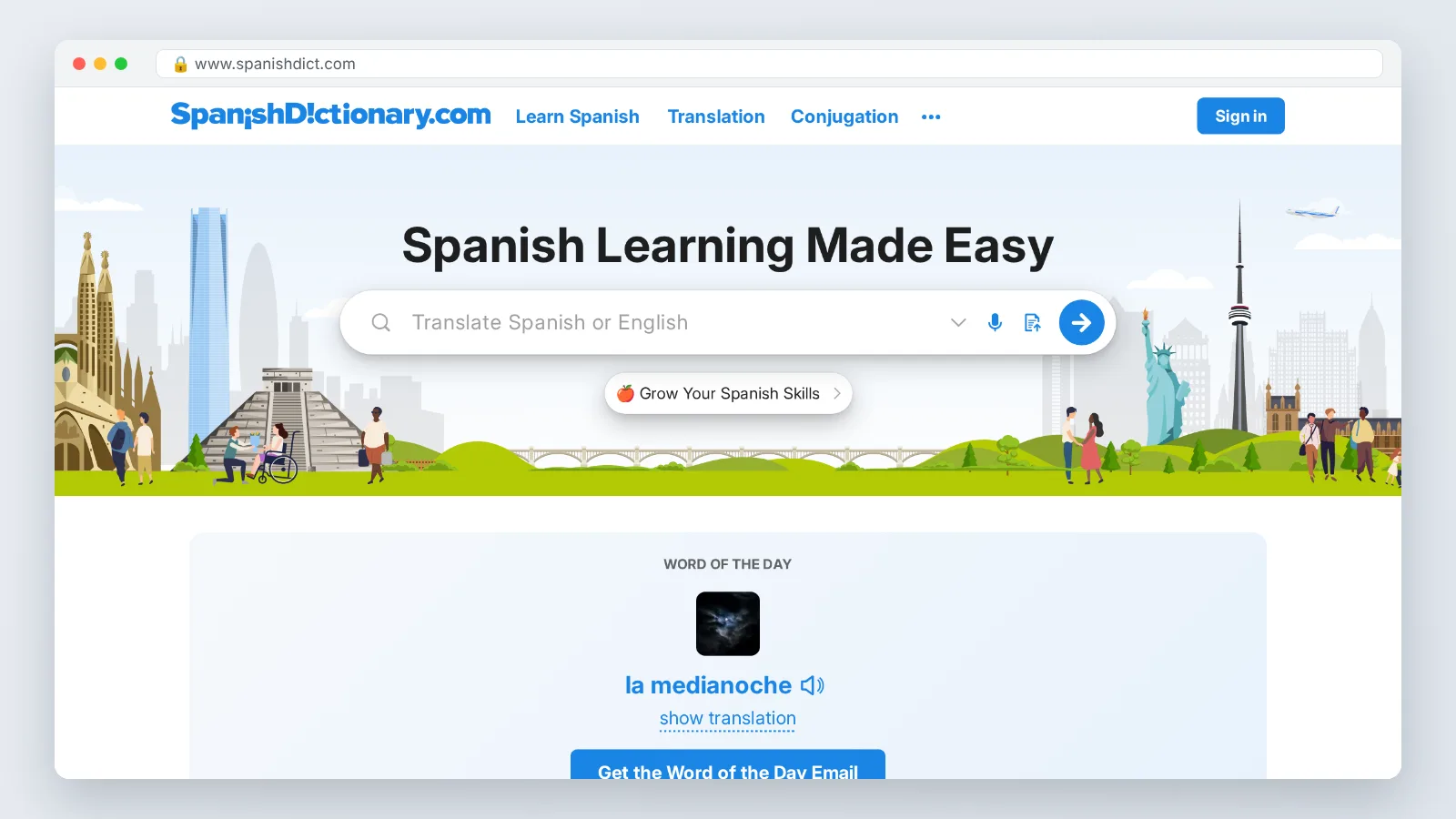
SpanishDict is built for people learning the language, not for people shipping a translated document. Entries pair definitions with example sentences, audio, regional labels and a conjugator that covers tenses you half-remember from class.
SpanishDictionary.com says its translator, dictionary and conjugator are used by more than 10 million people each month, according to its Google Play listing. That audience figure is a usage claim, not a quality measure; our own editorial read is simply that a tool this many learners open daily is worth a place in the rotation.
Switching costs nothing financially, but it does cost a habit. Linguee rewards you for searching long phrases; SpanishDict rewards you for searching one word and then reading the grammar around it. If you catch yourself looking up the same verb form three times a week, that is the signal to move.
Use it when you are studying, drilling conjugations, or checking whether a word carries a different meaning in Mexico than in Spain. Pair it with structured study — a reading list, a course, or the resources worth your time as an English speaker learning Spanish — rather than treating it as a translation engine.
4. WordReference
WordReference earns its place for one feature no corpus can replicate: human argument. Its forum threads are full of native speakers disagreeing about whether a word sounds cold, old-fashioned or regional, with the reasoning attached.
That is exactly what you want for the words that get people into trouble — courtesy formulas, insults that are mild in one country and vicious in another, verbs that shift meaning with a preposition. A Linguee example pair shows you that a rendering exists; a WordReference thread tells you who says it and when it lands badly.
Migration effort is low and the learning curve is mostly patience. Threads are long, answers conflict, and you have to read for judgment rather than grabbing the top result. The dictionary entries themselves are terse compared with learner-focused sites.
Keep it open as a second tab, not a replacement. It is the right tool when a single word is doing emotional work in your sentence — the same problem that makes choosing between de nada and its alternatives harder than it looks.
5. Google Translate
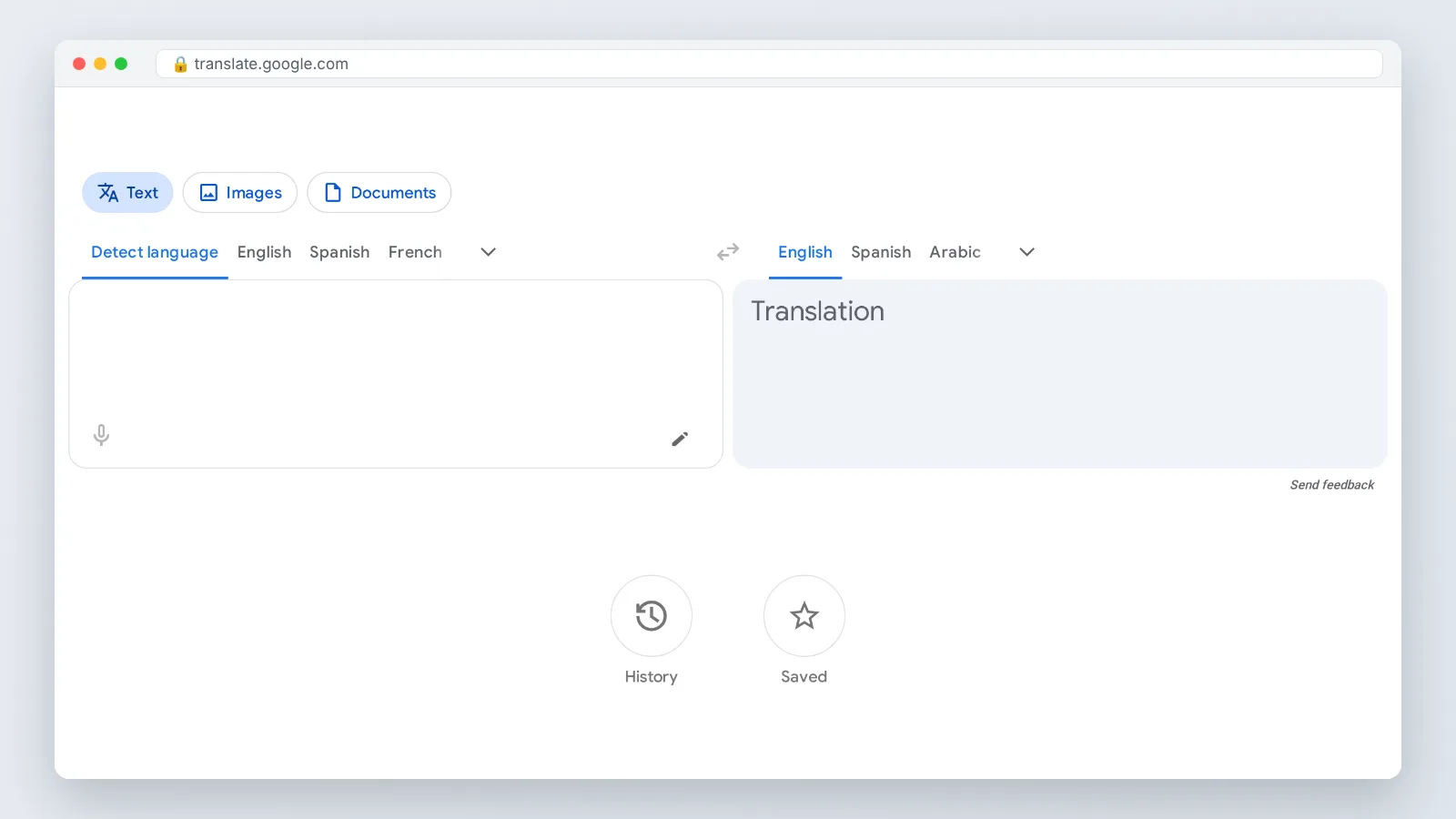
Google Translate is the breadth option. It handles camera input, speech, websites and offline packs, and it is already on the phone in your pocket, which is worth more than any feature list when you are standing at a pharmacy counter in Oaxaca.
Google announced in June 2024 that it was adding 110 new languages to Google Translate using AI, according to the Google Blog. That expansion nearly doubled Google Translate’s coverage from 133 to 243 languages, according to heise online.
For English to Spanish specifically, breadth is not the selling point — Spanish is the most heavily resourced pair there is. The selling point is input flexibility: sign, menu, voice, webpage, all in one app, with no paid tier checked for this comparison.
What you give up is evidence. There are no bilingual source pairs to inspect, and the output flattens register, so a polite request and a blunt one can come back looking similar. Treat it as a comprehension tool first and a production tool second.
6. ChatGPT and other chat assistants
General assistants solve a problem none of the dictionaries address: rewriting. You can ask for the same Spanish email in a warmer tone, two sentences shorter, addressed to a client you have never met, with usted throughout.
They also explain their choices, which is useful when you want to learn rather than copy. Ask why a subjunctive appeared, and you get a reason you can check elsewhere.
The risks are specific. Terminology drifts between paragraphs of the same document, confident explanations are sometimes invented, and there is no attested corpus behind any single choice. Verify key terms in Linguee or Reverso before the text leaves your hands.
Migration effort here is medium, because the skill is prompt discipline: state the audience, the country, the formality level and the terms that must not change. Pricing varies by vendor and plan and was not verified for this comparison.
How these tools were compared
This comparison is a desk review of public, official sources, current as of this October 2026 update. No translation quality benchmark was run, and nothing here is based on hands-on testing.
What was checked:
- DeepL’s Pro pricing page, for the per-seat price and the monthly character allowances on Individual and Team.
- DeepL Support documentation, for the free API character allowance.
- A 2026 pricing breakdown titled "DeepL pricing in 2026: every plan, every limit, and one gotcha most people miss," for the free Translator tier limit.
- GetApp’s Reverso Context listing, for the subscription price and trial length.
- The SpanishDictionary.com Google Play listing, for its stated monthly audience.
- The Dictionary Linguee App Store listing, published by DeepL SE, for the lexicographer count.
- The Google Blog and heise online, for the 2024 language expansion.
What was not checked: accuracy scoring across Spanish variants, mobile app stability, regional pricing or taxes, currency conversion between dollars and euros, enterprise quotes, and any price for WordReference, SpanishDict, Google Translate or chat assistants. Prices and limits change; confirm on the vendor’s own page before you subscribe.
When to stay with Linguee
Do not switch if your work is phrase verification in formal registers. Contracts, tender documents, technical specifications and anything with institutional vocabulary are precisely what Linguee’s corpus is dense in, and a single-output translator cannot show you that a rendering is attested.
Stay put in three situations:
- You need evidence, not fluency — someone may ask why you chose that term.
- You are already translating well and only need confirmation on a handful of phrases.
- Your volume is small enough that no paid plan is justified.
There is also no reason to treat this as a divorce. Linguee and DeepL come from the same company, so running the dictionary for phrase checks and the translator for full passages is a normal workflow rather than a compromise.
The honest failure case is register mismatch. If your Linguee examples keep sounding like an EU directive when you are writing to a cousin in Monterrey, the corpus is not wrong — it is just answering a different question than the one you have.
Choosing the right tool for your English-to-Spanish task
Match the tool to the unit of text you are holding. A word, a phrase, a paragraph and a document each have a different best answer, and most frustration comes from using a phrase tool on a document.
| Tool | Strongest for | Price (verified here) | Switching effort |
|---|---|---|---|
| Linguee | Attested phrase pairs from real documents | Not verified here | — |
| DeepL Translator | Full paragraphs, files, glossaries | $8.74 per month, billed annually (DeepL, October 2026) | Low — same company |
| Reverso Context | One phrase across many registers | €4.99 per month, or €39.99/year (GetApp, October 2026) | Low |
| SpanishDict | Conjugation, audio, learner grammar | No paid tier checked for this comparison | Low |
| WordReference | Single tricky words, native debate | No paid tier checked for this comparison | Low |
| Google Translate | Camera, voice, webpages, travel | No paid tier checked for this comparison | None |
| Chat assistants | Tone, rewriting, explanations | Not verified here | Medium — prompt habits |
A practical rule: draft in a translator, verify in a corpus, settle arguments in a forum. If you are fitting study around a job, keep the stack small — two tools you actually open beat six you bookmarked, which is the same logic behind a realistic study plan for working adults.
Audience decides the rest. Write down the country, the formality level and the three terms that must stay consistent before you open anything.
Frequently asked questions
Is Linguee the same thing as DeepL?
They come from the same company. DeepL SE publishes the Dictionary Linguee app, whose App Store listing credits the dictionary content to more than 400 lexicographers, while DeepL Translator is the separate machine translation product for full passages and documents.
Is DeepL’s free tier enough for English-to-Spanish schoolwork?
Often yes for short assignments. DeepL’s free Translator tier is limited to 50,000 characters per month, versus 300,000 on Individual and 1,000,000 per user on Team, according to a 2026 pricing breakdown titled "DeepL pricing in 2026: every plan, every limit, and one gotcha most people miss," so heavy document work pushes you toward a paid seat.
Which costs less per seat, DeepL or Reverso Context?
Reverso Context’s premium subscription is sold at €4.99 per month with a 7-day free trial, or €39.99 for a year, according to GetApp as of October 2026, while DeepL’s Pro page lists Individual at $8.74 per month billed annually, listed as of October 2026. They are priced in different currencies, so compare on your own bank’s rate.
Is Google Translate good enough for Spanish now?
For comprehension, menus, signs and travel, usually. Google announced in June 2024 that it was adding 110 new languages using AI, nearly doubling coverage from 133 to 243 languages according to heise online, but breadth does not fix register — check formal wording elsewhere before sending.
Which tool should a beginner start with?
SpanishDict, because it pairs definitions with conjugation tables, audio and regional labels, and its Google Play listing says more than 10 million people use its translator, dictionary and conjugator each month. Add Linguee once you start translating real sentences rather than single words.
Sources
- DeepL Pro — Find your perfect plan
- DeepL pricing in 2026: every plan, every limit, and one gotcha most people miss
- Usage count and billing in DeepL API — DeepL Support
- 110 new languages are coming to Google Translate — Google Blog
- 110 new languages on Google Translate, including Southern Franconian — heise online
- Dictionary Linguee on the App Store (Developer: DeepL SE)
- SpanishDictionary.com Learning — Google Play
- Reverso Context — Pricing, Features, Reviews & Alternatives (GetApp)
AI tools helped write this guide. The English to Spanish Editorial Team published it after checking every figure against the sources linked above.