Choose Latin American Spanish (es-419) when most of your readers, buyers or support tickets come from the Americas — Mexico, Colombia, Argentina, the US Hispanic market — and keep Spain Spanish (es-ES) for Europe-facing content.
What Is English to Latin American Spanish Translation?
Definition: English to Latin American Spanish translation converts English source text into the Spanish variety used across the Americas — tagged es-419 — adjusting vocabulary, verb forms, tone and cultural references for readers from Mexico to Argentina.
The label describes a family, not one dialect. A reader in Monterrey and a reader in Buenos Aires share grammar and almost all core vocabulary, but they split on slang, food words and how formal a brand is expected to sound. A translator working into es-419 picks the words that travel and drops the ones that stop at a border.
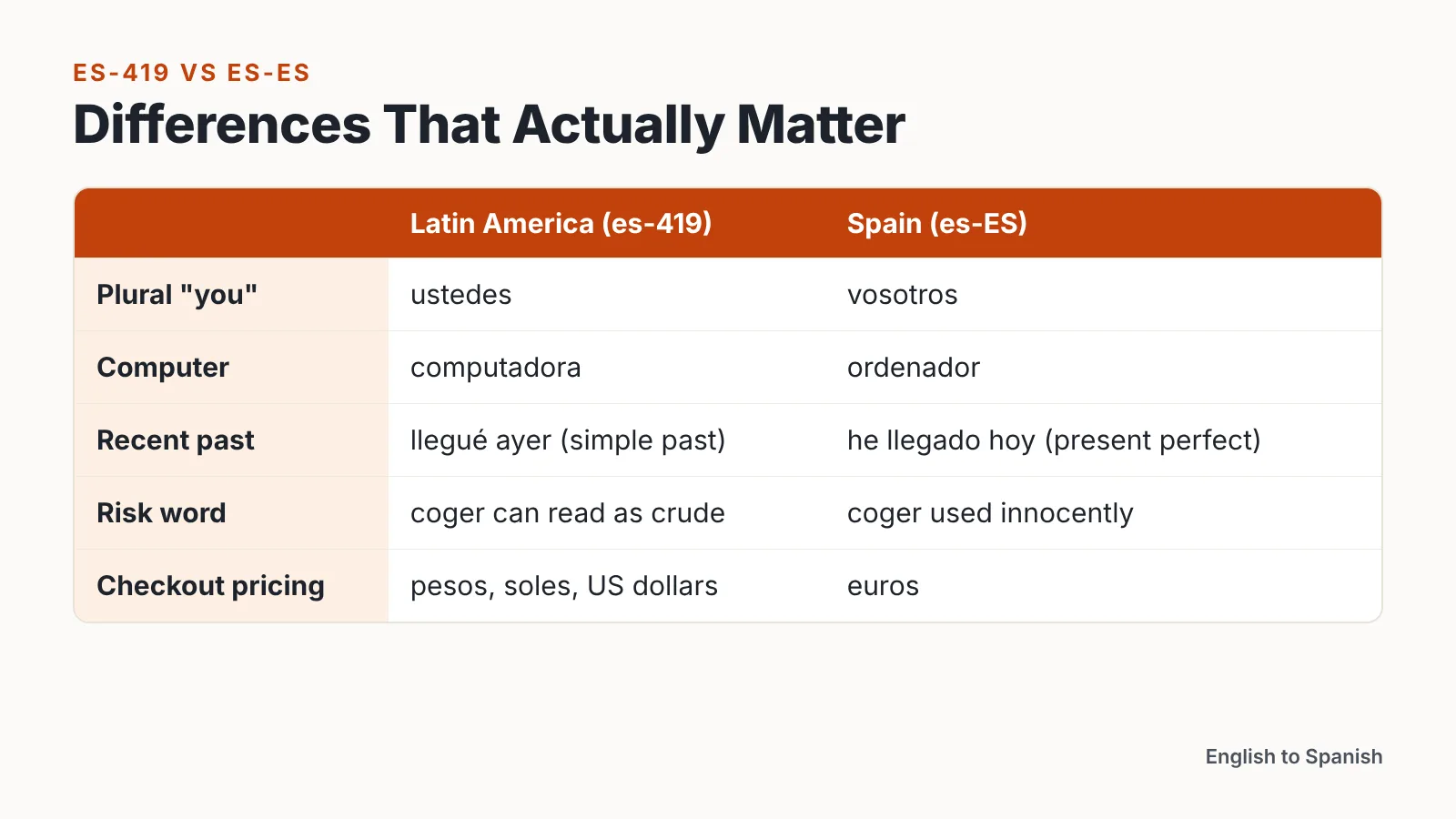
Three markers usually reveal the locale inside the first paragraph. Latin American Spanish uses *ustedes* for every plural "you," *computadora* instead of *ordenador*, and the simple past (*llegué ayer*) where Spain often reaches for the present perfect (*he llegado hoy*).
The choice is a publishing decision as much as a linguistic one. You are deciding which market reads your text as written for them, and which market hears a faint foreign accent on the page. Once you choose, a glossary, a style guide and translation memory carry that decision into every future update.
Who You’re Writing For: The es-419 Audience by the Numbers
Start with scale, because the asymmetry between Spain and the Americas drives most of the decision. The Instituto Cervantes 2025 yearbook reports that potential Spanish speakers worldwide now exceed 630 million. In 2025 the community of native-level Spanish speakers passed 500 million for the first time, reaching 520 million, according to the Instituto Cervantes.
The weight of that population sits west of the Atlantic. Latin America and the Caribbean had a population of more than 600 million inhabitants in 2025, per the Instituto Cervantes demolinguistics report. Spain contributes a comparatively small share of the Spanish-reading world, which is why es-419 is the higher-volume target for most English-language companies.
There is a diaspora layer on top. The Instituto Cervantes 2024 yearbook counts some 100 million Spanish speakers living outside Hispanic countries and more than 24 million learners of Spanish, and a large part of that group learned Latin American varieties from family, telenovelas or dubbed film.
Translate the demographics into a brief. If your analytics, resellers, app installs or support queue point to Mexico, Colombia, Peru, Chile, Argentina or US Hispanic users, es-419 is your default and Spain Spanish becomes the second file you commission later.
How It Works in Three Stages: Locale Choice, Translation, In-Country Review
Most English-to-Spanish projects that go wrong skipped stage one or stage three. The order matters, because a locale decision made after translation means paying twice.
Stage 1 — Locale choice. Pull your top markets from analytics, CRM and support tickets, then name one primary country even if you publish neutral es-419. That primary country becomes the tiebreaker whenever two valid wordings compete, and it decides which reviewer you hire.
Stage 2 — Translation and editing. Brief the translator with the locale tag, a glossary of product terms, a tone note and a do-not-translate list. A separate bilingual editor checks the Spanish against the English for meaning, consistency and register, which is a different job from proofreading.
Stage 3 — In-country review. A native reviewer living in your primary market reads the Spanish alone, without the English, and flags anything that sounds imported. This is where *vosotros* leftovers, Spain-only idioms and awkward literal renderings of English marketing verbs get caught.
For video, add a fourth checkpoint before release: listen to the full voiceover with a reviewer from the target country, since an accent problem is invisible in the script file.
Latin American Spanish vs. Spain Spanish: The Differences That Actually Matter
Grammar and spelling are shared, so comprehension is rarely the issue. The issue is signal — specific words that tell a reader which side of the Atlantic wrote the page.
| Feature | Latin American Spanish (es-419) | Spain Spanish (es-ES) |
|---|---|---|
| Plural "you" | *ustedes* for formal and informal | *vosotros* informal, *ustedes* formal |
| Recent past | Simple past: *llegó el pedido* | Present perfect: *ha llegado el pedido* |
| Computer | *computadora* / *computador* | *ordenador* |
| Cell phone | *celular* | *móvil* |
| Car | *carro* / *auto* | *coche* |
| "To take/grab" | *tomar*, *agarrar* (*coger* is vulgar in much of the region) | *coger* is neutral and common |
| Juice, driving, software terms | Often English-influenced loanwords | Often Spain-specific calques |
| Currency and dates | Local currency first, DD/MM/YYYY | Euro, DD/MM/YYYY |
Four of these carry real risk. Using *vosotros* marks the text as European in one word; *coger* can read as crude across Mexico, Argentina and much of Central America; euro pricing in a Chilean checkout breaks trust; and Spain-only idioms in ad copy make a brand sound borrowed.
The rest are preferences a reader forgives. Prioritize the giveaways, then spend remaining budget on tone rather than chasing every synonym.
Neutral es-419 vs. Country-Specific Spanish (es-MX, es-AR, es-CO): Which Do You Need?
Neutral es-419 is a deliberately flattened register: regional slang removed, *ustedes* throughout, vocabulary chosen because it is understood in every market. It is not spoken anywhere exactly as written, and that is the point.
| Option | Best for | Trade-off |
|---|---|---|
| Neutral es-419 | Websites, help centers, product UI, policies, e-learning | Reads slightly formal; never maximally local |
| es-MX | Largest single market, dubbing, consumer campaigns | Mexican slang can feel foreign in the Southern Cone |
| es-AR | Argentina and Uruguay, where *vos* and *che* dominate | Voseo looks wrong to readers elsewhere |
| es-CO | Colombia, often chosen for call centers and neutral voiceover | Still carries local collocations |
Start neutral for anything long-lived and expensive to maintain. One es-419 file keeps your translation memory clean and your support content consistent.
Split into country files where persuasion or performance is measured: paid social, landing pages tied to local payment methods, sales decks, and spoken voiceover. A Colombian prospect hearing a Mexican accent notices immediately, even when every word is correct.
When to Choose Latin American Spanish Instead of Spain Spanish: A Decision Checklist
About 44.9 million people in the United States, roughly one in seven residents aged 5 and older, speak Spanish at home, according to USAFacts — and that audience overwhelmingly maps to Latin American varieties, not Castilian.
Choose Latin American Spanish when any of these are true:
- Your paying customers, trials or app installs concentrate in the Americas.
- You sell to the US Hispanic market, including bilingual households.
- Your support team, call center or resellers are based in Mexico, Colombia or Central America.
- Your pricing uses pesos, soles or US dollars rather than euros.
- Your video content will be dubbed for streaming or social distribution in the region.
Choose Spain Spanish when your legal entity, EU compliance language, retail partners or hiring are centered in Spain, or when a Spanish-language campaign runs only on European media buys.
Publish both when the two markets touch the same funnel and the content is short-lived — ads, product launch pages, seasonal campaigns. Keep one locale as the source of truth so the files do not drift apart over a year of edits.
Practical Uses: Websites, Support Docs, Video Subtitles and Dubbing, Ads, and Legal Content
Commercial stakes are measurable. CSA Research’s "Can’t Read, Won’t Buy" study found 76% of online shoppers prefer buying products with information in their native language and 40% will never buy from websites in other languages. In the same CSA Research survey, the share choosing the product documented in their own language rises to 89% among respondents with no English-language competence.
Websites and support docs are the first candidates, because they are read under pressure. A help article that uses *ordenador* in a market that says *computadora* costs a search match and a ticket deflection.
Subtitles and dubbing have a harder constraint: an accent cannot be neutralized in post. Teams producing regional versions at volume often use AI voice tools for first drafts, then hand the audio to a native reviewer — platforms such as AI Studios offer text-to-speech voiceovers in 150+ languages and accents on paid plans, with 30+ languages on the Free plan.
Ads demand country-level work. A tagline that lands in Mexico City can be flat in Santiago, so test copy with a speaker from the exact market before the media buy.
Legal content is the one area where "neutral" is risky: terms of service, privacy notices and consumer warranties follow national law, so a Mexican version and an Argentine version may need different substance, not just different words. Have local counsel review each market’s text. This is general information, not legal advice.
Tools, Costs, and the Mistakes That Give You Away
Machine translation now treats the two varieties as separate targets. DeepL’s API documentation lists es-419 (Latin American Spanish) and es-ES (European Spanish) as separate target language codes alongside generic es. DeepL does not distinguish Spanish varieties on the source side, but offers European and Latin American Spanish as separate translation targets, with the Latin American variant limited to its next-generation model.
Budget in layers rather than a single line item. Raw machine output is cheapest and acceptable for internal tickets; machine translation plus human post-editing suits help centers; full human translation with in-country review belongs on anything a customer pays money after reading.
The mistakes that expose a Europe-first process are predictable:
- *Vosotros* forms surviving in one paragraph of a long page.
- *Coger* used innocently in instructions.
- Euro symbols, Spanish phone formats or Spain-only shipping language in checkout.
- Generic "es" machine output shipped without a locale decision.
- Idioms translated word for word from English marketing copy.
- A Castilian voiceover on a video aimed at Lima or Bogotá.
Lock the locale in your CMS and your translation memory on day one. Retrofitting es-419 onto a site already published in es-ES means re-reviewing every string, and that cost is almost always larger than the original translation.

Frequently asked questions
Is Latin American Spanish a single language variety?
No. es-419 is an umbrella tag covering roughly twenty countries, and Latin America and the Caribbean had more than 600 million inhabitants in 2025 per the Instituto Cervantes demolinguistics report. Neutral es-419 is a written compromise that strips regional slang so readers in Mexico, Colombia and Chile all understand it.
Will Spanish speakers in Spain understand es-419 content?
Yes, almost entirely. Grammar and spelling are shared, so comprehension is rarely the barrier; what changes is tone. A Spanish reader will notice ustedes everywhere, computadora instead of ordenador, and simple past forms, and will register the text as written for the Americas rather than for them.
Can machine translation produce Latin American Spanish directly?
Partly. DeepL’s API documentation lists es-419 (Latin American Spanish) and es-ES (European Spanish) as separate target language codes alongside generic es, so you can request the variety. Human post-editing and an in-country review still catch register, idioms and country-specific product terms that models flatten.
Do I need separate es-MX, es-AR and es-CO versions?
Only where persuasion or voice is involved. Keep neutral es-419 for websites, help centers and policies, then split into country files for paid ads, landing pages with local payment methods, sales decks and dubbed video, where an unfamiliar accent or slang term is noticed instantly.
How much does the wrong Spanish variety actually cost in sales?
CSA Research’s "Can’t Read, Won’t Buy" study found 76% of online shoppers prefer buying products with information in their native language and 40% will never buy from websites in other languages, which makes locale mismatch a conversion problem rather than a stylistic preference.
Sources
- CVC. Anuario 2025. El español: lengua para el mundo 2025. 20 claves del español en el mundo (Instituto Cervantes)
- CVC. Anuario 2025. Demografía del español en el mundo 2025 (Instituto Cervantes)
- El español en el mundo. Anuario del Instituto Cervantes 2024
- Languages supported — DeepL Documentation
- DeepL Translator languages — DeepL Support
- How many people are Spanish speakers at home? — USAFacts
- Consumers Prefer their Own Language — CSA Research (press release)
- Third Global Survey by CSA Research Finds Language Preference of Consumers in 29 Countries — Slator
AI tools helped write this guide. The English to Spanish Editorial Team published it after checking every figure against the sources linked above.