You need an english to spanish interpreter whenever the exchange is spoken and live — a clinic visit, a hearing, a parent conference, a phone call — and a wrong word would change care, rights, or money.

Why the interpreter-vs-translator choice matters more than it looks
An interpreter works in speech, live, with no second draft. A translator works in written text and can revise, check a glossary, and hand the file to a reviewer before anyone reads it. Same language pair, almost entirely different job.
Key takeaways
- Spoken and live → interpreter. Written and reviewable → translator.
- Apps handle low-stakes text well and live dialogue poorly.
- U.S. health programs covered by 45 CFR § 92.201 have specific duties around qualified interpreters and machine translation.
- Ask about mode, dialect, and certification before you ask about price.
The mix-up usually surfaces at the worst moment: a patient is in the room, a hearing is about to start, and the agency on the phone asks which service you actually booked. Booking a document translator for a live appointment wastes the slot. Booking an interpreter for a 12-page benefits packet wastes money.
Scale explains why this comes up so often in the United States. About 44.9 million U.S. residents aged 5 and over — roughly one in seven — spoke Spanish at home in 2024, according to U.S. Census Bureau American Community Survey data reported by USAFacts. That is not a niche request line; it is routine operational planning for clinics, school districts, and courts.
How English-to-Spanish interpreting actually works: speech, in real time, in modes
Strip it down and there are three moves. The interpreter listens for meaning rather than individual words, holds that meaning in memory (often with shorthand notes), then renders it in Spanish at the same register the speaker used. No editing pass exists, which is why training and stamina matter.
Two conventions surprise first-time users. A professional interpreter speaks in the first person — "I have chest pain," not "she says she has chest pain" — and interprets everything said in the room, including asides and profanity. If something is genuinely ambiguous, the interpreter stops and asks for clarification out loud.
The main modes:
- Consecutive — the speaker says a chunk, pauses, the interpreter renders it. Default for exam rooms, interviews, depositions, parent meetings.
- Simultaneous — the interpreter speaks while the source speaker keeps talking, usually with a headset or whisper. Used in courtrooms, conferences, large assemblies.
- Sight translation — the interpreter reads a written document aloud in Spanish. Common with consent forms and discharge instructions.
Dialect enters here more than people expect. Vocabulary for a car part, a classroom term, or a body part shifts between Caribbean, Mexican, and Southern Cone speakers, and a neutral choice is often safest — the same calculation behind choosing a neutral es-419 variety for Latin American audiences.
When you need an interpreter: clinics, courts, classrooms and calls
The trigger is not language ability in general. It is whether this particular person, in this particular conversation, can ask questions and push back in English. In 2024, 58.9% of U.S. Spanish-at-home speakers reported speaking English "very well," according to Census Bureau American Community Survey data reported by USAFacts — which leaves a sizable share who did not, and that group is where interpreters belong rather than apps.
Situations that almost always call for a live interpreter:
- Clinical visits — symptom history, medication dosing, consent before a procedure, discharge instructions a patient must follow at home.
- Court and law enforcement — hearings, plea discussions, protective order applications, recorded interviews.
- Schools — IEP and 504 meetings, discipline hearings, enrollment appointments, anything a parent must agree to.
- Phone and video calls — benefits eligibility, insurance claims, utility shutoff disputes, 911 and crisis lines.
- Workplaces — safety briefings before equipment use, incident investigations, HR complaints.
Low-stakes situations do not need one. Ordering lunch, asking directions, confirming a delivery window — a phone app and a few memorized phrases carry you, and knowing how to say you don’t speak Spanish politely buys goodwill while you sort out the rest.

Interpreter vs. translator vs. translation app
| Interpreter | Translator | Translation app | |
|---|---|---|---|
| Medium | Spoken words | Written text | Text, photo, or voice input |
| Timing | Live, no second draft | Asynchronous, revisable | Instant |
| Output | Speech (sometimes written notes) | A file you can proofread | Draft text or synthetic speech |
| Best for | Appointments, hearings, calls | Forms, contracts, manuals, web copy | Menus, signs, quick gist |
| Handles turn-taking | Yes, that’s the job | No | Poorly, with cross-talk |
| Accountable | Named person, often certified | Named person or agency | No one |
Read the table as a sequence, not a ranking. Many real jobs need two of the three: an interpreter in the appointment, then a translator for the follow-up paperwork the patient takes home. Recorded media is its own lane again — see the workflow for getting a recorded video into Spanish with captions and audio.
Apps fail in predictable places: overlapping speakers, idioms, regional slang, emotional nuance, and proper nouns. They also give you no way to check what the other person heard. If you want a tool for text anyway, compare behavior across engines first — a side-by-side of Linguee against six other translation tools shows how differently they handle context.
What the rules say: qualified interpreters and machine translation limits
In the United States, the clearest written standard sits in 45 CFR § 92.201, the Section 1557 rule that applies to health programs and activities receiving federal financial assistance — not to every private business. Courts, schools, and federal agencies operate under their own language-access rules, and state court interpreter requirements differ state by state.
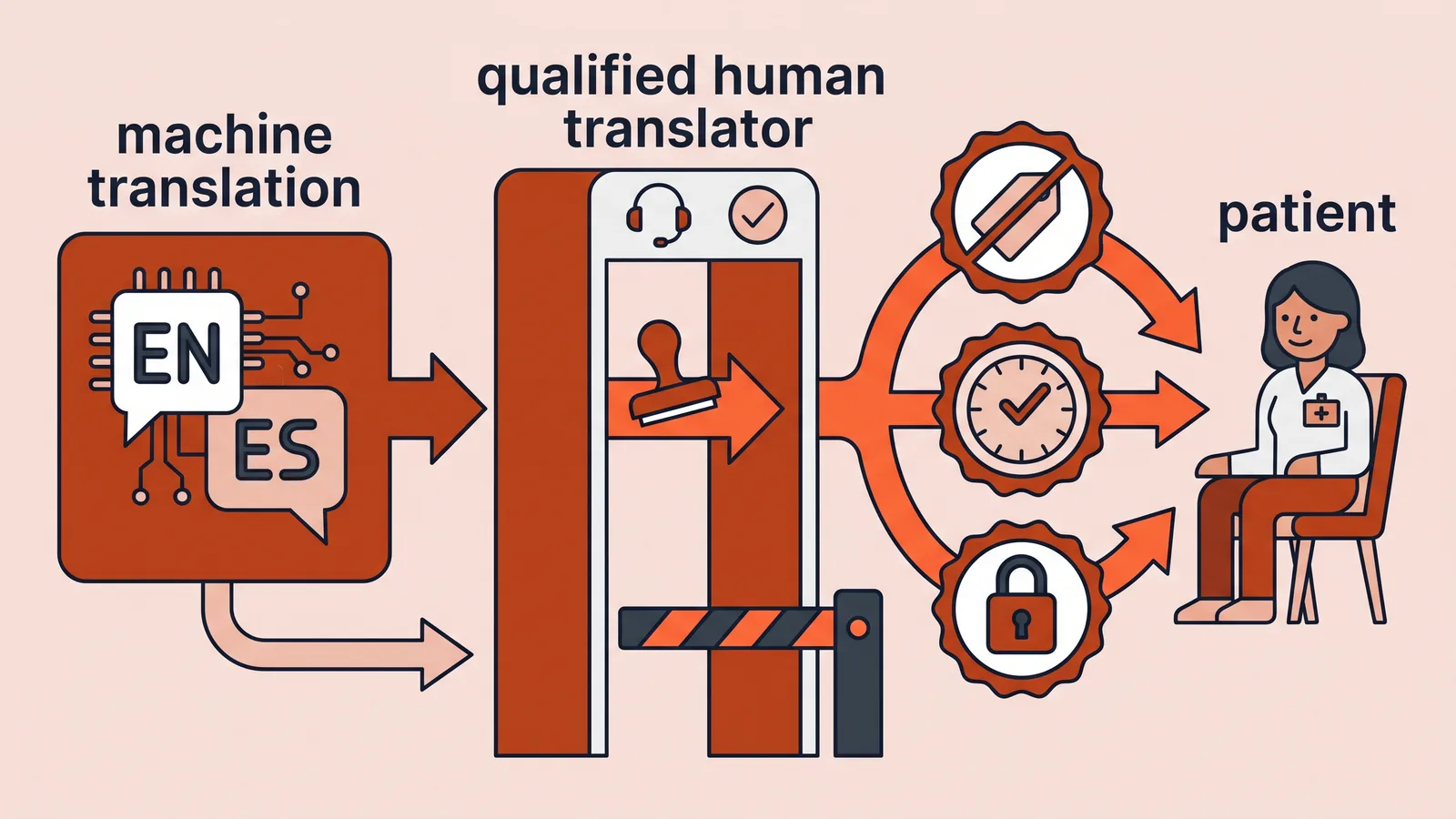
The regulation permits machine translation but requires a qualified human translator to review the output when the text is critical to a person’s rights, benefits, or access, when accuracy is essential, or when the language is complex, non-literal, or technical, according to the text of 45 CFR § 92.201 published by the Cornell Legal Information Institute.
Three more duties are spelled out in the same section. When language assistance is required in covered U.S. health programs, the eCFR text of 45 CFR § 92.201 says it must be free to the patient, accurate and timely, and must protect privacy and independent decision-making. "Free to the patient" is the line people miss most often — the obligation sits with the covered entity, not the person who needs the interpreter.
Common misconceptions: bilingual staff, family members, and "the app is good enough"
"Our front desk clerk is bilingual." Conversational fluency is not interpreting competence. A qualified interpreter demonstrates proficiency in both languages plus the specialized vocabulary and ethics of the setting, and that person also has a day job they are being pulled away from.
"The patient brought her daughter." Under 45 CFR § 92.201, federal rules bar covered health entities from relying on a minor child to interpret, except as a temporary stopgap in an emergency while a qualified interpreter is being located, according to the eCFR. Adult relatives raise separate problems: filtering, embarrassment, and a strong incentive to soften bad news.
"The app got us through last time." It got you through a conversation nobody audited. Voice tools struggle with cross-talk, dosage numbers, negation, and regional vocabulary — and the person relying on them cannot tell you what was lost, which is exactly the failure mode that produces repeat visits and signed forms nobody understood.
Cost, certification, remote vs. on-site, and how to book one
Pricing follows format. On-site assignments are usually billed by the hour with a minimum and travel time; phone interpreting is billed by the minute; video remote interpreting lands between them. In covered U.S. health programs, remember that 45 CFR § 92.201 requires language assistance to be free to the patient, so the bill belongs to the entity, not the family.
Use remote when the need is sudden, short, or purely verbal — a pharmacy callback, a benefits hotline, a quick triage question. Use on-site when the encounter is long, emotionally heavy, involves documents on a table, or requires reading body language: IEP meetings, mental health intakes, hearings, end-of-life conversations.
When you book, state the language pair, the setting, the expected mode, the duration, the country or region the speaker is from, and any specialized vocabulary. Ask which credential the interpreter holds and which body issued it, whether they carry healthcare or legal specialization, and how cancellations are billed. Confirm the dialect fits — the same caution that applies to translating English into Caribbean varieties like Dominican Spanish.
Bottom line: the simple test for choosing an interpreter
Run three questions in order. Is the exchange spoken and happening live? Does the other person need to ask questions back and be understood? Would a wrong word change someone’s health, legal standing, schooling, or money?
Three yeses mean you book a human interpreter and nothing else. Two yeses mean you book one unless the conversation is genuinely trivial. One yes — written text, reviewable, low stakes — means a translator or a well-checked app will do.
The rest is logistics: mode, dialect, remote or on-site, and who pays. Get those four right and the appointment stops being about language at all, which is the whole point.
This article is general information about U.S. language-access practice, not legal or medical advice; rules differ by jurisdiction and by the type of entity involved.
Frequently asked questions
How much does an English-to-Spanish interpreter cost?
Rates vary by format and specialization: on-site work is typically billed hourly with a minimum plus travel, phone interpreting by the minute, and video remote in between. In covered U.S. health programs, the eCFR text of 45 CFR § 92.201 says language assistance must be free to the patient, so the entity pays, not the family.
Does an English-to-Spanish interpreter need certification?
It depends on the setting. Court interpreting usually requires a state or federal credential, and hospitals commonly require a recognized medical interpreter certification, while community and business assignments may not. Always ask which credential the interpreter holds, which organization issued it, and whether it covers the specialty you need.
Is remote interpreting as good as having someone in the room?
For short, verbal, time-sensitive exchanges — a pharmacy callback, a benefits hotline, a triage question — remote works well and arrives in minutes. On-site is better for long meetings, documents spread on a table, emotionally heavy conversations, and any encounter where reading body language changes the outcome.
Can I use a translation app instead for a medical appointment?
Not for the parts that matter. The text of 45 CFR § 92.201 published by the Cornell Legal Information Institute allows machine translation but requires qualified human review when the material is critical to rights, benefits, or access, when accuracy is essential, or when the language is complex, non-literal, or technical.
Can a patient’s adult family member interpret instead?
Only if the patient asks for it and a qualified interpreter is also available. Federal rules under 45 CFR § 92.201 bar covered health entities from relying on a minor child except as a temporary emergency stopgap, according to the eCFR, and adult relatives often filter bad news or omit sensitive details.
How far in advance should I book one?
Book as soon as the appointment is set, especially for on-site work, court dates, and IEP meetings where a specific dialect or specialization is required. For unplanned needs, phone interpreting services connect within minutes and are the practical fallback while you arrange someone in person.
Sources
AI tools helped write this guide. The English to Spanish Editorial Team published it after checking every figure against the sources linked above.