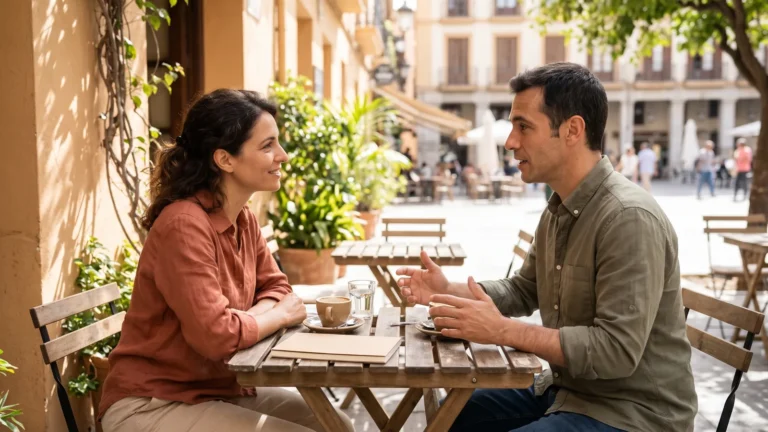
The short answer on how to say good afternoon in spanish: buenas tardes, used from midday until sunset. Before midday, buenos días. Once the sun is down, buenas noches — which works as both a greeting and a goodbye.
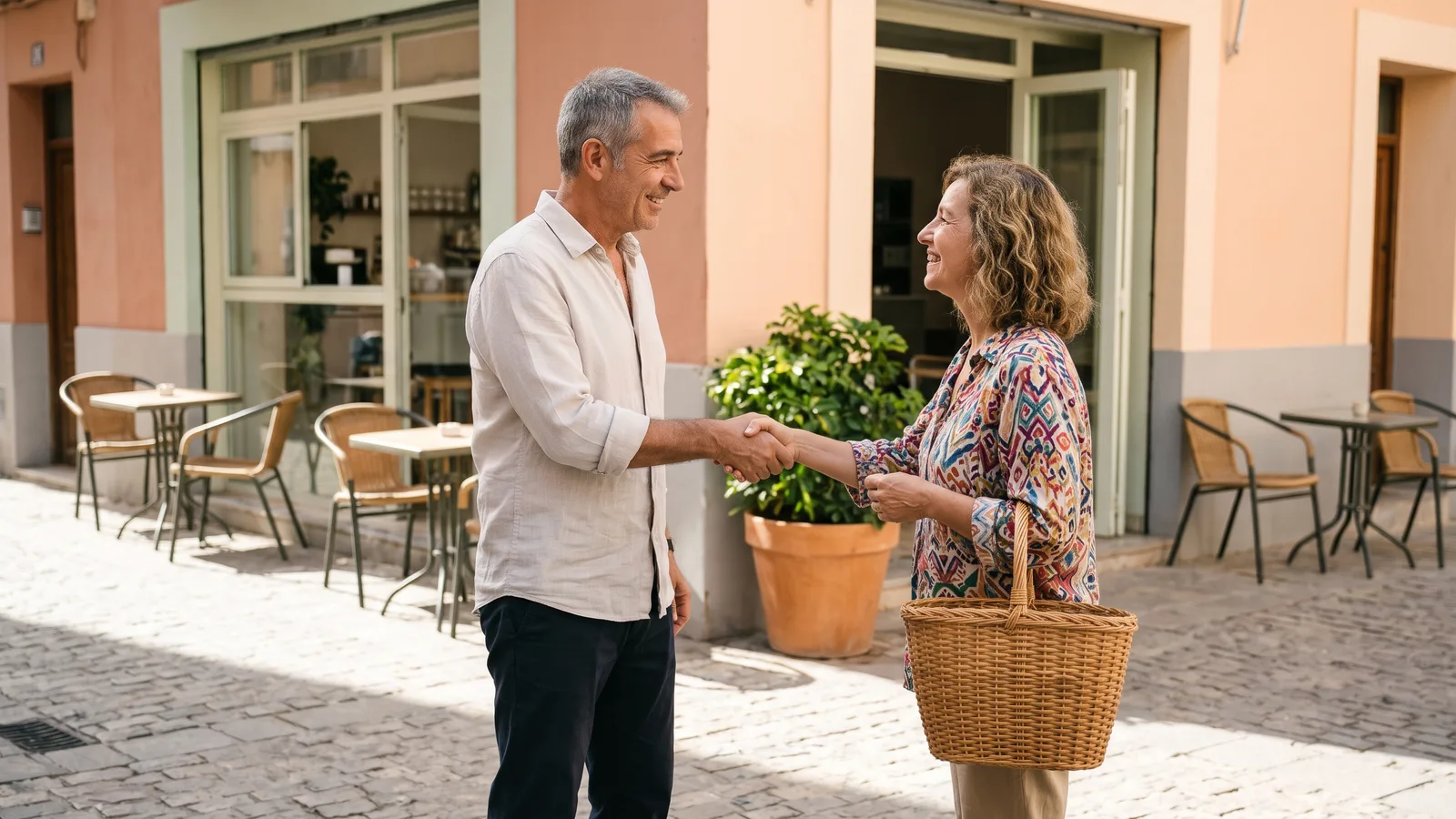
Quick steps: pick the right greeting in under a minute
- Use buenos días up to midday.
- At midday, switch to buenas tardes — roughly BWEH-nahs TAR-dehs.
- Keep using it while the sun is still up where you are.
- Once the sun has set, greet with buenas noches, which also serves as goodbye.
- Caught between two of them? Say buenas and keep moving.
Those five lines cover nearly every exchange you’ll have at a reception desk, a bakery counter or the opening seconds of a call. Two details catch English speakers out. The phrase is plural — buenas tardes, never buena tarde — and the end of the window is set by daylight, not by a number on your phone.
English ties good afternoon loosely to the clock and stops caring after about five. Spanish ties tarde to the stretch of day between noon and darkness, which is why a 7 p.m. video call can need two different greetings in June and in December. The steps below set your start time, your end time, and the seasonal correction between them.
What to decide first: clock time, daylight and country
Three inputs decide the greeting: the local clock, whether the sun is still above the horizon, and local habit. Check them in that order and you will almost never be wrong. The table that follows is an editorial description of regional habit rather than a dictionary rule: only the midday-to-nightfall window comes from the Real Academia Española, and everything else below is convention as we have observed it in everyday use.
| Window | Spain | Mexico & Central America | Southern Cone (Argentina, Chile, Uruguay) |
|---|---|---|---|
| Dawn to midday | buenos días | buenos días, often buen día | buen día, buenos días |
| The hour or two after midday | buenos días frequently holds until lunch | buenas tardes from midday | buenas tardes from midday |
| Midday through to sunset | buenas tardes | buenas tardes | buenas tardes |
| After the sun sets, any hour | buenas noches | buenas noches | buenas noches |
| Quick, informal, any hour | buenas / muy buenas | buenas | buenas, buen día |
So put the European Commission’s 2027 summer-time dates — Sunday 28 March and Sunday 31 October — straight into the calendar you keep for Madrid and Barcelona contacts, and on the Monday after each one, re-check sunset before you assume a 7 p.m. call still counts as tarde.
Regional habit is the input most learners skip, and it is the part no dictionary settles. In our own observation, a Bogotá receptionist will answer buenas tardes at 12:05, while a Madrid colleague may still be on buenos días at the same moment, and both are correct in their own setting. Readers working with one country in particular will find more of these small divergences in this guide to the word choices that misfire in Colombian Spanish.
Step 1 — Set your start time: move from buenos días to buenas tardes at midday
What you need: a clock set to the other person’s local time, not yours.
The Real Academia Española’s Diccionario de la lengua española defines tarde as the part of the day running from midday to nightfall, which is exactly the window in which buenas tardes is used. Midday is the hinge. Before it, buenos días; after it, buenas tardes.
Spain bends that rule in daily speech. The morning greeting tends to survive until people break for the midday meal, which lands considerably later there than lunch does in the United States, so you will hear buenos días in a Seville office well after twelve. Nobody will correct you for switching on the hour — you’ll simply sound slightly more Latin American than Spanish.
For remote work, pin the clock to the person you are greeting. A 10 a.m. call from Chicago reaches Madrid in the afternoon, and opening with buenos días to someone who ate lunch an hour ago reads as careless. Check the time zone before you dial, then pick the word.
Written Spanish follows the same boundary. An email sent at 1 p.m. opens Buenas tardes: with a colon, and the capital letter sits on the first word only.
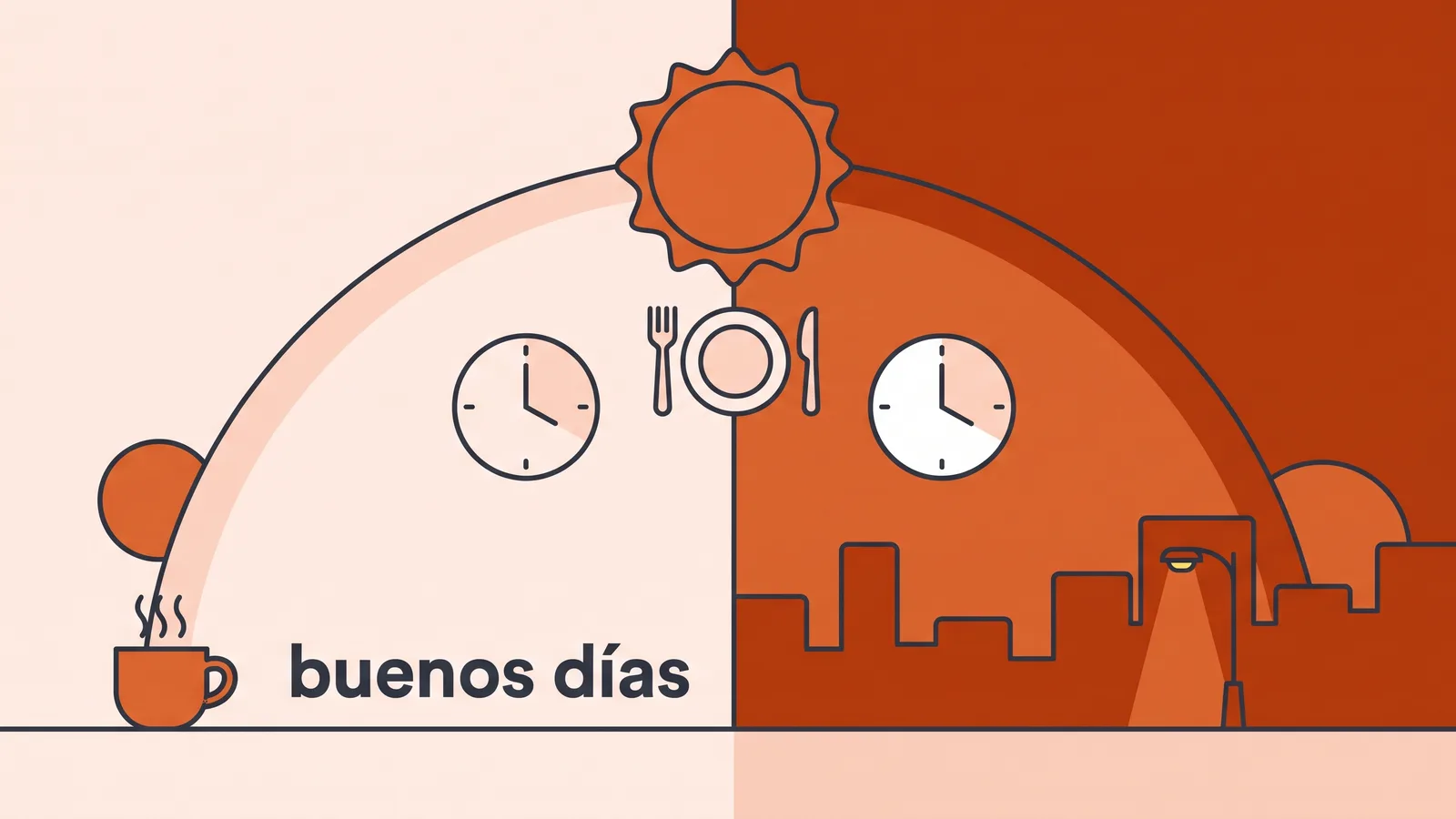
Step 2 — Set your end time: switch to buenas noches at sunset, not at a fixed hour
What you need: today’s local sunset time, which your weather app already shows.
The RAE dictionary defines noche as the part of the day between sunset and dawn, so buenas noches becomes the correct greeting once the sun has set — not at a fixed clock hour. That single rule removes most of the guesswork. Look outside; if the light is gone, so is tarde.
English speakers hesitate here because good night in English is a farewell. Buenas noches is not. It greets the pharmacist you walk in on at eight in the evening, and it also closes the conversation on your way out, doing the job of both good evening and good night.
Spanish has no separate word for evening. The darkening hours between day and bedtime fall under noche, with tarde-noche available when you want to describe that in-between slot — in a text about meeting times, for example.
A practical habit: glance at the sky before you open your mouth in a doorway. Indoors, under office lighting, people lose track and greet at four the way they greet at nine.
Step 3 — Adjust for season, latitude and the March/October clock change
What you need: a calendar and a rough sense of how far north or south your contact lives.
Spain and every other EU member state move the clocks forward from the last Sunday in March to the last Sunday in October, which pushes sunset — and the buenas tardes to buenas noches switch — about an hour later for half the year, according to the proposal on seasonal clock changes published by the European Commission on EUR-Lex. The greeting that fits at 8 p.m. in July will not fit at 8 p.m. in January.
Latitude matters just as much. Near the equator, in Quito or Bogotá, sunset barely moves across the year, so the switch sits at roughly the same hour every month. In Madrid, Buenos Aires or Santiago, the gap between a midsummer and a midwinter sunset is wide enough to move your greeting by hours, not minutes.
Southern-hemisphere seasons run opposite to yours. December in Montevideo is long and bright; December in Spain is not.
If you greet the same people regularly, set one reminder for the last Sunday in March and one for the last Sunday in October, then forget about the calculation in between.
Step 4 — Match the situation: greeting vs. goodbye, formal vs. casual, buenas and buen día
What you need: nothing but a read on how formal the room is.
The RAE’s 2001 edition of the dictionary gives tarde a second sense, the last hours of the day, which explains why some speakers keep saying buenas tardes into the early evening. Treat that as permission to relax rather than a reason to argue with anyone.
Formality sits in what follows the greeting, not in the greeting itself. Buenas tardes, señor Rivas. ¿Cómo está usted? is respectful; Buenas tardes, ¿qué tal? is friendly and neutral; ¡Buenas! between neighbours on a stairwell is as casual as it gets.
Variants worth knowing:
- Buenas — all-day, informal, extremely common in Spain and the Southern Cone.
- Muy buenas — warmer version of the same, good for shopkeepers you know.
- Buen día — standard in Argentina, Uruguay and much of Mexico, mostly for mornings.
- Buenas tardes a todos — the opening line for a group, a webinar or a meeting.
As a goodbye, buenas tardes works when you leave mid-afternoon, though hasta luego sounds more natural on the way out. Introductions that follow the greeting are covered in this walkthrough of the phrases Spanish speakers actually use on first meeting, and the polite interruption that often comes next is handled in this guide to asking for attention without sounding abrupt.

Check yourself: a three-question test before you speak
Run these three questions in order and the answer falls out.
- Has local midday passed? No — buenos días. Yes — go to question two.
- Is the sun still above the horizon there? Yes — buenas tardes. No — buenas noches.
- Am I in Spain around lunchtime? If so, buenos días is still safe until people get up from the table.
Checklist before you open your mouth:
- ☐ Both words plural: buenas tardes, not buena tarde
- ☐ Clock checked in the other person’s time zone, not yours
- ☐ Sunset checked for their city, not the hour on your wall
- ☐ Season and hemisphere accounted for
- ☐ Title or usted added if the setting is formal
- ☐ Buenas ready as the fallback when you genuinely cannot tell
The common failure, and how to dodge it. Most learners treat buenas noches as a bedtime farewell and keep saying buenas tardes when they walk into a restaurant after dark, which sounds like greeting someone with good afternoon at nine at night. Example: you arrive in Valencia for an 8:30 p.m. dinner reservation in November, the streetlights are on, and the right greeting at the door is buenas noches — the same words you will use when you leave. Fix it by checking the sky, not the clock.
When the reply comes back faster than you can follow, the sentence to have ready is in this guide to saying you don’t speak Spanish politely.
Frequently asked questions
When exactly does buenas tardes start and stop?
It starts at midday and ends when the sun goes down. The Real Academia Española defines tarde as the part of the day from midday to nightfall, so the closing boundary moves with sunset through the year instead of sitting at a fixed hour like 6 p.m.
What is the difference between buenas tardes and buenas noches?
Daylight separates them. Buenas tardes covers the lit part of the day after midday; buenas noches takes over once the sun has set and runs until dawn, and unlike English good night it greets people on arrival as well as sending them off.
Is it ever right to say buenas tardes at 8 p.m.?
In a Spanish or Argentine midsummer, yes, because the sun is still up. The EU clock change pushes sunset about an hour later from the last Sunday in March to the last Sunday in October, according to the European Commission proposal on EUR-Lex, so the same hour flips between greetings across the year.
Can I just say buenas instead?
Yes, in casual settings. Buenas works morning, afternoon and evening, which makes it the safest choice when you cannot see the sky or cannot remember whether midday has passed. Keep the full buenas tardes for clients, officials, job interviews and written messages.
How do I write buenas tardes in an email or a message?
Open with Buenas tardes: followed by a colon, capitalising only the first word, then start the body on the next line. Add the person’s title if the tone is formal — Buenas tardes, Sra. Ortiz: — and check their time zone before choosing the greeting.
Sources
- tarde | Diccionario de la lengua española (RAE-ASALE)
- noche | Diccionario de la lengua española (RAE-ASALE)
- tarde | Diccionario de la lengua española, 22.ª ed. (2001) — RAE
- Proposal for a Directive discontinuing seasonal changes of time and repealing Directive 2000/84/EC — EUR-Lex
- Communication from the Commission — Schedule for the summer-time period (C/2026/1660), EUR-Lex
AI tools helped write this guide. The English to Spanish Editorial Team published it after checking every figure against the sources linked above.