Here is how to learn spanish for free: pick one free core course, add daily listening you mostly understand, practice pronunciation out loud, and trade weekly conversation with native speakers. Basic A1–A2 Spanish needs steady hours, not subscriptions.

Quick steps: the free-only Spanish stack
Free Spanish material is not scarce — your attention is. One core course, daily listening and one human to talk with will carry you to basic Spanish with nothing on your credit card. The plan fits in five lines.
- Name your target: A1 (survival phrases, simple questions) or A2 (short everyday conversations).
- Block fixed study slots in your calendar and treat them like appointments you cannot move.
- Choose one free core course with a real syllabus and stay with it for 90 days.
- Add daily listening you mostly understand, plus a few minutes of out-loud imitation.
- Start weekly conversation exchange in week one, not month six.
I Love Languages reports that the State Department’s published training time runs up to 88 weeks and 2,200 class hours for its hardest group, Category IV, with Spanish sitting at the cheapest end of that time budget. Those hours describe full-time classroom study with instructors, not free self-teaching at a kitchen table. The ranking still matters to you: an hour spent on Spanish goes further than an hour spent on Arabic, Japanese or Korean.
What to decide first: level, hours and free toolkit
Three decisions do most of the work, and all three fit on one page. Write them down before you open another app, because an undefined goal is what turns free learning into months of streak-keeping with zero conversations.
| Decision | Free options | Pick this when |
|---|---|---|
| Target level | A1 — greetings, prices, directions | You want travel and small talk |
| Target level | A2 — past tense, short conversations | You want appointments, calls, family visits |
| Weekly hours | Three or four short sessions | Your schedule fragments easily |
| Weekly hours | Two longer sessions plus daily listening | You have fixed free evenings |
| Core course | Structured audio course | You learn by ear and commute |
| Core course | Open courseware or a free textbook PDF | You want grammar explained in order |
| Daily input | Beginner comprehensible-input video | You can watch most days |
| Speaking | Language-exchange partner online | You can trade English for Spanish |
| Speaking | Library conversation table or local group | You prefer face-to-face practice |
| Correction | Partner flags three errors per session | You want targeted feedback at no cost |
A1 means you can introduce yourself, order food and ask where the bathroom is. A2 adds the past tense and conversations about work, family, plans and small problems. Choose one target and give it a date.
Hours matter more than intensity. Four short sessions a week that you actually keep will beat a three-hour Sunday that collapses after a month; if your week is already full, this plan for adults learning Spanish around a full-time job shows how to fit study into gaps you already have. Ask your public library whether a card gets you free language-course access — many offer it, and it costs you a phone call to find out.
Step 1 — Set a CEFR target and an honest weekly hour budget
What you need: a calendar you actually check, one notebook page for logging minutes, and ten minutes of planning.
The U.S. State Department’s Foreign Service Institute budgets 24–30 weeks, or 600–750 class hours, for Category I languages — the group it describes as most similar to English — and Audaz Revista notes that Spanish sits in exactly that easiest group for English speakers. Read it as a scale, not a promise: those are supervised classroom hours for full-time diplomats-in-training. Your free plan runs on evenings and commutes, so the calendar stretches.
Write one sentence on paper: "By [month], I will hold a five-minute conversation about my job and my weekend." That is a testable A2-ish goal. "Learn Spanish" is not.
Then count the hours you genuinely have. Look at last week, not your ideal week — the gym you skipped and the two evenings that vanished are data. Mark the slots in your calendar with a start time, a place and what you will do in them.
Keep one log line per session: date, minutes, what you studied. A paper tally works. The log is what tells you in week six whether the plan failed or whether you simply never ran it.
Step 2 — Choose one free core course and commit to 90 days
What you need: a free course with a visible syllabus, your notebook, and a start date on the calendar.
Your core course is the spine of everything else: it introduces grammar in order, feeds you vocabulary, and tells you what comes next so you never open a session wondering what to do. Judge candidates on five things:
- A sequence you can see from lesson one to the end, not an endless feed.
- Audio recorded by native speakers, available on every lesson.
- Explanations in English for the first weeks, then increasingly in Spanish.
- Exercises that make you produce language, not only tap the right tile.
- Free with no trial clock running out mid-unit.
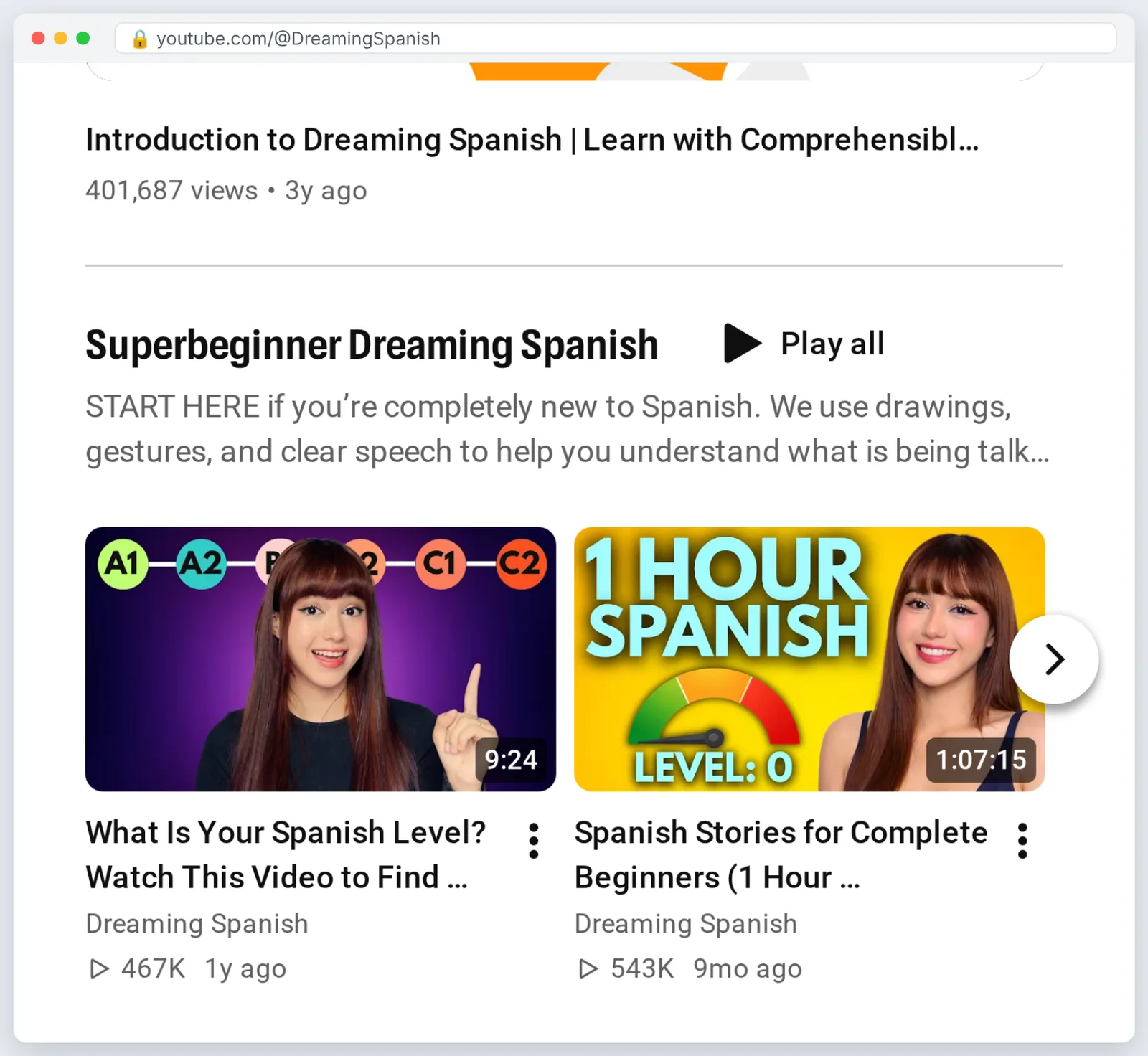
Three free options meet those criteria with published lesson lists you can inspect before you commit: Language Transfer’s audio Spanish course, the public-domain Foreign Service Institute Spanish materials (text plus recordings), and the Dreaming Spanish beginner roadmap if you prefer an input-led route. Audio-first courses suit commuters and people who learn by ear; open courseware and free textbook PDFs suit anyone who wants conjugation tables laid out plainly. Gamified apps keep you showing up but rarely push you to speak in full sentences. A longer rundown of free and paid Spanish resources for English speakers can help you shortlist, but shortlist only once.
Then close the other tabs. Finish the current unit before you even consider switching, and if a lesson bores you, do it anyway and move on — boredom is not evidence that a course is wrong. Ninety days is long enough to see real gains and short enough to stay interesting.
Step 3 — Add daily free listening input and pronunciation practice
What you need: headphones, a free beginner video or podcast series, and a quiet spot where you can speak out loud.
Audaz Revista reports that the free Dreaming Spanish comprehensible-input roadmap places its level 5 at 600 hours of input and level 7 at 1,500 hours. Those milestones are long-haul markers, not entry requirements; your first hundred hours of listening still change how Spanish sounds to you.
Pick material you follow without mentally translating. If you are pausing every ten seconds, drop a level. Switch subtitles to Spanish rather than English, or turn them off entirely for the second watch — and if you want Spanish captions on clips you already enjoy, this walkthrough for translating video into Spanish covers the workflow.
Spend a few minutes a day on sound. Spanish has five clean vowels that never slide into the English "uh"; keep a, e, i, o, u short and pure. Shadow single sentences: play, pause, repeat aloud at the same speed and rhythm, three times. If you want a phrase list read back to you, AI Studios offers text-to-speech in 30+ languages on its Free plan — a supplement to recordings of real speakers, never a stand-in for one.
Step 4 — Get free speaking practice and correction from real people
What you need: a 30-minute block, a partner, and three questions written in Spanish before you start.
Free correction exists, but you have to ask for it explicitly. Agree the rule at the top of the call: your partner notes three errors, says nothing mid-sentence, and reads the corrections back at the end. Write those three corrections in your notebook and use them in the next session.
Language exchanges work on a trade. Split the time evenly — half in Spanish, half in English — and set a timer so the English half does not swallow the hour. Prepared questions keep silence from killing the session: ask about their city, their job, their weekend.
Offline options cost nothing either: library conversation tables, university Spanish clubs open to the public, community center groups, church gatherings, and coworkers who grew up speaking Spanish and are happy to chat for ten minutes at lunch.
Learn your repair phrases before your first session. ¿Puedes repetir, más despacio? buys you another chance, and knowing how to say you don’t speak much Spanish yet keeps a conversation going instead of ending it.
Check your work: free ways to confirm you reached basic Spanish
Streak counters measure attendance, not ability. The full-time classroom budget cited in Step 1 is a useful reality check when month two feels slow: trained diplomats get months of supervised instruction, so evenings and commutes will take longer. Run these free tests instead of guessing.
- Monthly self-recording. Speak for two minutes, unscripted, about your week. Listen back next month and count what has changed.
- Unseen listening test. Watch a beginner video you have never seen and summarize it in English. Missing the gist means stay at this level.
- CEFR can-do statements. Read the A1 and A2 descriptors aloud and mark each honestly: can do, can do with effort, cannot do yet.
- Partner verdict. Ask a Spanish speaker whether they understood you without switching to English.
Free Spanish checklist
- ☐ Target level written down with a date
- ☐ Study slots in the calendar, not in your head
- ☐ One core course chosen, 90-day end date set
- ☐ Daily listening source bookmarked
- ☐ Weekly conversation slot booked with a real person
- ☐ Session log with minutes and topics
- ☐ Monthly self-recording saved for comparison
The failure that ends most free plans
App-hopping. You try one course, hit the subjunctive or a dull unit, find a shinier free option, and restart at hola for the fourth time. Guard against it with a written 90-day end date on your core course, a minutes log you can see, and one scheduled conversation each week — the appointment with another person is the hardest thing to quietly drop.
Frequently asked questions
Can you really learn Spanish for free, or do you eventually have to pay?
You can reach A1–A2 on free material alone: free courses, free listening and free conversation exchange cover everything a beginner needs. People usually start paying later for one thing only — scheduled tutoring that forces regular speaking when a trade partner cancels too often.
How many hours of listening does it take to understand Spanish comfortably?
Comfortable listening is a long-haul target: see the Dreaming Spanish roadmap milestones cited in Step 3, which stretch well beyond a beginner’s first year. Basic comprehension of slow beginner material arrives far earlier, within your first weeks of daily practice.
Is a free app on its own enough to reach A2?
Rarely. Apps drill vocabulary and recognition well, but A2 requires producing sentences under time pressure with a real person. Pair your app with daily listening and one weekly conversation, as laid out in Steps 3 and 4, and the app becomes useful rather than sufficient.
Where can I find free speaking partners without a subscription?
Language-exchange communities where you trade English for Spanish, library conversation tables, university Spanish clubs open to the public, community centers, and Spanish-speaking coworkers or neighbors. Offer something concrete in return — English practice, a resume read-through — and partners stay consistent for months.
How do I know whether I have actually reached basic Spanish?
Use the checks in the verification section: a monthly two-minute self-recording, an unseen beginner video you summarize in English, the CEFR A1 and A2 can-do statements marked honestly, and a native speaker confirming they understood you without switching to English.
Sources
AI tools helped write this guide. The English to Spanish Editorial Team published it after checking every figure against the sources linked above.