Most english to dominican spanish errors come from a short list: vaina, qué lo que, ahorita, un chin, guagua, concho, colmado, dique, tíguere. Their textbook senses miss what Dominicans actually mean in writing and speech.
Quick Steps for Your First Dominican Draft
Pull the English apart before you translate a word of it. The traps cluster in ordinary daily-life vocabulary, not in complex sentences.
- Flag every term tied to daily life — transport, stores, food, money, time, trash, greetings — since that is where Dominican usage splits from textbook Spanish.
- Look each flagged term up in the Diccionario del español dominicano (DED) first, then in the ASALE Diccionario de americanismos to see how far the word travels beyond the island.
- Search the phrase on Dominican news sites and ministry pages to confirm it appears in writing, not only in conversation.
- Split your file in two: guest-facing text stays readable for any Spanish speaker, staff-facing text can carry local register.
- Send the draft to a Dominican reviewer with a specific question attached to each flagged line, never a vague "does this sound right?"
Steps 1 through 3 you can finish alone in an afternoon. Step 5 is the one that catches the words a dictionary marks as neutral but a Dominican reader hears as sarcasm, insult, or street slang.
Why "Spanish" Isn’t Enough for a Dominican Reader
Dominican Spanish carries a lexicon large enough to fill its own reference work. A review published in Cuaderno de Pedagogía Universitaria (PUCMM) reports that the 2024 edition of the Diccionario del español dominicano documents 11,061 entries, 19,831 senses, 4,123 idioms and proverbial phrases, and 10,173 sourced usage examples.
The sources of that vocabulary are mixed. Taíno survivals, West African roots, contact with Haitian Creole along the border, and loans brought back by the New York and Boston diaspora all show up in everyday speech.
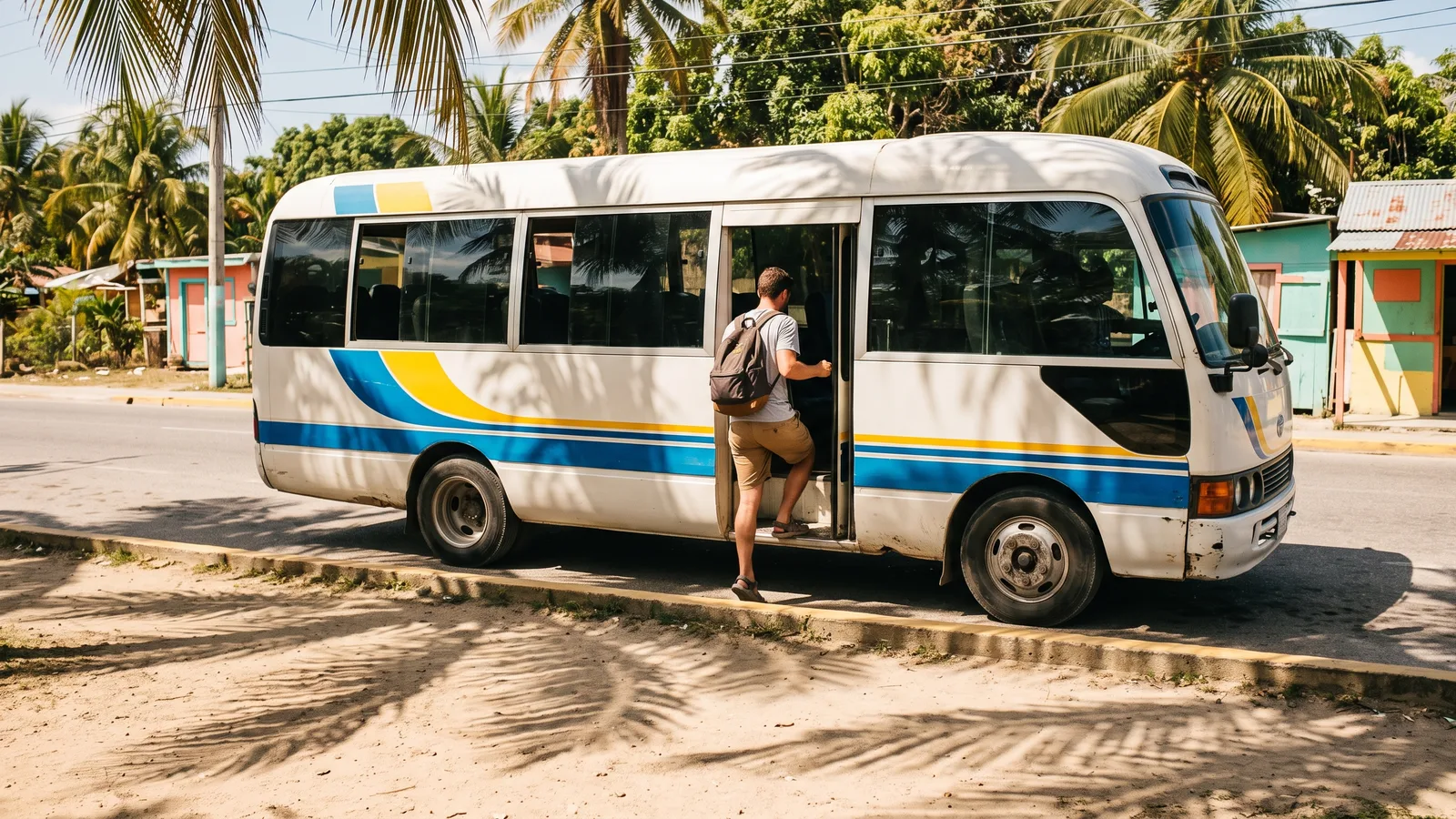
Some collisions are ordinary words. A cake is a bizcocho, not a pastel or a torta; a cent is a chele; a bus is a guagua, which means "baby" in Chile.
Address is its own decision. Dominicans use tú widely in service settings, with usted reserved for distance or deference, so a European-Spanish vosotros form in a guest guide reads as an import.
If your file is also shipping to Mexico, Colombia, and Argentina, read when a neutral es-419 file is the right call before you localize anything to one island.
The Scenario: A Punta Cana Guest Guide and Staff WhatsApp Messages
Example: a Punta Cana resort rewrites two things at once — the in-room guest guide (check-in, excursions, tipping, beach safety) and the WhatsApp broadcast messages sent to housekeeping, grounds, and kitchen staff. One audience is international. The other is Dominican.
The Presidency of the Dominican Republic reports that the country closed 2024 with a record 11,192,047 visitors, made up of 8,535,742 air arrivals and 2,656,305 cruise passengers from January to December.
That split decides your register. Guest text has to survive readers whose Spanish came from a classroom in Ohio, so local words appear only when the guest will hear them outside — guagua, colmado, concho — each glossed once in parentheses.
Staff text is the opposite. Housekeeping messages written in stiff pan-Hispanic Spanish read as corporate and get skimmed; the same instruction in Dominican register gets acted on.
Treat them as two files with two glossaries and one shared term list, not as one file with a dialect filter applied at the end.
Dominican Expressions That Trip Up English Speakers
The literal reading is almost never the working meaning. The table below is the short list worth memorizing before you touch a Dominican file.
| Expression | Literal reading | What it actually means | Where to use it |
|---|---|---|---|
| ¿Qué lo que? / klk | "What the what" | Hey, what’s up | Staff chat only |
| vaina | Pod, husk | Thing, stuff, situation; mildly crude | Never in guest text |
| un chin / un chinchín | — | A little bit, a touch | Informal speech |
| ahorita | "Little now" | In a while — not immediately | Never for deadlines |
| guagua | Baby (in Chile) | Bus or minibus | Guest text, glossed |
| concho | — | Shared route car taxi | Guest text, glossed |
| colmado | — | Corner store with credit and delivery | Guest text, glossed |
| dique | Dike, levee | Supposedly, allegedly | Never in official text |
| tíguere | Tiger | Street-smart guy; praise or insult | Avoid in writing |
| bultero | Bundle-maker | Show-off, bluffer | Avoid in writing |
| estar en olla | "To be in a pot" | To be broke | Casual speech only |
| dar un pon | — | Give someone a ride | Staff messages |
| zafacón | — | Trash can | Housekeeping instructions |
| ¡Ta’ to’! | "It’s all" | All set, deal | Staff chat only |
Two entries deserve extra caution. Ahorita promises nothing a scheduler can use, so write a clock time instead, and vaina can be affectionate between coworkers and offensive in print.
Politeness formulas shift too, and "excuse me" is where English speakers most often pick the wrong word — see which excuse-me form to use when you squeeze past someone.
Sound Before Spelling: Dropped -s, Swallowed -r, Failed Transcripts
Written Dominican Spanish and spoken Dominican Spanish are not the same object. Your listening fails because the sounds you were trained to expect are gone.
Four patterns cover most of it:
- Final -s weakens or disappears. Las dos lands as "lah do’", so plurals vanish from the audio signal.
- -ado collapses to -ao. Pescado becomes pescao, cansado becomes cansao.
- Cibao vowel shift. In the inland north around Santiago, syllable-final -r and -l turn into -i: porque sounds like poique, verdad like veidá.
- Final -d drops. Usted lands as usté.
Automatic transcripts inherit every one of those gaps. Speech-to-text tools trained on broadcast Spanish will hand you missing plurals and invented words, and your QA reviewer will flag correct Dominican speech as a typo.
Build a phonetic column into your glossary that spells what staff will actually hear. When the gap is too wide to bridge live, the phrase that gracefully ends a conversation you can’t follow is more useful than nodding along.
Before and After: A Generic-Spanish Draft Rewritten Line by Line
Five guest-guide and staff lines are below. Four change; one stays exactly as written, on purpose.
| Line | Generic Spanish draft | Dominican rewrite | Change type |
|---|---|---|---|
| Shuttle | Tome el autobús de enlace en la entrada principal. | La guagua del hotel sale por la puerta principal. | Vocabulary |
| Local taxi | Puede solicitar un taxi compartido. | Puede tomar un concho (carro de ruta compartido). | Vocabulary + gloss |
| Nearby shop | Hay un supermercado pequeño a dos calles. | Hay un colmado (tienda de barrio) a dos calles. | Vocabulary + gloss |
| Staff message | Por favor, confirme la recepción de este mensaje. | Confírmame que lo viste, por favor. | Register |
| Emergency | Llame de inmediato a la línea nacional de emergencias. | Llame de inmediato a la línea nacional de emergencias. | Unchanged |
Three of the four rewrites are vocabulary swaps, one is a register shift from usted plus formal imperative to tú, and the emergency line is deliberately left in neutral Spanish.
Glossing matters because many readers are new to the country. Diario Libre reports that official 2024 figures show Dominican tourism grew 9% versus 2023, and 44% of arriving tourists were visiting the country for the first time.
The Verification Procedure You Can Repeat Every Time
Run the sources in this order, every time, and record the result for each term.
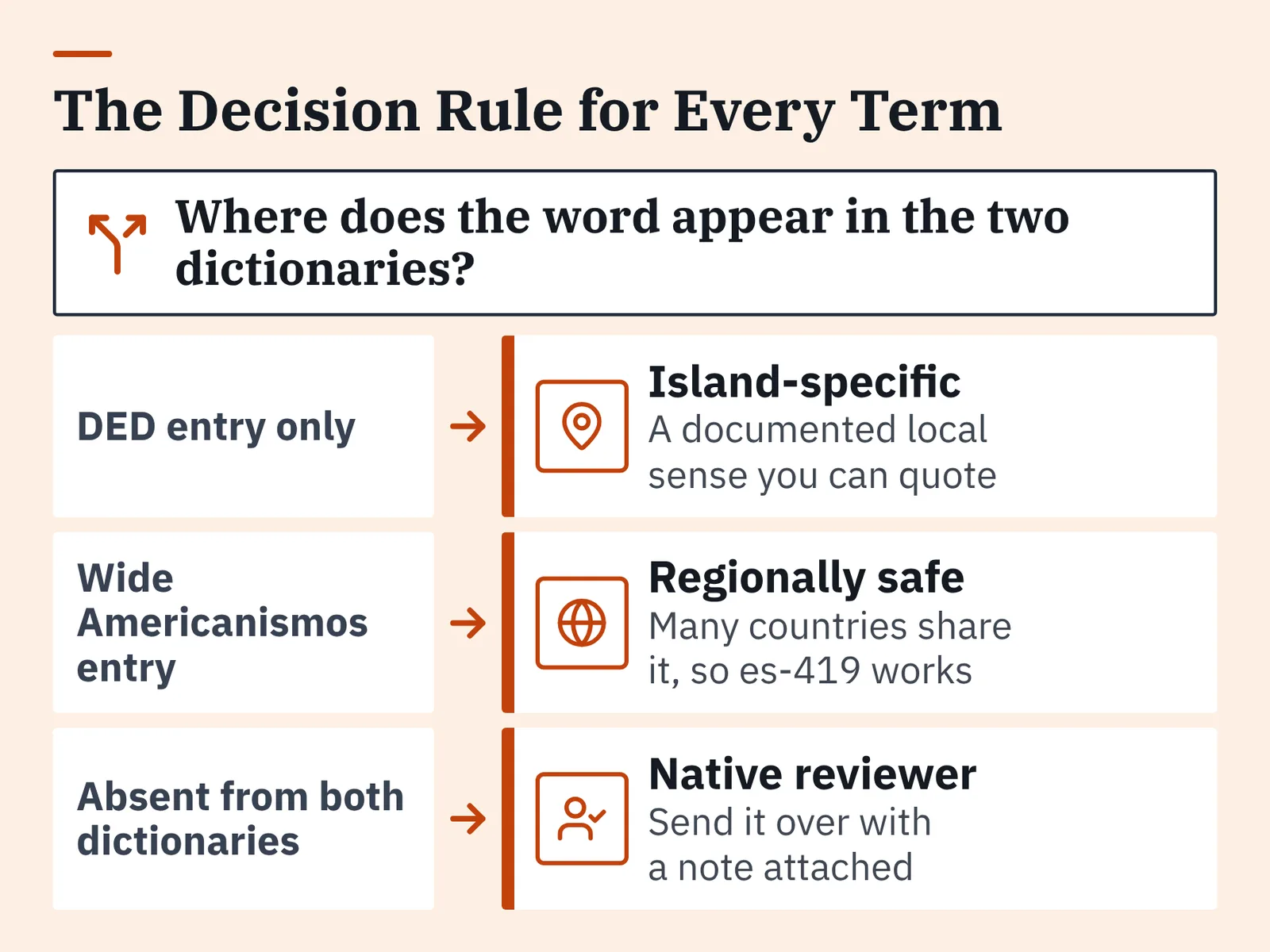
- Diccionario del español dominicano (DED). If the word has a Dominican entry, you have a documented local sense and a usage example to quote.
- Diccionario de americanismos (ASALE). This tells you how many countries share the word, which decides whether the term is safe in a regional es-419 file.
- Corpus check. Search Dominican newspapers, ministry pages, and public institutional PDFs to see whether the word is written or only spoken.
- Native reviewer. A Dominican reader rules on tone, offense risk, and anything the first three steps left ambiguous.
The decision rule is simple: DED-only means island-specific, a wide Americanismos entry means regionally safe, and a word absent from both goes to the reviewer with a note.
A review in Cuaderno de Pedagogía Universitaria (PUCMM) notes that the second edition of the Diccionario del español dominicano was published on 18 September 2024, eleven years after the first edition. Diario Libre reports that this second edition added 700 new words plus thousands of new senses compared with the 2013 first edition.
General bilingual tools sit outside this chain; see how the major bilingual lookup tools handle regional vocabulary before trusting one for a dialect call.
When Not to Localize: Legal, Medical, and Pan-Hispanic Content
Some text should stay neutral no matter how Dominican your audience is.
- Contracts, waivers, and terms governed by Dominican Republic law. Keep standard legal Spanish and have a licensed Dominican attorney review the wording; employment and consumer rules differ from US state law and from Spain’s.
- Medical and safety instructions. Dosage, allergy, and evacuation text needs unambiguous terms — un chin de is not a measurement, and a swallowed plural can flip a count.
- Content reused across markets. Anything shipping to Mexico, Spain, and Argentina from the same source file should stay in neutral Spanish, with a local glossary layered on top.
Staff-facing policy documents sit in the middle, and the audience is large: the Dominican Ministry of Tourism states that tourism accounts for 8.81% of national GDP and employs 7% of the population.
Write those documents in plain neutral Spanish, then add a Dominican one-page summary for the shift briefing. This is general information, not legal or medical advice.
Build and Maintain Your Own Dominican Glossary
One spreadsheet, seven columns, owned by one person. That is the whole system.
| Column | What goes in it |
|---|---|
| Term | The Dominican word or phrase |
| Register | Guest text, staff text, or do-not-use |
| DED | Entry found, yes or no |
| Americanismos | Countries listed |
| Approved rendering | The exact string your files use |
| Heard-as | What it sounds like in speech |
| Reviewed | Reviewer name and date |
Tie your review cycle to the dictionary itself. Acento reports that the Diccionario del español dominicano is maintained with quarterly online updates, the most recent being DED.2.2026.3 covering changes approved in July–September 2026.
Re-read your staff vocabulary twice a year, because chat slang moves faster than any dictionary. Keep the do-not-use rows forever, since the real value of the sheet is remembering why you rejected vaina in a guest guide eighteen months ago.
Frequently asked questions
Which Dominican words most often cause mistranslations?
The repeat offenders are vaina, ahorita, un chin, guagua, concho, colmado, dique, tíguere, bultero, and zafacón. Each has a textbook sense that differs from daily Dominican use, and three of them — vaina, dique, tíguere — carry tone risk that makes them unsafe in guest-facing text.
Is the Diccionario del español dominicano worth using as a primary source?
Yes, as your first lookup. A review in Cuaderno de Pedagogía Universitaria (PUCMM) reports that the 2024 edition documents 11,061 entries, 19,831 senses, 4,123 idioms and proverbial phrases, and 10,173 sourced usage examples, which is far more Dominican detail than a general Spanish dictionary carries.
Should a hotel guest guide be written in Dominican Spanish?
Mostly no. Keep guest text in readable neutral Spanish and introduce local terms only when guests will encounter them outside the property, glossing each once — guagua (autobús), concho, colmado — because Diario Libre reports that 44% of arriving tourists in 2024 were first-time visitors.
Why do my Spanish transcripts of Dominican speech come out wrong?
Dominican speech weakens or drops final -s, reduces -ado to -ao, drops final -d, and in the Cibao region turns syllable-final -r and -l into -i. Transcription tools trained on broadcast Spanish lose plurals and invent words, so audio needs a human pass.
How often should I update a Dominican glossary?
Quarterly for dictionary-driven terms and twice yearly for staff chat slang. Acento reports that the Diccionario del español dominicano is maintained with quarterly online updates, the most recent being DED.2.2026.3 covering changes approved in July–September 2026, so a quarterly rhythm matches the source.
Sources
- Reseña de la segunda edición del Diccionario del español dominicano — Cuaderno de Pedagogía Universitaria (PUCMM)
- Reseña de la segunda edición del Diccionario del español dominicano (Dialnet PDF)
- El Diccionario del Español Dominicano — Diario Libre
- El ‘Diccionario del español dominicano’ se actualiza — Acento
- RD cierra 2024 con récord histórico de más de 11 millones de turistas — Presidencia de la República Dominicana
- Turismo dominicano creció un 9 % en 2024; la mayoría viene de EE.UU. — Diario Libre
- Hacia un plan de Desarrollo Turístico Sostenible — Ministerio de Turismo de República Dominicana
AI tools helped write this guide. The English to Spanish Editorial Team published it after checking every figure against the sources linked above.