Here is how to say i don’t speak spanish in spanish: "No hablo español." To stay polite, add "Hablo un poco" and a request — "¿Habla inglés?" or "¿Puede hablar más despacio, por favor?"

Quick steps
Five lines cover the vast majority of moments where your Spanish runs out — a pharmacy counter, a phone call, a hotel lobby, a neighbor at the door.
- Say "No hablo español" (noh AH-bloh ess-pah-NYOHL) — I don’t speak Spanish.
- Soften it with "Hablo un poco de español" — I speak a little Spanish.
- Ask "¿Habla inglés?" — Do you speak English?
- Slow things down: "¿Puede hablar más despacio, por favor?"
- Buy a second chance: "¿Me lo puede repetir?" — Can you repeat that?
The sequence matters more than your accent. You name your limit, you offer what you do have, and you give the other person one specific thing to do. That last part is what turns a dead end into a conversation that keeps moving.
Practice them out loud, not in your head. Thirty seconds of saying each phrase three times is enough to make it come out automatically when your pulse is up. Keep the whole script under fifteen words per sentence so you can deliver it without stalling halfway.
Why "No hablo español" alone isn’t enough
"No hablo español" is correct, grammatical and complete. It is also a door closing. Said flat, with no follow-up, it tells the other person the exchange is over and leaves them guessing what to do next.
The practical problem is that it is often untrue in the useful sense. You probably understand numbers, prices, days of the week and a handful of nouns. Declaring zero Spanish throws away the small amount you can actually use.
There is also a question of who is doing the accommodating. Limited-English-proficient individuals make up 41 percent of all Spanish speakers in the United States, according to the Migration Policy Institute, so the person in front of you may have no English to switch into. Assuming they will adjust is a bad bet.
A better move is a three-part sentence: limit, offer, request. "No hablo mucho español, pero entiendo un poco. ¿Puede hablar despacio?" You have said what you can’t do, what you can do, and exactly how they can help you.
That structure also changes the tone. People respond to effort, and a phrase that admits a limit while still trying reads as respectful rather than dismissive.
Step 1 — Learn the core sentence: "No hablo español" and how to pronounce it
Time: 3 minutes. What you need: your voice and a mirror or phone recorder.
The sentence has four pieces and no hidden traps. "No" is the negative, "hablo" means I speak, and "español" is the language. Spanish drops the subject pronoun, so there is no word for "I" — saying "Yo no hablo español" is correct but adds emphasis you usually don’t want.
| Spanish | Rough pronunciation | What it means |
|---|---|---|
| No hablo español. | noh AH-bloh ess-pah-NYOHL | I don’t speak Spanish. |
| No hablo mucho español. | noh AH-bloh MOO-choh ess-pah-NYOHL | I don’t speak much Spanish. |
| No entiendo. | noh en-TYEN-doh | I don’t understand. |
| Perdón, no le entiendo bien. | pehr-DOHN, noh leh en-TYEN-doh byen | Sorry, I don’t understand you well. |
The h in "hablo" is silent. The ñ in "español" is the ny sound in canyon. Stress lands on the last syllable: espa-NYOL.
Record yourself once and play it back. If "hablo" came out with an English h, say it again as "AH-bloh" until the breath disappears. Thirty seconds of this fixes the single most recognizable giveaway in the sentence.
Keep "No entiendo" separate in your mind. It means you missed that particular sentence, not that you have no Spanish at all, and it is the phrase you will reach for most often once a conversation starts.
Step 2 — Soften it: "Hablo un poco de español" and "Todavía estoy aprendiendo"
Time: 2 minutes. What you need: the four softeners below, memorized in order.
Softening is not politeness theater. It tells the listener how much to simplify, which is information they genuinely need. "Un poco" signals short sentences and basic vocabulary; "nada" signals they should find another channel entirely.
- Hablo un poco de español. — I speak a little Spanish.
- Hablo poquito español. — I speak just a tiny bit. (warm, very common in Latin America)
- Todavía estoy aprendiendo. — I’m still learning.
- Entiendo más de lo que hablo. — I understand more than I speak.
That last one is the most useful line in this article for most learners. It gives the other person permission to keep speaking Spanish slowly instead of giving up on you.
Add "perdón" or "disculpe" at the front when you are interrupting someone or asking for extra patience. Census data cited by Skycom show 44,867,699 U.S. residents aged five and over speak Spanish at home, of whom 18,432,221 speak English less than "very well," which means these softeners get used far more often inside the United States than most English speakers expect.
If you are building toward longer conversations rather than survival phrases, a realistic hour-based plan for how long fluency actually takes will set your expectations better than any phrase list.
Step 3 — Ask for help in the same breath: "¿Habla inglés?", "¿Puede hablar más despacio?", "¿Me lo puede repetir?"
Time: 5 minutes. What you need: three questions and the habit of asking immediately.
Never end on the limit. End on the request, because a request is something the other person can act on in two seconds.
| Ask | Spanish | When to use it |
|---|---|---|
| Do you speak English? | ¿Habla inglés? | First contact, when stakes are high |
| Can you speak more slowly? | ¿Puede hablar más despacio, por favor? | They answered in Spanish, fast |
| Can you repeat that? | ¿Me lo puede repetir? | You caught half of it |
| Can you write it down? | ¿Me lo puede escribir? | Addresses, prices, names, times |
| Is there someone who speaks English? | ¿Hay alguien que hable inglés? | Clinics, banks, counters with staff |
Ask for English without apology, but don’t lead with it in every situation. In a Spanish-speaking country, opening with "¿Habla inglés?" before a single word of Spanish reads as entitled; after "Hablo un poco de español," it reads as practical.
"¿Me lo puede escribir?" is underrated. Written numbers and street names are far easier to decode than spoken ones, and you end the exchange with something you can show to the next person.
If the interruption itself is the awkward part, the difference between perdón, disculpe and con permiso is worth five minutes of your time before a trip.
Step 4 — Choose the right register: usted vs. tú, and regional variations
Time: 4 minutes. What you need: one rule and three verb forms.
The rule for travelers and new learners: use usted with everyone you don’t know. Clerks, drivers, doctors, officials, anyone older, anyone in a uniform. You will never offend someone by being slightly too formal, and the reverse is not true.
| Formal (usted) | Informal (tú) | English |
|---|---|---|
| ¿Habla inglés? | ¿Hablas inglés? | Do you speak English? |
| ¿Puede repetir? | ¿Puedes repetir? | Can you repeat? |
| ¿Me entiende? | ¿Me entiendes? | Do you understand me? |
Regional habits vary, and they matter. In Colombia and much of Central America, usted is used even among friends. In Spain, tú arrives quickly and vosotros replaces ustedes for plural you. In Argentina and Uruguay you will hear vos — "¿Hablás inglés?" — and you do not need to produce it, only recognize it.
The Hispanic/Latino population now makes up nearly 19% of the United States population, according to the Journal of the National Hispanic Medical Association, and that population spans every one of those regional norms, so the usted default serves you well at home too.
For writing rather than speaking, the choice of variety is a separate decision — how to pick neutral Latin American Spanish for a document or site covers the trade-offs.
Step 5 — Have a backup: translation apps, written notes, and pointing to the phrase
Time: 10 minutes of setup at home. What you need: a phone, an offline language pack, and an index card.
Spoken phrases fail in loud rooms, on bad phone lines, and when someone answers with a sentence you cannot parse. Plan for that before it happens.
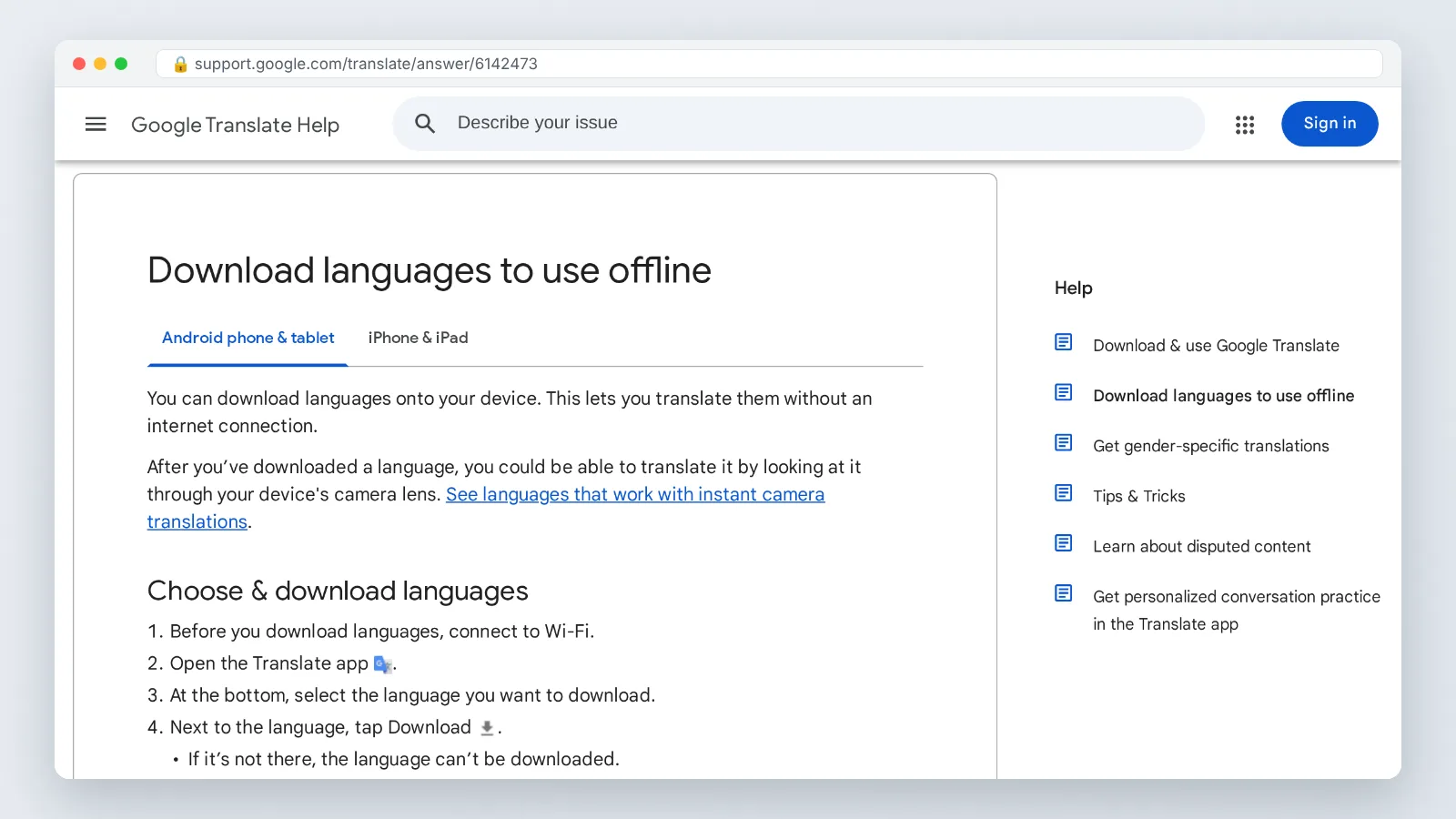
- Download the offline Spanish pack in your translation app while you’re on Wi-Fi. Conversation mode is useless on a dead signal.
- Write a card. Four lines in Spanish: who you are, what you need, your limit, your phone number. Hand it over; no pronunciation required.
- Screenshot your key phrases so you can show them without hunting through an app.
- Type, don’t speak, when it’s noisy. Voice input in a busy pharmacy produces nonsense.
- Ask if an interpreter is available at clinics and government offices: "¿Hay servicio de intérprete?"
Treat the app as a bridge, not a crutch. Read the Spanish it produces out loud when you can — that is free pronunciation practice attached to a sentence you actually needed.
Access Multilingual reports that Spanish speakers account for 17,218,782 of U.S. residents with limited English proficiency, or 63 percent of that group, which is why written backup is standard practice at hospitals, schools and utility offices across the country.
To move past survival mode, a sorted list of apps, podcasts and courses that are actually worth your hours beats downloading five apps and finishing none.
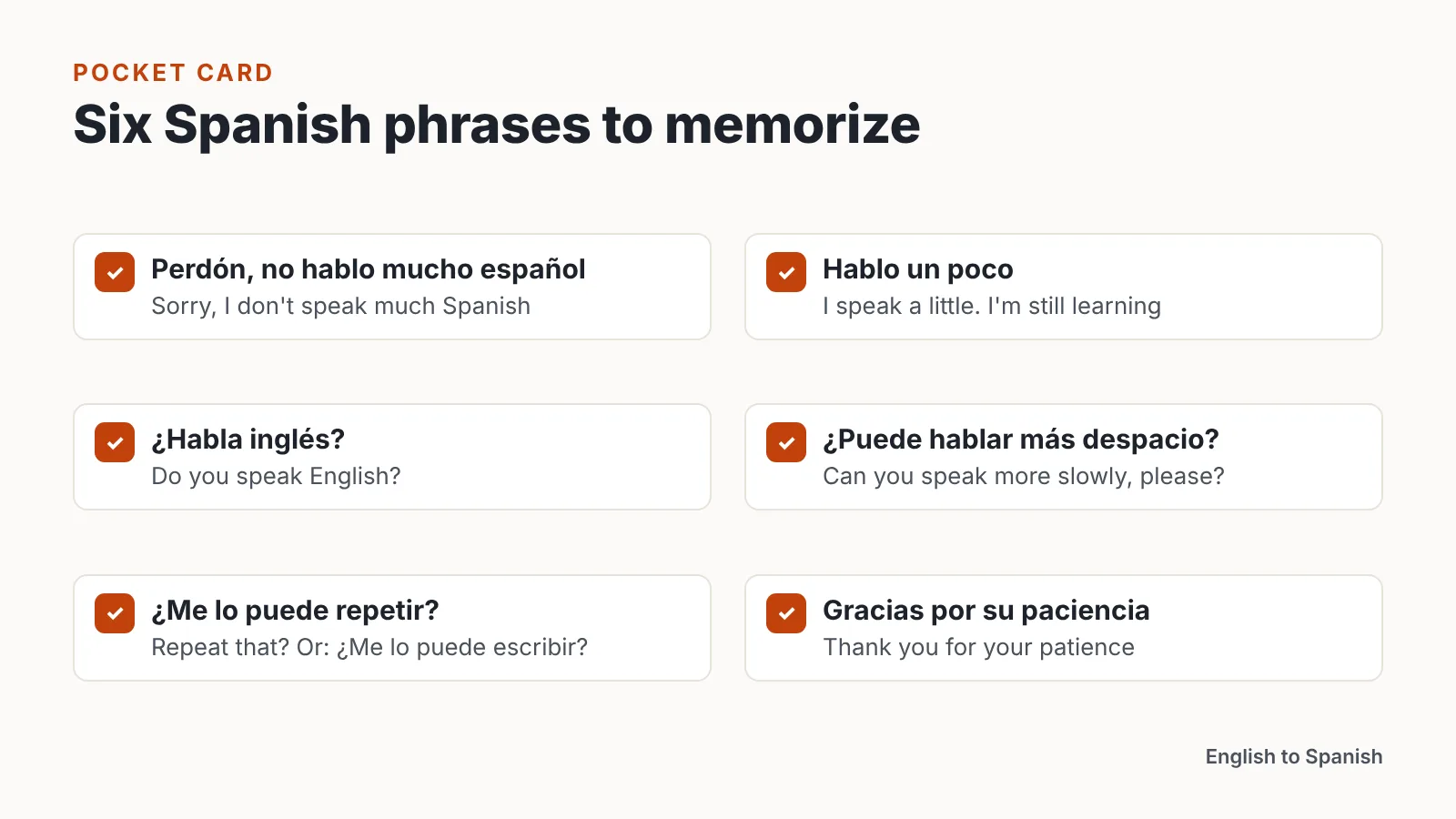
Your pocket checklist: the phrases to memorize before you go
Six lines. Learn them in this order and you can handle a counter, a phone call or a stranger’s question without freezing.
- ☐ Perdón, no hablo mucho español. — Sorry, I don’t speak much Spanish.
- ☐ Hablo un poco. Todavía estoy aprendiendo. — I speak a little. I’m still learning.
- ☐ ¿Habla inglés? — Do you speak English?
- ☐ ¿Puede hablar más despacio, por favor? — Can you speak more slowly, please?
- ☐ ¿Me lo puede repetir? / ¿Me lo puede escribir? — Repeat that? / Write it down?
- ☐ Gracias por su paciencia. — Thank you for your patience.
Say the whole set out loud three times the night before you need it. Then say it once in the car, the elevator, or the hallway right before the conversation — recall decays fast, and a warm-up thirty seconds ahead is worth more than an hour last week.
About 61 percent of immigrants in the United States with limited English proficiency — roughly 12.8 million people — speak Spanish, according to the Migration Policy Institute, so these six lines have a very wide range of use without any travel at all.
Closing well matters as much as opening well, and there are better options than one stock word — the full range of ways to answer gracias will keep the last ten seconds of the exchange as warm as the first.
Common mistakes English speakers make (and how to fix them)
The failure that costs people most: saying "No hablo español" and then going silent. The other person reads silence as the end of the conversation, switches to gestures or walks away, and whatever you needed goes unresolved. Fix it by never letting the phrase be your last sentence — attach a question every single time.
Other repeat offenders, and the correction for each:
- Pronouncing the h in "hablo." It’s silent: AH-bloh.
- Saying "Español" when you mean the language in Spain only. "Castellano" is used in parts of Spain and the Southern Cone; español is understood everywhere.
- Using "No sé" for "I don’t understand." "No sé" means I don’t know the answer. Use "No entiendo."
- Defaulting to tú with strangers. Usted is the safe register with clerks, officials and anyone older.
- Apologizing four times. One "perdón" is polite; repeated apologies slow the exchange and make the other person manage your discomfort.
- Speaking louder instead of slower. Volume doesn’t help; short sentences and written numbers do.
Spanish speakers are the largest non-English language group in the United States, at nearly 42 million people, according to the Journal of the National Hispanic Medical Association — which means the next chance to practice these fixes is usually closer than you think.
Frequently asked questions
Is it rude to say "No hablo español"?
The phrase itself is neutral and perfectly correct. It becomes rude only when it’s delivered flatly and followed by silence, because that leaves the other person with nowhere to go. Add "perdón" in front and a question behind it — "¿Habla inglés?" or "¿Puede hablar más despacio?" — and it reads as cooperative rather than dismissive.
How do I say "I only speak a little Spanish"?
Say "Hablo un poco de español" (AH-bloh oon POH-koh deh ess-pah-NYOHL) or the warmer "Hablo poquito español," which is very common across Latin America. If you understand more than you can produce, "Entiendo más de lo que hablo" tells the other person to keep speaking Spanish slowly instead of giving up on the conversation entirely.
What’s the difference between "No hablo español" and "No entiendo"?
"No hablo español" describes your overall ability — you don’t speak the language. "No entiendo" means you missed that specific sentence just now. In a real conversation you will use "No entiendo" far more often, because most breakdowns are about one fast sentence, not about your whole skill level.
Should I use usted or tú when asking for help?
Use usted with strangers, clerks, officials, medical staff and anyone older than you: "¿Habla inglés?" and "¿Puede repetir?" The informal versions are "¿Hablas inglés?" and "¿Puedes repetir?" Being slightly too formal never offends anyone; being too casual with a stranger sometimes does, and the usted forms work in every Spanish-speaking country.
How common is it to need these phrases in the United States?
Very common. Spanish speakers are the largest non-English language group in the United States, at nearly 42 million people, according to the Journal of the National Hispanic Medical Association, and the Migration Policy Institute reports that limited-English-proficient individuals make up 41 percent of all Spanish speakers in the country.
Sources
- Language Diversity and English Proficiency in the United States — Migration Policy Institute
- Estimating the Impact of Limited English Language Proficiency on Mental Health Services for Spanish Speakers in the United States — Journal of the National Hispanic Medical Association
- Language access statistics in the United States: a reference for 2026 — Access Multilingual
- Spanish-Speaking Customer Service Demand in the U.S.: The Data Behind the Support Gap — Skycom
AI tools helped write this guide. The English to Spanish Editorial Team published it after checking every figure against the sources linked above.