Going from English to Colombian Spanish means defaulting to usted, swapping coche for carro and ordenador for computador, softening requests with me regala, and trading duda for inquietud — tone and word choice, not accent.
Quick Steps: Your First Pass at Colombian Spanish
Colombian copy usually fails in small places. A tú where the reader expected usted, a coche where every driver in Bogotá says carro, a vale borrowed straight from Madrid. Those one-word slips are what make a translated page read as foreign.
- Set
ustedas the default pronoun for business, support, billing and legal text. - Translate into neutral Latin American Spanish first, then run a separate Colombian editing pass.
- Swap the highest-frequency offenders: coche→carro, ordenador→computador, móvil→celular, pajita→pitillo, vale→listo.
- Replace
dudawithinquietudand close service messages withcon gusto. - Have a Colombian speaker read the final text aloud before it ships.
Each step costs minutes. Skipping the fourth one is what gets flagged in user interviews, because duda reads as slightly clinical to a Bogotá reader while inquietud is what support agents actually write. Treat the list above as the minimum, then use the sections below when the text is longer than an email.
Why "Colombian Spanish" Is a Localization Decision, Not Just an Accent
Accent lives in audio. Everything a reader sees on a screen — pronouns, verb endings, nouns, politeness formulas, currency and date formats — is a set of written choices you control.
According to Google Cloud, the Cloud Translation language support documentation lists Latin American Spanish under the language code es-419, which is the broadest regional bucket most pipelines offer. That code covers Mexico City, Buenos Aires and Bogotá at once, and no single wording satisfies all three. Choosing es-CO means you accept narrower reach in exchange for copy that sounds local.
The practical consequences go past vocabulary. Colombian prices are written in pesos with a decimal comma ($1.500.000), dates run day-month-year, phone numbers carry the +57 country code, and the national ID field is labeled cédula, not número de identificación. Address formats follow the Calle 85 #11-20 pattern that many US-built forms reject.
If you are still deciding how wide to aim, the trade-offs in this breakdown of when es-419 is the right target are the place to start before you commit to a country code.
The Scenario: Taking a US SaaS Onboarding Email from English to Bogotá Users
Example: a US field-service SaaS called FieldPing sells to operations managers at mid-size logistics companies in Bogotá. The English onboarding email is 110 words, warm, first-name, with one CTA button labeled "Add your team."
The English source already carries problems. "Reach out," "you’re all set," and "awesome" have no clean Spanish equivalent and push machine translation toward stiff literalism. The CTA verb "add" will come back as añadir, correct everywhere and preferred almost nowhere in Colombia, where agregar is the everyday choice.
Run that email through a general engine and you get Spanish that a Bogotá operations manager understands completely and trusts slightly less. The giveaways are consistent: informal tú addressed to a stranger with budget authority, peninsular leftovers like vale and móvil, and a closing that translates "let us know" into something no Colombian support team writes.
The fix is not a better engine. It is a pronoun policy, a term list, and one reading pass by someone who answers emails in Bogotá.
Pronouns and Tone: When Usted Outranks Tú, and Where Vos and Sumercé Appear
Usted is the safe default across most of Colombia, and it is not cold the way usted can feel in Mexico. Colombians use it with coworkers, with parents, sometimes with partners.
Use this split when you write your style sheet:
- usted — Bogotá and the interior, all B2B copy, support, billing, legal, any first contact regardless of the reader’s age.
- tú — young consumer brands, and the Caribbean coast, where Barranquilla and Cartagena readers use it freely.
- vos — Medellín and Antioquia, Cali and Valle del Cauca, Nariño; warm and peer-level, risky in written marketing unless the audience is regional.
- sumercé — Boyacá, Cundinamarca and older Bogotá speakers; deferential and affectionate, charming in dialogue, wrong in a UI string.
A sociolinguistic study of voseo in Colombia’s Nariño department, published via Dialnet, based its gender analysis on a survey of 28 men and 20 women. Samples that size are a reminder that regional pronoun research is narrow and local — do not generalize one department’s habits to the whole country.
Register also shows up in greetings. Buenos días outperforms a bare Hola in professional email, and the handshake-level phrasing covered in this walkthrough of introductions in Spanish transfers directly to onboarding copy.
Vocabulary Swaps: Neutral es-419 Wording vs. Colombianismos Your Reader Actually Uses
Neutral Spanish is built to offend nobody, which is why it rarely sounds like anybody. Your swap list does not need to be long; it needs to cover the words that appear in product copy every week.
| English | Neutral es-419 | What your Colombian reader says |
|---|---|---|
| car | auto / coche | carro |
| computer | computadora / ordenador | computador |
| cell phone | móvil | celular |
| okay / got it | de acuerdo / vale | listo / de una |
| drinking straw | pajita / popote | pitillo |
| snacks | bocadillos | pasabocas (bocadillo = guava paste) |
| great / cool | genial | chévere / bacano |
| money | dinero | plata |
| question / concern | duda | inquietud |
| could you send me… | ¿puede enviarme…? | ¿me regala…? / hágame el favor |
The bocadillo row is the one that costs you. In Spain it is a sandwich, in neutral Spanish a snack, in Colombia a block of guava paste — so a food-delivery app offering bocadillos is advertising something else entirely.
Regalar deserves its own note. Colombians use me regala un tinto to order coffee without any sense of asking for a gift, and that softening verb makes form labels and support prompts sound native instantly.
The same trap-spotting discipline applies to other markets; the slip patterns in this guide to Dominican Spanish show how fast a neutral draft can land wrong.
Before and After: The Same Paragraph Rewritten for a Colombian Reader
Before (neutral machine output):
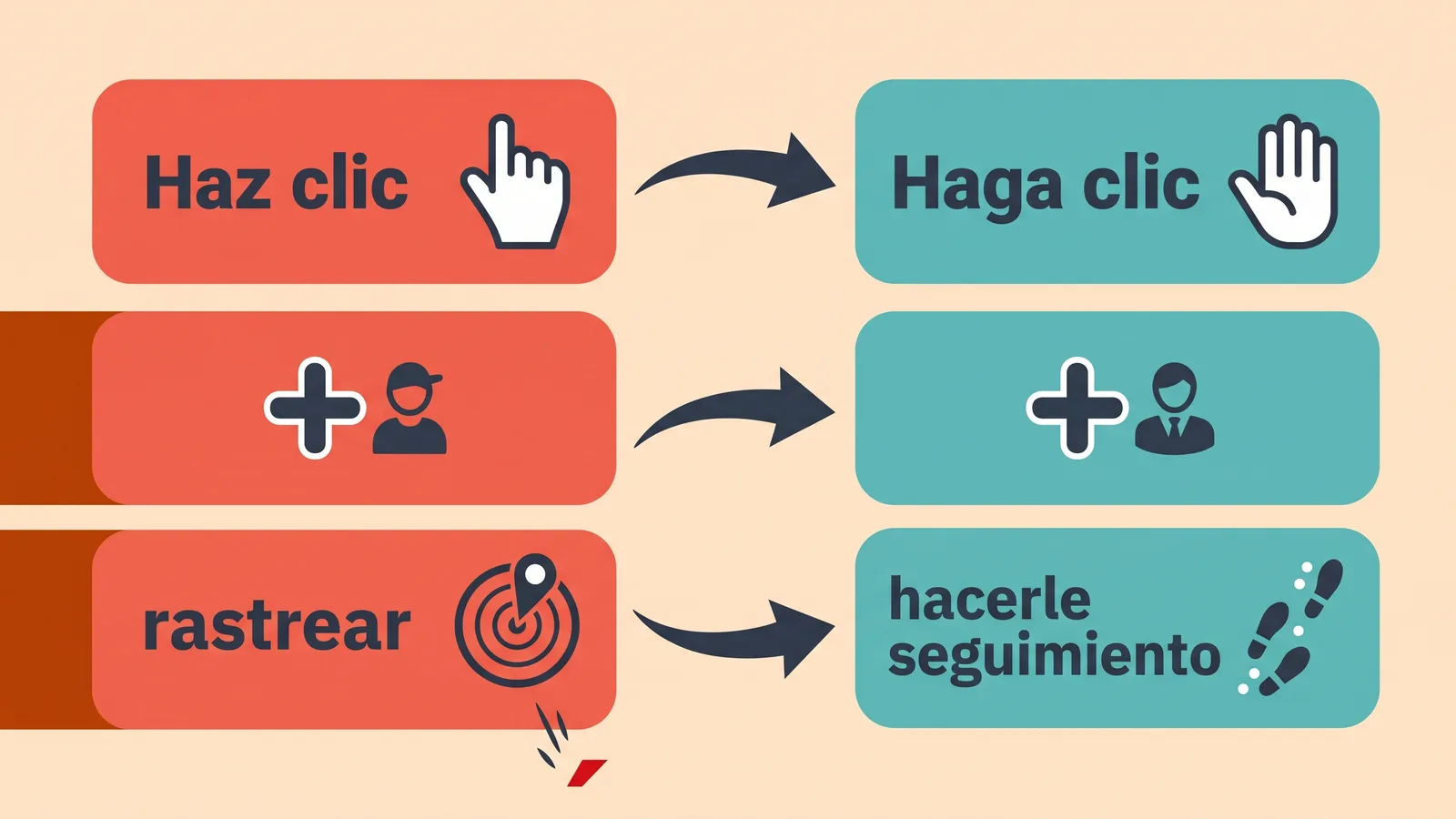
¡Hola, Juan! Gracias por registrarte en FieldPing. Tu prueba gratuita ya está activa. Haz clic en el botón de abajo para añadir a tu equipo y empezar a rastrear tus trabajos de campo. Si tienes alguna duda, escríbenos.
After (Bogotá B2B, usted):
Buenos días, Juan. Gracias por registrarse en FieldPing. Su prueba gratuita ya quedó activa. Haga clic en el botón de abajo para agregar a su equipo y empezar a hacerle seguimiento a sus visitas en campo. Cualquier inquietud, escríbanos: con gusto le ayudamos.
The before version carries seven tú-marked forms — registrarte, tu, haz, tu, tus, tienes, escríbenos. The after version carries zero, since escríbenos becomes escríbanos. That is the measurable difference a pronoun policy produces in a single paragraph.
The main edits are:
¡Hola!becomesBuenos díasfor a first business contact.registrartebecomesregistrarse.tu/tusbecomesu/sus.Haz clicbecomesHaga clic.añadirbecomesagregar.rastrearbecomeshacerle seguimiento, sincerastrearsuggests tracking a person or a parcel, andtrabajos de campobecomesvisitas en campo.dudabecomesinquietud, closed withcon gusto le ayudamos.
Nothing in the after version is slang. That is the point — localization for a professional audience means the right register, not the loudest colombianismos.
The Reproducible Procedure: A 7-Step English → Colombian Spanish Workflow
Run these seven steps in order. The sequence matters, because pre-editing the English before machine translation prevents errors you would otherwise fix twice.
- Define the segment. Bogotá enterprise buyers, Medellín consumer app users and Barranquilla retail shoppers need different pronouns; write down which one you are serving.
- Lock a one-page style sheet. Pronoun default, greeting formula, CTA verb list, currency and date format, and your three banned words.
- Pre-edit the English source. Remove idioms, phrasal verbs and hype words; "reach out" becomes "contact us," "awesome" becomes "done."
- Machine-translate into Latin American Spanish. Treat the output as a base draft, never as a deliverable.
- Run the colombianismo pass. Apply your term list with find-and-replace, then check each hit in context so
platadoes not replace a literal silver. - Read aloud with a Colombian speaker. Rhythm problems and over-formal clauses surface in speech that silent proofreading misses.
- Freeze the glossary. Save approved terms, log every change with a reason, and reuse the file on the next release instead of re-litigating
computador.
Steps 1 through 3 take an afternoon the first time and about twenty minutes afterward. Steps 5 and 6 are where the quality shows up, and neither can be automated away.
Tooling Reality Check: What es-419, es-CO, and Today’s MT Engines Can and Can’t Do
Machine translation is excellent at Spanish and blind to Colombia specifically. Plan your budget around that gap rather than hoping a newer model closes it.
According to DeepL’s support documentation, DeepL offers only European Spanish or Latin American Spanish as target languages, with the Latin American variant restricted to its next-generation model and no country-level Colombian option. Written translation therefore tops out at the regional bucket. Speech tooling went further: Microsoft announced at //Build 2021 that Azure neural text-to-speech added es-CO, Spanish (Colombia), as one of 10 newly released languages.
What that means in practice:
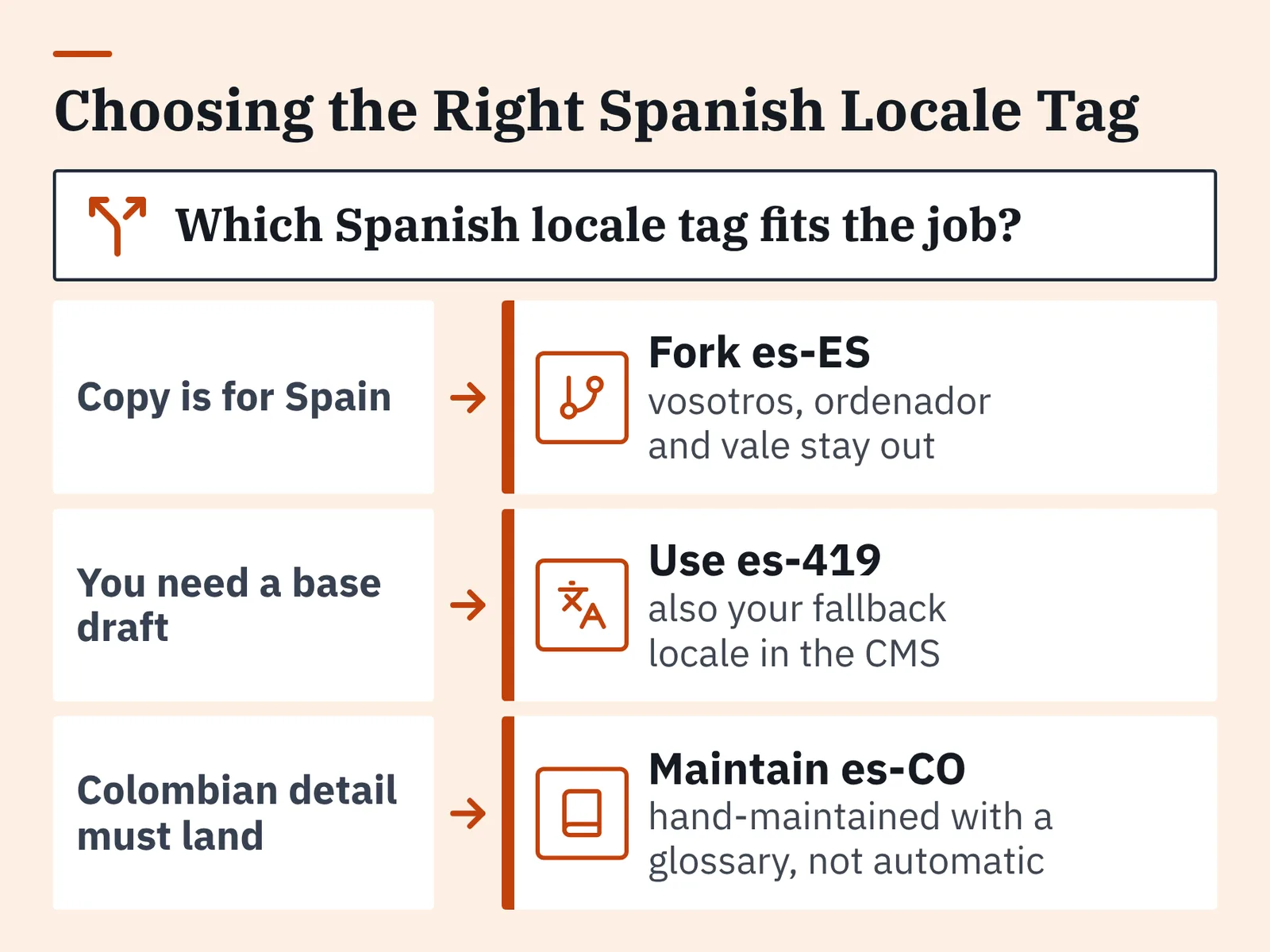
- es-ES — fork it separately; peninsular
vosotros,ordenadorandvalehave no place in Colombian copy. - es-419 — your base draft and your fallback locale in a content management system.
- es-CO — a locale tag you maintain by hand, with a glossary, not a setting an engine fills for you.
Dictionary tools help at the term level once you know what you are checking; the trade-offs in this comparison of Linguee against six other tools are useful when you need usage examples rather than a single gloss. For a parallel case where locale tags also run out before the dialect does, see the step-by-step Puerto Rican Spanish workflow.
QA Checklist: Validating Register, Regional Fit, and Terminology Before You Publish
Check these eight items before anything goes live. Each one is a search you can run in minutes.
- Search for
tú,tus,tiandcontigoin any usted-register file; the count should be zero. - Search for
vosotros,vale,ordenador,móvil,coche,zumo,pajita— all are peninsular tells. - Confirm every CTA verb matches the glossary:
agregar, notañadir;ingresar, notacceder. - Verify currency renders as pesos with a decimal comma, and dates as day-month-year.
- Check that ID and address fields accept
cédulavalues and theCalle 85 #11-20pattern. - Confirm phone fields accept +57 and ten-digit mobile numbers.
- Read the longest paragraph aloud; anything you stumble over gets shortened.
- Confirm no mixed voseo if you targeted Medellín or Cali.
That last item has a technical definition. Dialectology research published in Dialectologia distinguishes three forms of voseo, beginning with full voseo, in which the pronoun vos is paired with its matching verb forms. Mixing vos with tú conjugations in the same sentence is the error reviewers catch most often, so check pronoun and verb together rather than searching for vos alone.
Log every correction with a one-line reason. The log becomes your style sheet for the next release, and it ends the argument about computador permanently.
Frequently asked questions
Is Colombian Spanish the same as neutral Latin American Spanish?
No. Neutral Latin American Spanish is a regional compromise — Google Cloud’s language support documentation lists it under the code es-419 — while Colombian copy adds usted as the default pronoun, carro over auto, computador over computadora, celular over móvil, and inquietud over duda.
Should I use usted or tú when writing for a Colombian audience?
Default to usted for business, support, billing and legal text, and for any first contact regardless of the reader’s age. Reserve tú for young consumer brands and for Caribbean coast readers in Barranquilla and Cartagena, where it is the everyday form.
Do I need to handle vos in Colombian translations?
Only if you target Medellín, Cali or Nariño specifically. Dialectology research published in Dialectologia distinguishes three forms of voseo, beginning with full voseo, where vos takes its matching verb forms — mixing vos with tú conjugations is the most common written error.
Can DeepL or Google Translate produce Colombian Spanish directly?
Not at country level for text. DeepL’s support documentation states it offers only European Spanish or Latin American Spanish as targets, with the Latin American variant restricted to its next-generation model and no Colombian option, so the colombianismo pass stays a human editing step.
What is the fastest quality check before publishing Colombian Spanish copy?
Run four searches: tú-marked forms in usted files, peninsular tells like vale and ordenador, CTA verbs against your glossary, and currency or date formats. Then have a Colombian speaker read the longest paragraph aloud to catch rhythm problems.
Sources
- DeepL Translator languages – DeepL Support
- Language support | Cloud Translation | Google Cloud Documentation
- Azure Text-to-Speech updates at //Build 2021 – Microsoft Tech Community
- Caracterización del voseo en el departamento de Nariño (Dialnet)
- Dialectologia 24 (2020), 91-109 – Universitat de Barcelona
AI tools helped write this guide. The English to Spanish Editorial Team published it after checking every figure against the sources linked above.