In Spanish, kitchen is la cocina (feminine). The same word can also mean stove, and él cocina means "he cooks." Core items: el refrigerador, el horno, el fregadero, la sartén, la olla, los cubiertos.
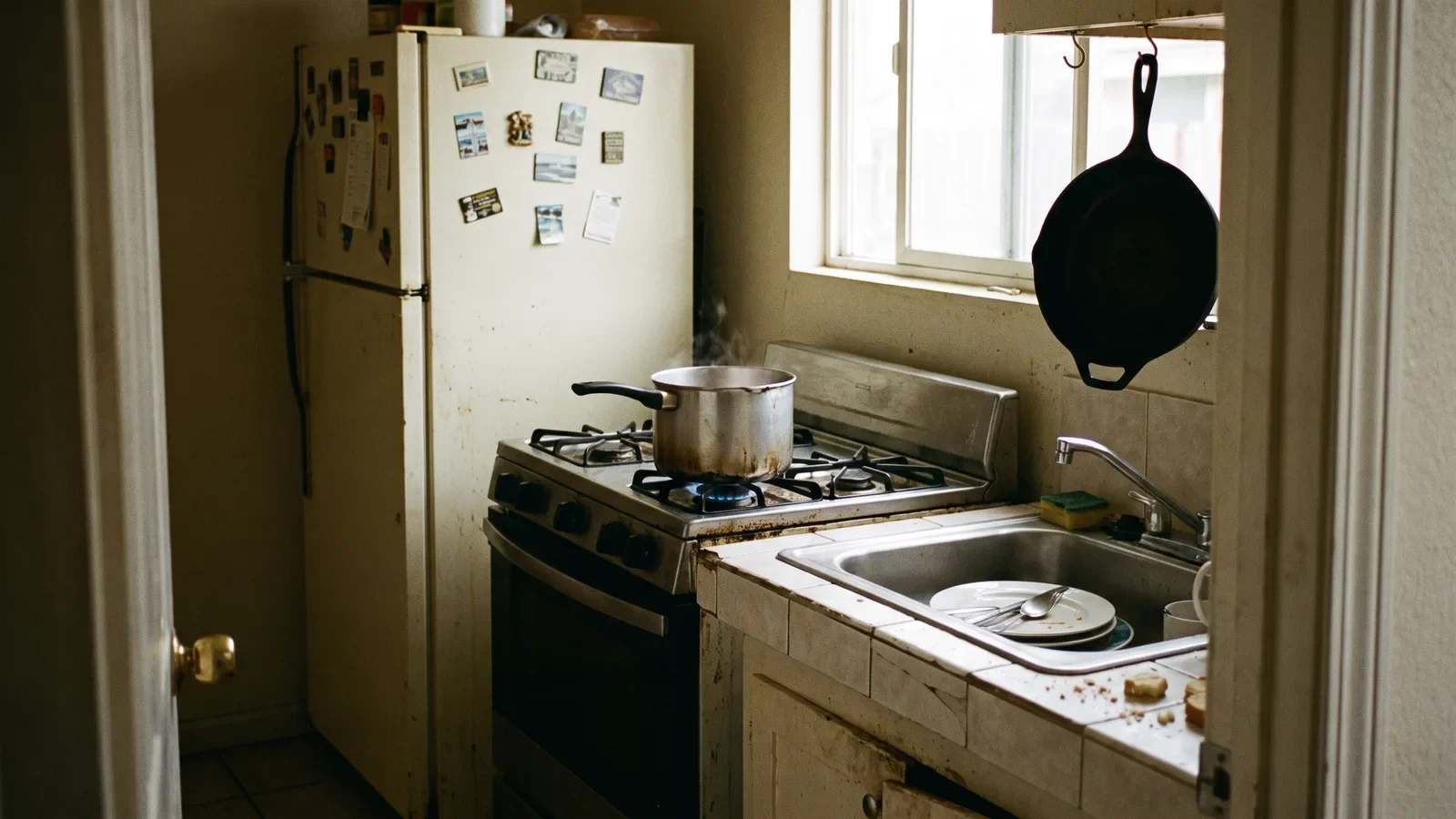
"Kitchen" in Spanish: the one word you need (and the trap inside it)
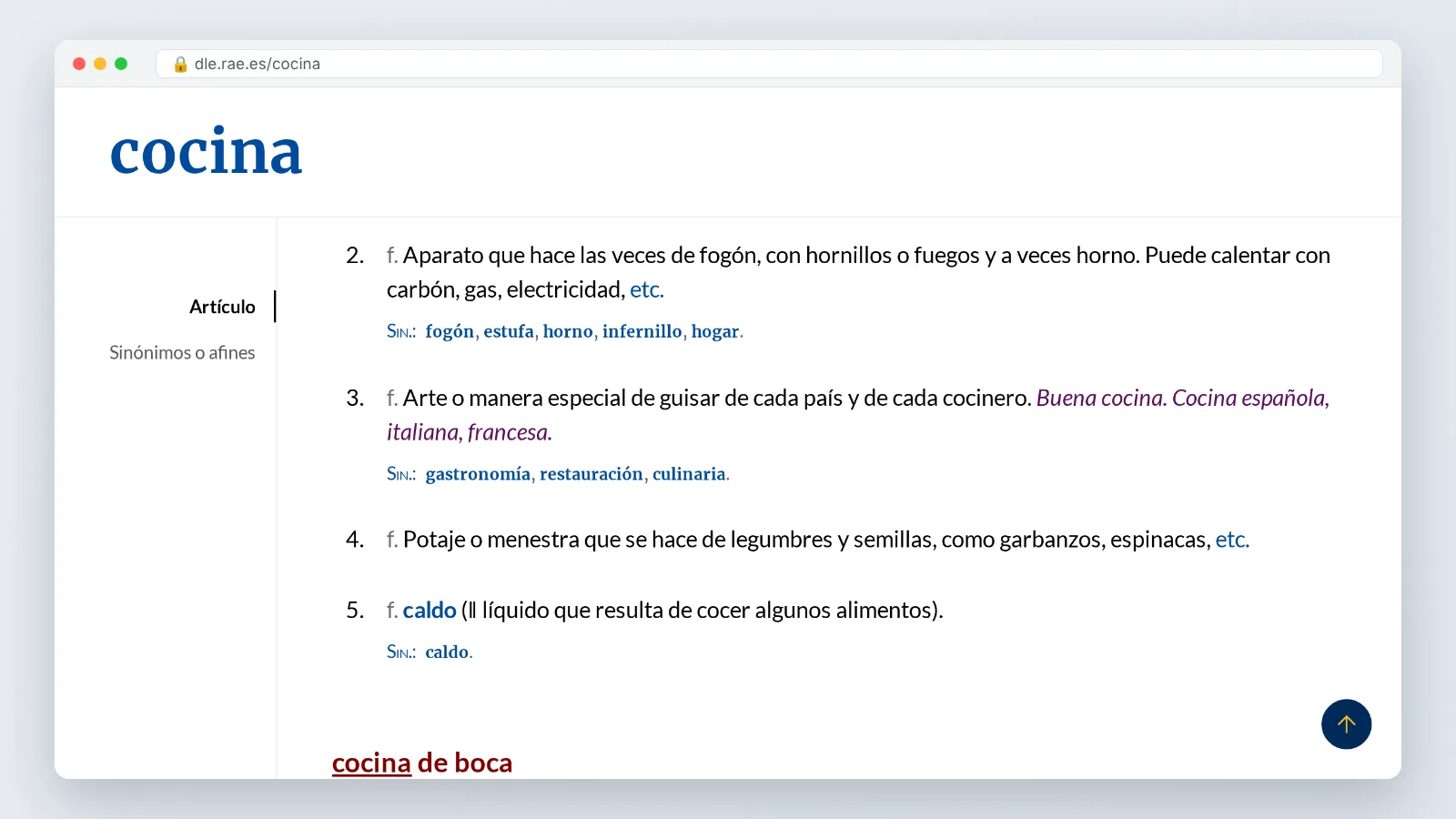
Ask for the kitchen in Madrid, Bogotá or San Juan and you will use the same six letters: cocina. What changes is the picture in your listener’s head. The Real Academia Española’s Diccionario de la lengua española lists cocina with sense 1 as the room of the house where food is cooked and sense 2 as the appliance that works as a stove.
That second sense is the trap. In Spain and parts of South America, la cocina is the cooking range sitting against the wall, not the room around it. Voy a la cocina means "I’m going to the kitchen"; Enciende la cocina means "Turn on the stove."
A third use catches people in writing. Cocina is also the he/she form of the verb cocinar, so Mi hermano cocina los domingos means "My brother cooks on Sundays." One spelling, three jobs.
How to tell them apart in two seconds:
- After la, una, esta → it’s a noun (room or appliance).
- After a name or subject pronoun, with no article → it’s a verb.
- Followed by de gas, eléctrica or de inducción → it’s the appliance.
- Followed by de la casa or paired with está plus a place → it’s the room.
Step 1 — Say la cocina: article, gender and pronunciation
Time: five minutes out loud. What you need: nothing but your voice.
Cocina is feminine, so the article is la: la cocina, las cocinas, una cocina pequeña, esta cocina. Learn the article as part of the word. Students who store "cocina = kitchen" without la end up guessing gender on every adjective that follows.
Three syllables, stress on the middle one: co-CI-na. In Latin America and much of southern Spain you say koh-SEE-nah. In most of Spain, the c before i becomes a soft "th," giving koh-THEE-nah. Both are standard Spanish; match the people you actually talk to.
Keep the vowels short and clean. The final -a stays "ah" and never drifts toward the English "uh" in sofa. The o does not glide into "ow."
According to the RAE dictionary entry, cocina comes from Vulgar Latin cocīna, from Late Latin coquīna, derived from the Latin verb coquĕre, "to cook." That shared root with English cook and concoct makes the word stick faster than rote repetition.
Say these five lines before moving on: La cocina es grande. Estoy en la cocina. ¿Dónde está la cocina? Mi cocina es pequeña. Vamos a la cocina.
Step 2 — Name the big appliances and fixtures (el refrigerador, el horno, el fregadero)
Time: about 15 minutes. What you need: your own kitchen, standing in the doorway.
Walk the room clockwise and name each large object out loud with its article. Physical movement plus speech beats silent reading, because you attach the word to a thing you touch daily. Start with the four you use every morning, then add the rest.
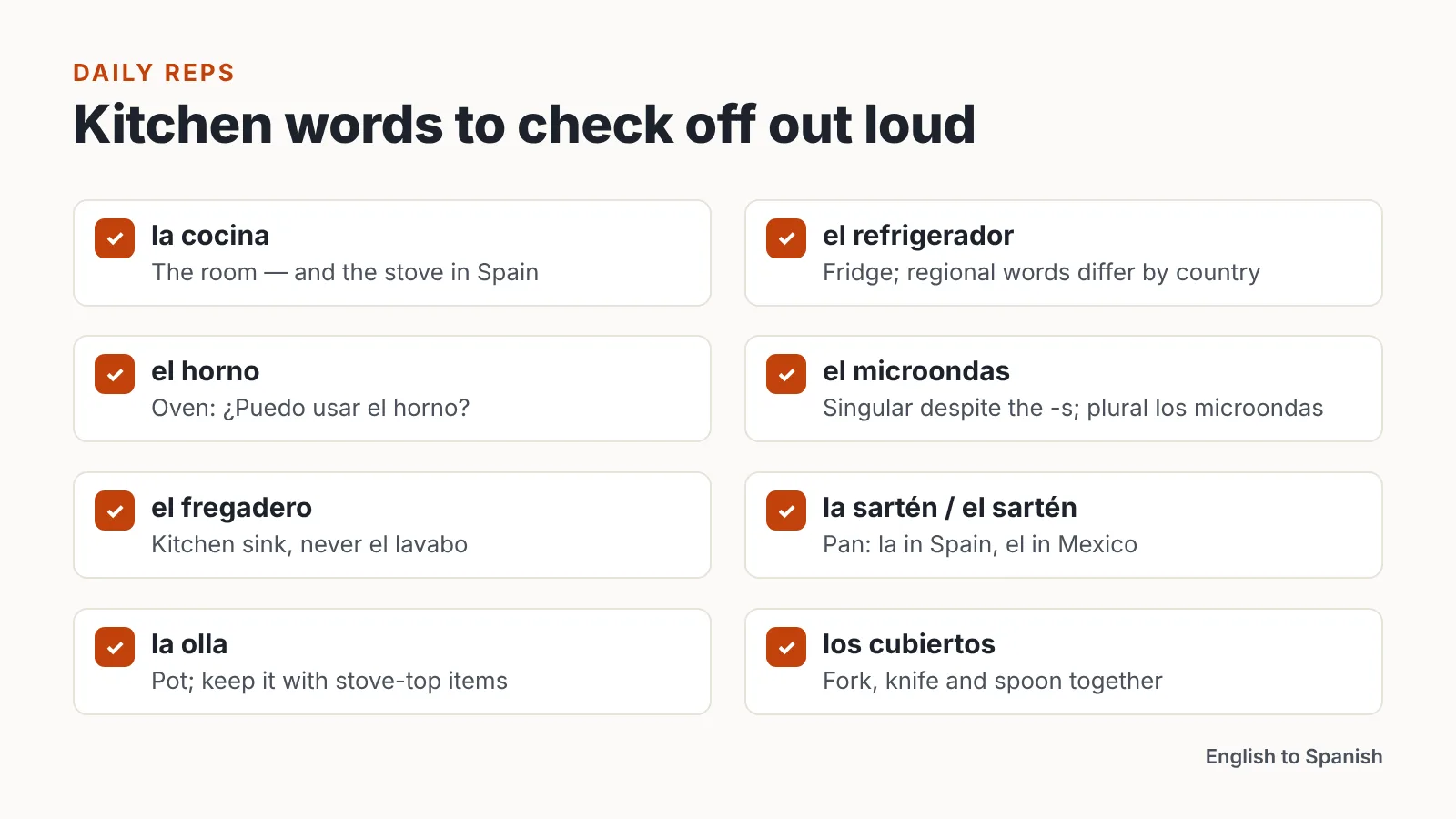
Two warnings before the list. El microondas ends in -s but is singular — los microondas is the plural, and the article does all the work. El fregadero is the kitchen sink, while el lavabo is the bathroom sink; swapping them is how a plumber ends up in the wrong room.
| English | Spanish | Notes |
|---|---|---|
| refrigerator | el refrigerador | la nevera, la heladera, el frigorífico by region |
| freezer | el congelador | part of the fridge or standalone |
| stove / range | la estufa | la cocina in Spain, la hornilla for a burner |
| oven | el horno | al horno = baked, roasted |
| microwave | el microondas | singular despite the -s |
| dishwasher | el lavavajillas | el lavaplatos in much of Latin America |
| sink | el fregadero | la pileta in Argentina, el lavaplatos in Chile |
| faucet | el grifo | la llave (Mexico), la canilla (Argentina) |
| countertop | la encimera | la barra or la cubierta in Mexico, el mesón in Colombia and Chile |
| cabinet | la alacena | el gabinete, el armario |
| range hood | la campana extractora | often shortened to la campana |
| pantry | la despensa | not la pantería, which does not exist |
| trash can | el bote de basura | el cubo (Spain), el tacho (Southern Cone) |
Step 3 — Add cookware, utensils and tableware (la sartén, la olla, los cubiertos)
Time: 20 minutes, split into two sittings. What you need: one drawer and one cabinet you can open.
Group these by where they live, not alphabetically. Everything that goes on the stove forms one set, everything in the utensil drawer forms a second, and everything that reaches the table forms a third. Three small sets beat one long column.
Sartén is the famous gender puzzle. It is la sartén in Spain and most of South America, el sartén in Mexico and much of Central America, and both are accepted usage. Pick the one your conversation partners use and stay consistent.
Los cubiertos covers the whole silverware set — fork, knife and spoon together. You can also name them individually as el tenedor, el cuchillo and la cuchara.
| English | Spanish |
|---|---|
| frying pan | la sartén / el sartén |
| pot | la olla |
| saucepan | la cacerola |
| lid | la tapa |
| cutting board | la tabla de cortar |
| knife | el cuchillo |
| wooden spoon | la cuchara de madera |
| ladle | el cucharón |
| spatula | la espátula |
| strainer / colander | el colador |
| grater | el rallador |
| can opener | el abrelatas |
| mixing bowl | el tazón / el bol |
| plate | el plato |
| glass | el vaso |
| mug / cup | la taza |
| napkin | la servilleta |
| silverware | los cubiertos |
Watch the drinking vessels. El vaso is a plain glass, la copa has a stem, and la taza holds coffee or tea. English "cup" covers all three, which is why learners reach for the wrong one at breakfast.
Step 4 — Choose the right regional word for the same object
Time: 10 minutes. What you need: a decision about which country you speak to most.
The Instituto Cervantes 2024 yearbook reports more than 600 million Spanish speakers worldwide, of whom almost 500 million are native speakers. A kitchen object with four names is normal across that many people, and none of the four is wrong.
Pick a home variety, learn one alternative per high-frequency object, and let the rest sit in passive memory. Mexico is the country with the most Spanish speakers, with over 120 million of the 600 million people who speak the language worldwide, according to Instituto Cervantes, which makes Mexican usage a practical default for most US readers.
| Object | Mexico | Spain | Argentina | Caribbean / Colombia |
|---|---|---|---|---|
| refrigerator | el refrigerador | el frigorífico / la nevera | la heladera | la nevera |
| stove | la estufa | la cocina | la cocina | la estufa |
| sink | el fregadero | el fregadero | la pileta | el lavaplatos |
| faucet | la llave | el grifo | la canilla | la pluma / el grifo |
| frying pan | el sartén | la sartén | la sartén | la sartén |
| drinking straw | el popote | la pajita | la pajita / el sorbete | el sorbete / el pitillo |
One swap deserves a flag. La estufa means a space heater in Spain, so asking a Spanish host to turn on la estufa in August will earn you a puzzled look.
The spread of the language is part of why the lists differ. In Duolingo’s 2024 language report, Spanish was the most studied language in 33 countries, behind English’s 135 — learners are picking it up in many places at once, and each of those places has its own word for the fridge.
Step 5 — Put kitchen words into real sentences and questions
Time: 15 minutes. What you need: the vocabulary from Steps 2 and 3.
Isolated nouns fade within a week. Drop each word into a frame sentence you would genuinely say in someone’s house, then reuse the frame with a different noun. Four frames carry most kitchen conversation.
- ¿Dónde está…? — ¿Dónde está el colador? (Where is the strainer?)
- ¿Me pasas… , por favor? — ¿Me pasas la sartén, por favor? (Can you pass me the pan?)
- ¿Puedo usar…? — ¿Puedo usar el horno? (May I use the oven?)
- Se me… — Se me quemó la cebolla. (I burned the onion — literally, the onion burned on me.)
Full lines worth memorizing: La cocina está al fondo a la derecha. No hay nada en el refrigerador. El fregadero está tapado. Voy a lavar los platos. Pon los cubiertos en la mesa.
About 44.9 million people in the United States, or 1 in every 7 people aged 5 and over, speak Spanish at home, according to USAFacts. Your odds of using these sentences in a real kitchen, not a classroom, are high.
Ask the meta-question too, since it works for any object you cannot name: ¿Cómo se dice "kitchen" en español? Point at the thing, use the frame, and you will never be stuck.
Your printable kitchen vocabulary checklist
Run this list once a day for a week, standing in your kitchen, pointing at each item as you say it. Check the box only when the article comes out automatically with the noun.
The room and the verb
- ☐ la cocina (room)
- ☐ la cocina / la estufa (stove)
- ☐ cocinar — yo cocino, él cocina
Big six appliances
- ☐ el refrigerador
- ☐ el congelador
- ☐ el horno
- ☐ el microondas
- ☐ el lavavajillas / el lavaplatos
- ☐ la campana extractora
Fixtures
- ☐ el fregadero
- ☐ el grifo / la llave
- ☐ la encimera
- ☐ la alacena
- ☐ la despensa
Cookware and utensils
- ☐ la sartén / el sartén
- ☐ la olla
- ☐ la cacerola
- ☐ la tabla de cortar
- ☐ el cuchillo
- ☐ el cucharón
- ☐ el colador
Tableware
- ☐ el plato
- ☐ el vaso
- ☐ la taza
- ☐ los cubiertos
- ☐ la servilleta
Four sentence frames
- ☐ ¿Dónde está…?
- ☐ ¿Me pasas…, por favor?
- ☐ ¿Puedo usar…?
- ☐ Se me quemó…
Short daily reps are easier to keep up than a two-hour cram on Sunday, so aim for ten minutes while the coffee brews. Saying each line out loud in the room itself also keeps the article glued to the noun, which is the part most learners drop first.
Common mistakes English speakers make with kitchen Spanish
The mistake that causes the most confusion is treating estufa as universal. A learner who studied Mexican Spanish lands in Seville, asks the host to turn on la estufa, and gets directed to a heater instead of the burner. Avoid it with one habit: before a trip, check the three words for stove, fridge and sink in that specific country, and use the local pair in the first conversation.
Other frequent slips, with the fix:
- Dropping the article. Voy a cocina is wrong; say Voy a la cocina.
- Confusing el fregadero and el lavabo. Kitchen sink versus bathroom sink.
- Saying los microondas for one unit. The singular is el microondas.
- Using copa for a water glass. Copa is stemmed; everyday water goes in un vaso.
- Pronouncing cuchillo with an English "l" sound. The ll is a "y" sound: koo-CHEE-yoh.
- Translating "dish" as plato every time. El plato is both the plate and a prepared dish, but dirty dishes are los trastes in Mexico and los platos elsewhere.
Vocabulary moves, so check a current dictionary rather than an old classroom handout. The Real Academia Española keeps the Diccionario de la lengua española free to search at dle.rae.es, and it revises entries periodically, so the usage notes there will settle an argument about a regional word faster than a phrasebook printed years ago.
Frequently asked questions
How do you say kitchen in Spanish?
Kitchen is la cocina, a feminine noun pronounced koh-SEE-nah in Latin America and koh-THEE-nah in most of Spain. The Real Academia Española lists cocina as both the room where food is cooked and the stove appliance.
Why does cocina sometimes mean stove?
The RAE’s Diccionario de la lengua española gives cocina a second sense: the appliance that works as a stove. In Spain you will hear una cocina de gas for a gas range, while Mexican speakers usually say la estufa for the same machine.
Is it la sartén or el sartén?
Both are correct depending on where you are. Spain and most of South America say la sartén; Mexico and much of Central America say el sartén. Choose the one your listeners use and keep adjectives agreeing with it.
What are the most useful kitchen words to learn first?
Start with the room, four appliances and four utensils: la cocina, el refrigerador, el horno, el microondas, el fregadero, la sartén, la olla, el cuchillo and los cubiertos. Those nine cover nearly every everyday kitchen request.
Will the same kitchen words work in every Spanish-speaking country?
Mostly, but fridge, sink, faucet and stove change by region. The Instituto Cervantes 2024 yearbook reports more than 600 million Spanish speakers worldwide, of whom almost 500 million are native speakers, so variation is expected and never counts as an error.
Sources
- cocina | Diccionario de la lengua española (RAE)
- La RAE presenta las novedades del Diccionario de la lengua española (DLE) en su actualización 23.8 (nota de prensa)
- CVC. Anuario 2024. Presentación. Carmen Pastor Villalba — Instituto Cervantes
- El anuario «El español en el mundo 2024» radiografía el estado de la lengua en los países de América Latina — Instituto Cervantes
- How many people speak Spanish at home? — USAFacts
- The 2024 Duolingo Language Report — Duolingo Blog
AI tools helped write this guide. The English to Spanish Editorial Team published it after checking every figure against the sources linked above.