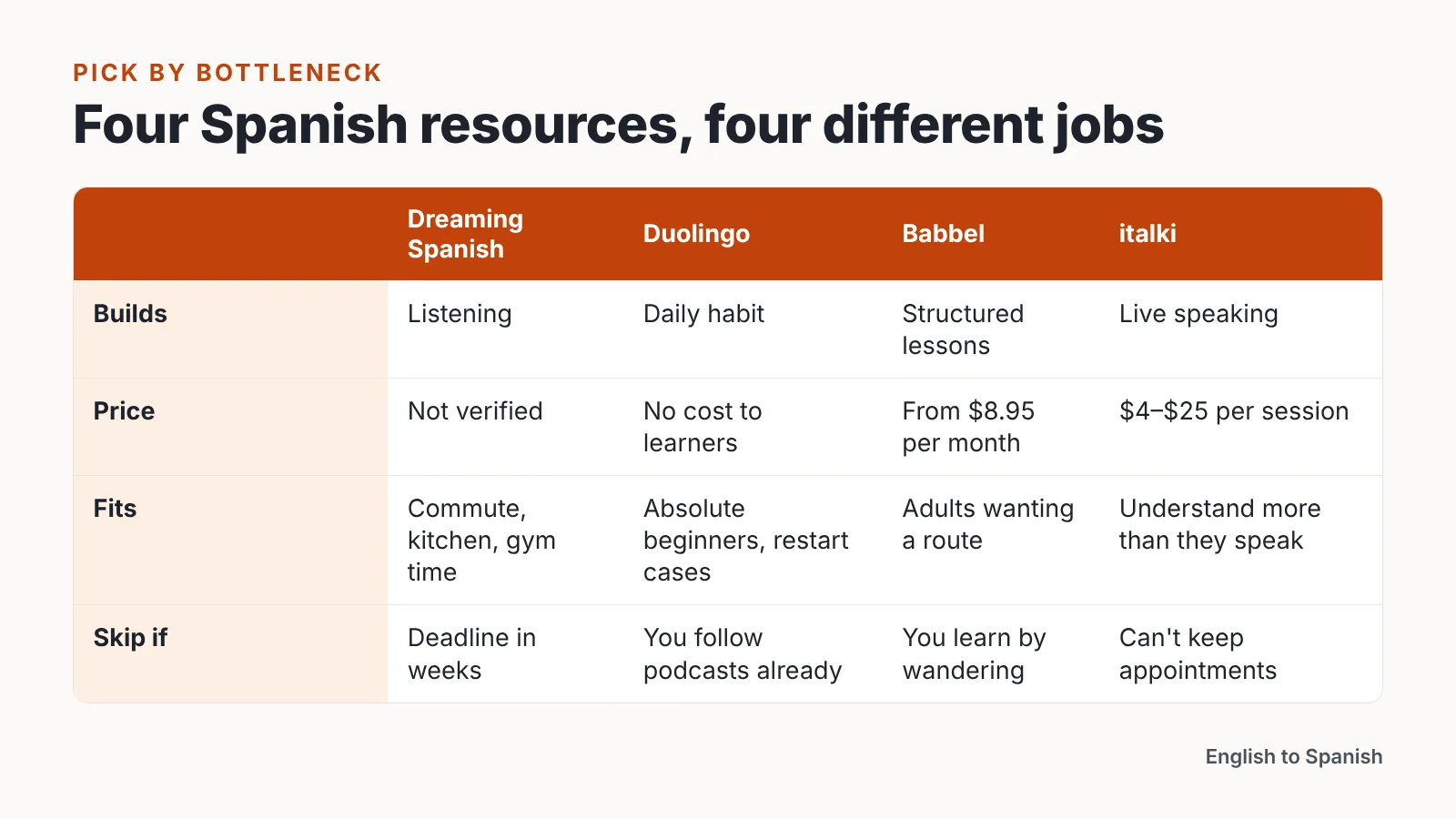
Dreaming Spanish for listening, Duolingo for daily habit, Babbel for structured lessons, and italki for live speaking practice. We’d suggest pairing two of them rather than stacking all four.
How we compared
Four resources, four axes: the skill each one actually builds, the published price in a unit you can compare, the learner it serves best, and the learner who gets nothing from it. Nothing here was ranked by popularity alone. Popularity tells you what people download, not what moves your Spanish forward.
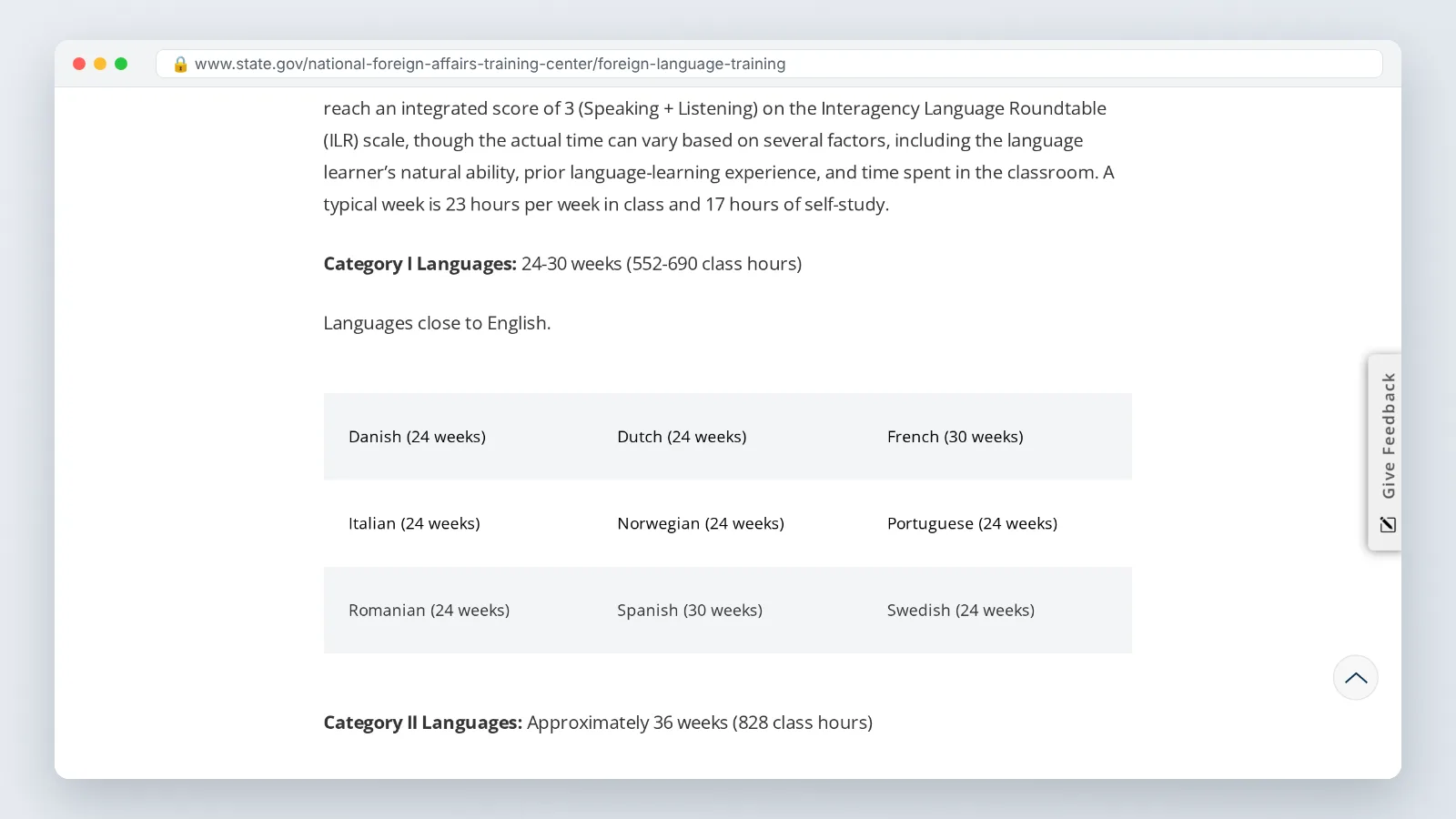
Time is the honest denominator for all of it. The U.S. State Department’s Foreign Service Institute classifies Spanish in Category I, where languages typically take 24–30 weeks, or 600–750 class hours, to reach General Professional Proficiency. On the State Department’s FSI training-time list, Spanish is given as 30 weeks, the same as French and longer than Portuguese or Italian at 24 weeks. Spanish is the easy end of that scale, and the easy end still costs a full-time semester.
Pricing is normalized where the sources allow it: subscription tools are quoted per month, one-to-one tutoring per session. Those units are not interchangeable, and that gap is the point — a single tutoring hour can cost more than a month of app access. One blank in the table deserves a warning before you read it: Dreaming Spanish’s pricing fell outside our verified evidence set, so the column says exactly that. Read it as unverified, not as free, and check the site before you build a budget around it.
| Resource | Main skill it builds | Published price | Best for | Skip it if |
|---|---|---|---|---|
| Dreaming Spanish | Listening comprehension through video input | Not covered by our sources | Learners willing to log hundreds of listening hours | You need to speak at a wedding in three weeks |
| Duolingo | Daily vocabulary and sentence recall | Duolingo states its 100+ courses are offered at no cost | Habit building and streak-driven consistency | You already understand podcasts and need output |
| Babbel | Structured, dialogue-based lesson sequence | From $8.95 per month, per Reviewed’s long-term test | Learners who want a syllabus, not a buffet | You refuse to pay before trying a full level |
| italki | Live speaking with a human | $4–$25 per session, no subscription, per italki | Anyone whose mouth lags behind their ears | Your calendar can’t hold a weekly appointment |
What we checked, and what we didn’t
Checked: published pricing pages, official help documentation, each company’s own progress or annual report pages, and FSI training-time data from the State Department. Not checked: nothing was tested hands-on, and no two resources were run side by side with the same learner.
Promotional pricing, regional pricing and discount cycles move constantly, so treat every figure as the published list value on the date of the source rather than a quote anyone owes you. Babbel and italki in particular run their own promotional calendars. Tutor quality on a marketplace varies person to person and cannot be summarized by a platform-wide number.
1. Dreaming Spanish
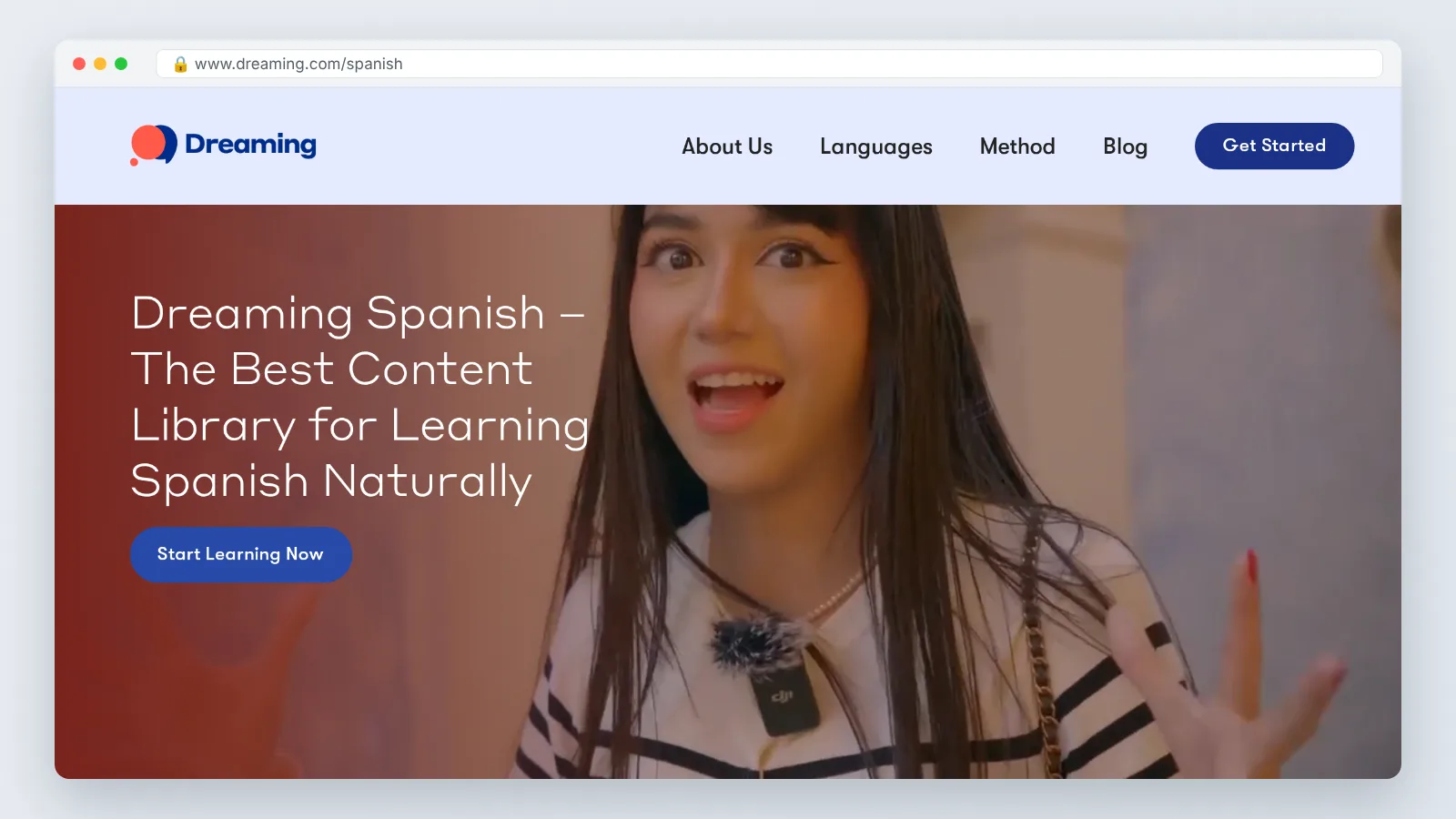
The method is comprehensible input: you watch Spanish video you mostly understand, and you keep watching until understanding becomes automatic. Grammar drills are not the engine here. Hours are.
Dreaming Spanish estimates that understanding native speakers talking to you at normal speed takes about 600 hours of input and roughly 5,000 known words. Dreaming Spanish’s official progress tracker puts Level 7 — using the language effectively for all practical purposes — at 1,500 hours of input and 12,000+ known words. Those are the clearest published milestones in consumer Spanish learning, and they tell you something uncomfortable: there is no five-minute path.
What you get in exchange is low-friction study. Watching beginner-level video while folding laundry counts toward the same hour total as a focused session, which makes the method survive busy weeks better than a lesson schedule does. It also rewards patience over intensity, which is the opposite of how most app streaks are designed.
The approach also explains why so much Spanish instruction has migrated to video, and why teachers now spend as much time producing clips as planning lessons. That production side has its own tool category — AI Studios, DeepBrain AI’s cloud platform for AI avatar videos, text-to-video and video translation, is one example — and it is worth being blunt about the limits. Those tools make video; they do not teach Spanish, and nothing in our evidence set speaks to the quality of their Spanish dubbing or text-to-speech accents. If you are a learner rather than a publisher, the whole category is a detour.
Who it fits: learners with commute time, kitchen time or gym time who can convert dead hours into listening.
Skip it if: you have a fixed deadline measured in weeks, or you need explicit grammar explanations in English to feel like you’re progressing. Input-first learners also tend to feel slow at speaking early on, because speaking is deliberately deferred.
2. Duolingo
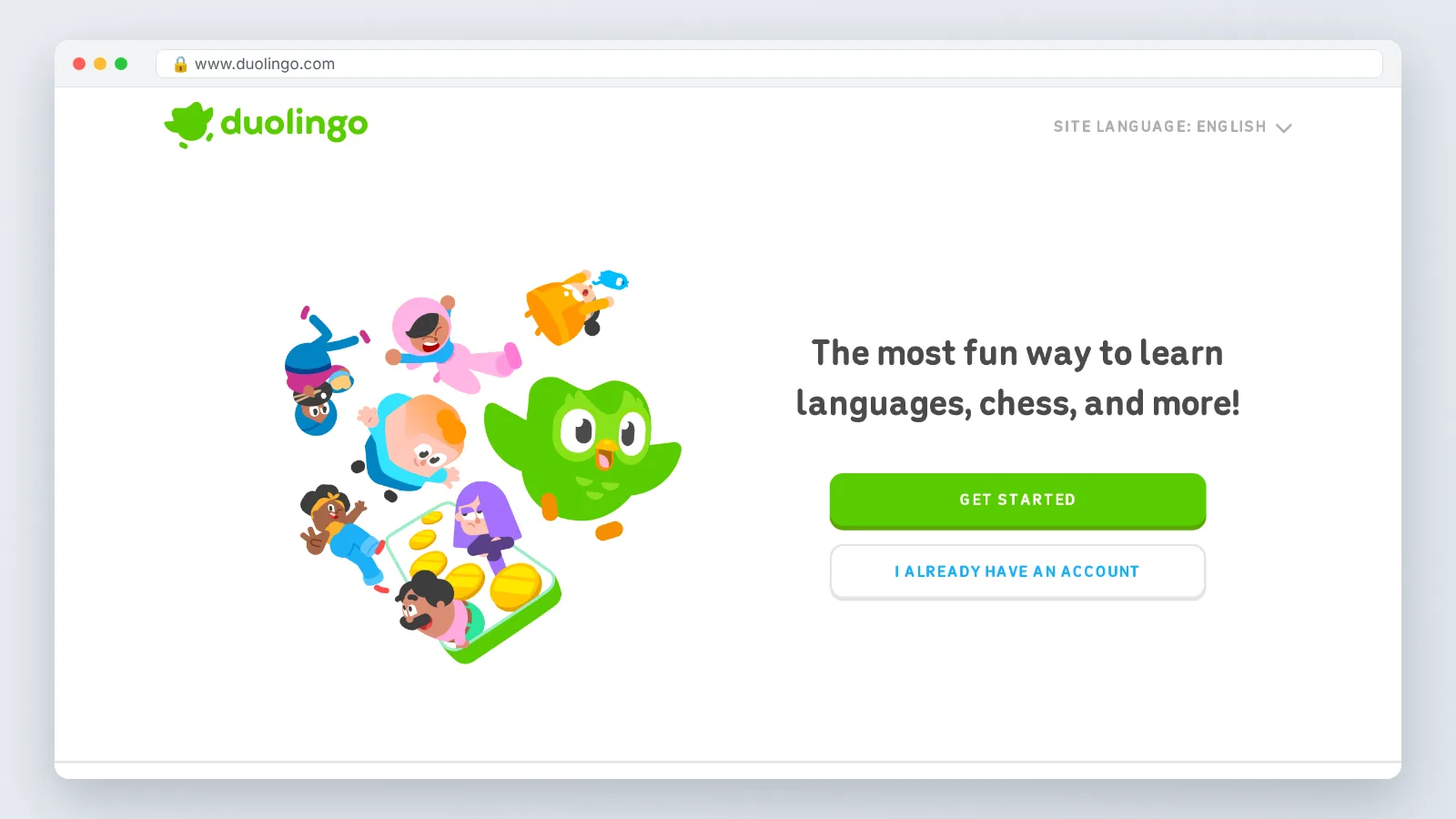
Treat Duolingo as a habit device rather than a curriculum. It is very good at getting you to open the app on a Tuesday night when you’re tired, and that single behavior compounds across months.
Duolingo states it offers over 100 courses covering more than 40 languages at no cost to learners. In the 2025 Duolingo Language Report, Spanish ranked #1 among the courses attracting the most serious learners, ahead of English at #2 and Italian at #3. Our reading of that ranking is that you’ll have no shortage of fellow learners and community material around the course — though the report gives a ranking, not a headcount, so treat the crowd as an inference rather than a published fact.
The ceiling is the known limitation. Tapping word tiles trains recognition, not production under time pressure, and recognition is the cheap half of fluency. Pair it with anything that forces you to generate sentences out loud, and the weakness mostly disappears.
Who it fits: absolute beginners, restart cases, and anyone whose real problem is consistency rather than method.
Skip it if: you already follow a Spanish-language podcast without subtitles. At that stage the exercises cost more attention than they return, and your hours belong in conversation or longer-form listening.
3. Babbel
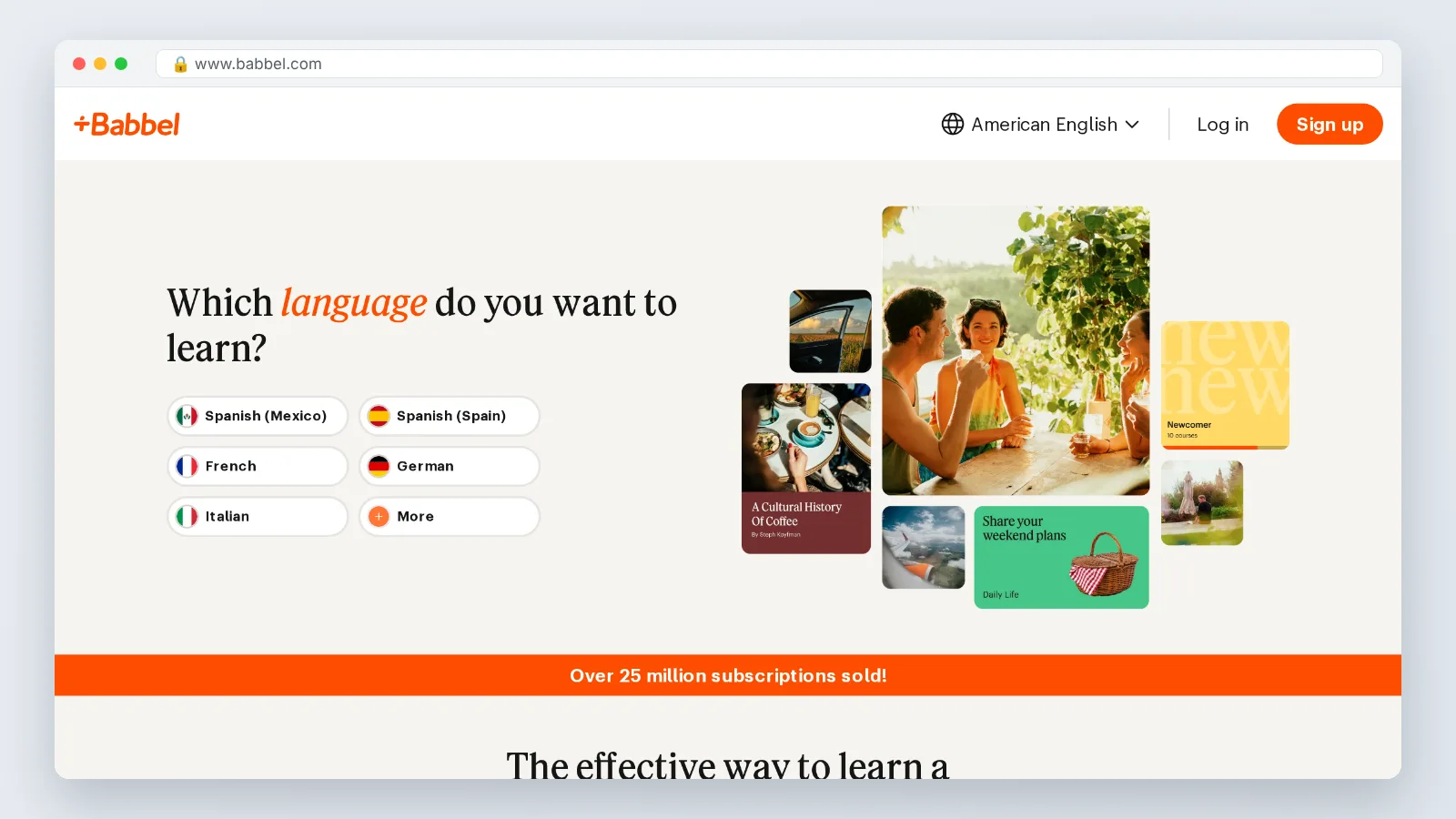
Babbel’s pitch is sequence. Lessons build around practical dialogues — renting an apartment, ordering, making plans — and the next unit assumes the last one, which is what most self-study collapses without.
Reviewed’s long-term Babbel test reports pricing starting at $8.95 per month before the lifetime option. Compared per unit, that monthly figure sits below the $10 floor italki sets for a single Professional Teacher lesson, so a subscription is the cheaper way to buy structured volume — and the more expensive way to buy corrective feedback, since there is none from a human.
The trade-off is rigidity. A fixed path is a gift when you don’t know what to study next and a nuisance when you want to spend three weeks only on the subjunctive.
Who it fits: adult learners who want a defined route from zero to basic conversation without assembling their own syllabus.
Skip it if: you learn by wandering, or you’re already at the stage where your errors are specific and personal. Generic lesson sequences can’t see that you keep confusing por and para in the same construction every time.
4. italki
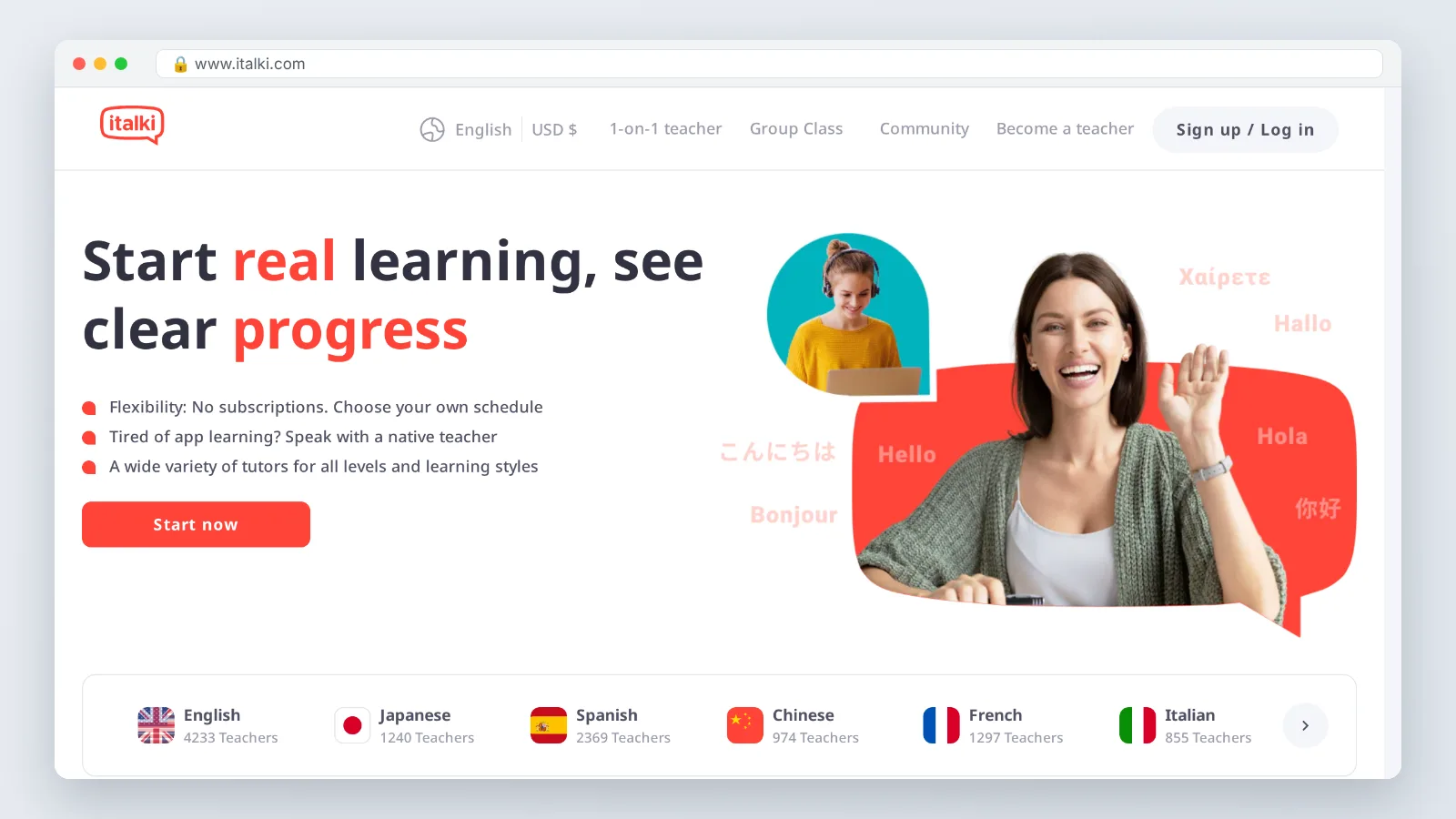
Speaking is the skill that refuses to develop passively, and italki exists to solve exactly that. You book individual lessons with individual teachers and pay per session.
italki says it connects over 10 million learners with more than 30,000 teachers across over 150 languages for one-on-one lessons. italki’s own help documentation sets floor prices for tutors: $10 USD per lesson minimum for Professional Teachers and $5 USD for Community Tutors — roughly the gap between a trained instructor and a conversation partner. italki’s pricing guide says most lessons fall between $4 and $25 per session, with no subscription required.
That per-session model is the real advantage for irregular schedules. Travel-heavy months cost you nothing, and a pre-trip push of three lessons a week costs exactly three lessons a week.
Who it fits: anyone who understands more Spanish than they can produce, and anyone preparing for a specific event — a visit, an interview, a family dinner.
Skip it if: you cannot reliably hold a scheduled appointment, or you’re on day two with twenty words of vocabulary. Booking live time before you have raw material to work with burns money on silence.
Which one fits you
No single tool covers listening, structure and output at once. Pick by the bottleneck you actually have this month, then add a second resource only when the first one stops moving.
| If this is you | Start with | Why |
|---|---|---|
| Total beginner, inconsistent | Duolingo | Builds the daily touch before anything else matters |
| Understand slowly, miss native speed | Dreaming Spanish | Hour targets are published: ~600 for normal-speed comprehension |
| Want a defined path, hate choosing | Babbel | Sequenced dialogue lessons from $8.95 per month, per Reviewed |
| Freeze when you have to speak | italki | Per-session pricing, $4–$25, no subscription lock-in |
| Trip in six weeks | italki + Dreaming Spanish | Live rehearsal plus heavy passive listening |
The practical case for Spanish is close to home. About 44.9 million people in the United States speak Spanish at home, roughly one in every seven people aged 5 and over, which means your practice partners are likely within driving distance, not across an ocean.
If you want one recommendation instead of four options, we’d suggest pairing a listening source you enjoy with a human who corrects you weekly, and leaving the stack there until that pairing stops producing results. Everything else on this list is support for those two.
Frequently asked questions
How long does it realistically take an English speaker to learn Spanish?
The U.S. State Department’s Foreign Service Institute places Spanish in Category I, where languages typically take 24–30 weeks, or 600–750 class hours, to reach General Professional Proficiency. Part-time self-study stretches that calendar considerably, since FSI counts intensive classroom hours, not fifteen-minute app sessions.
Can free Spanish learning resources get me to conversational level?
Partly. Duolingo states it offers over 100 courses covering more than 40 languages at no cost to learners, and free video libraries cover listening well, but nothing free forces you to produce unscripted speech with correction. Most learners eventually pay for live conversation time.
Is a tutor worth it compared with an app subscription?
They buy different things. italki’s pricing guide says most lessons fall between $4 and $25 per session with no subscription required, while Reviewed’s long-term Babbel test reports pricing starting at $8.95 per month. Apps give volume cheaply; tutors give correction you cannot get otherwise.
How many hours of listening do I need before Spanish sounds normal speed?
Dreaming Spanish estimates that understanding native speakers talking to you at normal speed takes about 600 hours of input and roughly 5,000 known words, and its progress tracker puts effective all-purpose use at 1,500 hours and 12,000+ known words.
Sources
- Foreign Language Training – United States Department of State
- How many people are Spanish speakers at home? | USAFacts
- 2025 Duolingo Language Report (Duolingo Blog)
- The 2024 Duolingo Language Report (Duolingo Blog)
- Track Your Spanish Learning Progress — Dreaming Spanish
- italki Review 2026: Is It Worth It? (italki)
- How much should I charge for my lessons? — italki Support
- How Much Does italki Cost? Complete Pricing Guide (italki)
- Is Babbel worth it? We used it for two years to find out — Reviewed
AI tools helped write this guide. The English to Spanish Editorial Team published it after checking every figure against the sources linked above.