Puerto Rican Spanish keeps standard grammar but changes the vocabulary layer: it tolerates English loanwords like transportación and parquear, uses ustedes for every plural you, leans on diminutives, and prefers island nouns such as guagua, china and habichuelas.

Why "English to Puerto Rican Spanish" Is a Different Job From "English to Spanish"
Most Spanish briefs name a market and stop there. A Puerto Rico brief cannot, because your reader may be holding the English original in the next browser tab. The Puerto Rico Official Languages Act, Act No. 1 of January 28, 1993, establishes that both Spanish and English are official languages of the island’s government, so the source document you receive may legally have been drafted in either language.
That same 1993 statute repealed Act No. 4 of April 5, 1991, which had briefly made Spanish the sole official language, and it declares both languages usable interchangeably in government business. Translating for the island means translating alongside English, not away from it.
The grammar you studied still holds. Verb morphology, agreement and subjunctive triggers do not shift between Madrid, Mexico City and Mayagüez. What shifts is lexicon, loanword tolerance, pronoun habit and the social temperature of *usted*.
Treat es-PR as a locale with its own term list and its own reviewer, the way you would treat pt-BR against pt-PT. A translator in Bogotá producing clean neutral Spanish is not a substitute for someone who has sat in a *tapón* on the Baldorioty.
The Scenario: Translating a U.S. Health Insurer’s Benefits Email for Island Readers
Picture a brief that lands on a Tuesday. A U.S. health insurer needs its annual wellness-visit email localized for plan members living on the island — roughly 400 words, one call-to-action, compliance review before send. The English version will also go out, because many members read both.
The U.S. Census Bureau reported that 78.3% of the U.S. population age 5 and older spoke only English at home in the 2018-2022 American Community Survey 5-year estimates. Your island readers live the inverse of that: Spanish at home, English arriving through work, school and insurance paperwork.
Three people touch the file. A localization manager stateside, a translator in San Juan, and a compliance reviewer who reads Spanish but writes her comments in English.
The first draft came back in textbook neutral Spanish — grammatically clean, and wrong on six words. After the es-PR pass, exactly one item stayed open for the native reviewer: whether *pon*, the island word for a free ride, belongs in an insurer’s formal email. It does not, and that is the kind of call a reviewer settles in seconds.
The cost of getting it wrong is measurable in call-center volume. Members who cannot tell whether *consultorio* means their doctor’s office will phone and ask.
Five Places Textbook Spanish Breaks on the Island: Pronouns, Anglicisms, Diminutives, Register, and Food and Place Nouns
These five categories account for most of what a native reviewer marks up. Learn them and your neutral draft stops sounding borrowed.
| Feature | Neutral / textbook Spanish | Puerto Rican Spanish (es-PR) | Why it matters |
|---|---|---|---|
| Pronouns | *vosotros* taught in Spain-based textbooks; subject pronoun after the verb in questions | *ustedes* for every plural *you*; subject pronoun often before the verb (*¿Qué tú crees?*) | A *vosotros* form in member-facing copy marks the text as European instantly |
| Anglicisms | *transporte*, *aparcar*, *imprimir* | *transportación*, *parquear*, *printear* (speech only) | Some loanwords are standard in formal island writing; others are speech-only |
| Diminutives | *-ito* used sparingly | *-ito/-ita* everywhere: *ahorita*, *momentito*, *cafecito* | Diminutives soften instructions and warm up service copy |
| Register | *usted* as the default for all formal text | *usted* in health, banking and government; *tú* in retail and youth marketing | Mixing both inside one email reads careless |
| Food and place nouns | *frijoles*, *autobús*, *plátano*, *naranja*, *pastel*, *vaqueros* | *habichuelas*, *guagua*, *guineo*, *china*, *bizcocho* (cake), *mahones* | Wrong noun, wrong product — and sometimes a wrong dish entirely |
Watch the false friends inside the variety itself. A *pastel* on the island is a masa-based holiday dish wrapped in a plantain leaf, not a pastry, and *bizcocho* is the word you want for birthday cake. *China* is an orange. Getting that one wrong in a grocery promotion is not a nuance problem; it is a comprehension problem.
Before and After: The Same English Paragraph in Neutral Spanish vs. es-PR
English source: "Your plan covers an annual checkup at no cost. Bring your ID card to the appointment. If you need transportation to the clinic, call the number on the back of your card. You can also park in the lot behind the building."
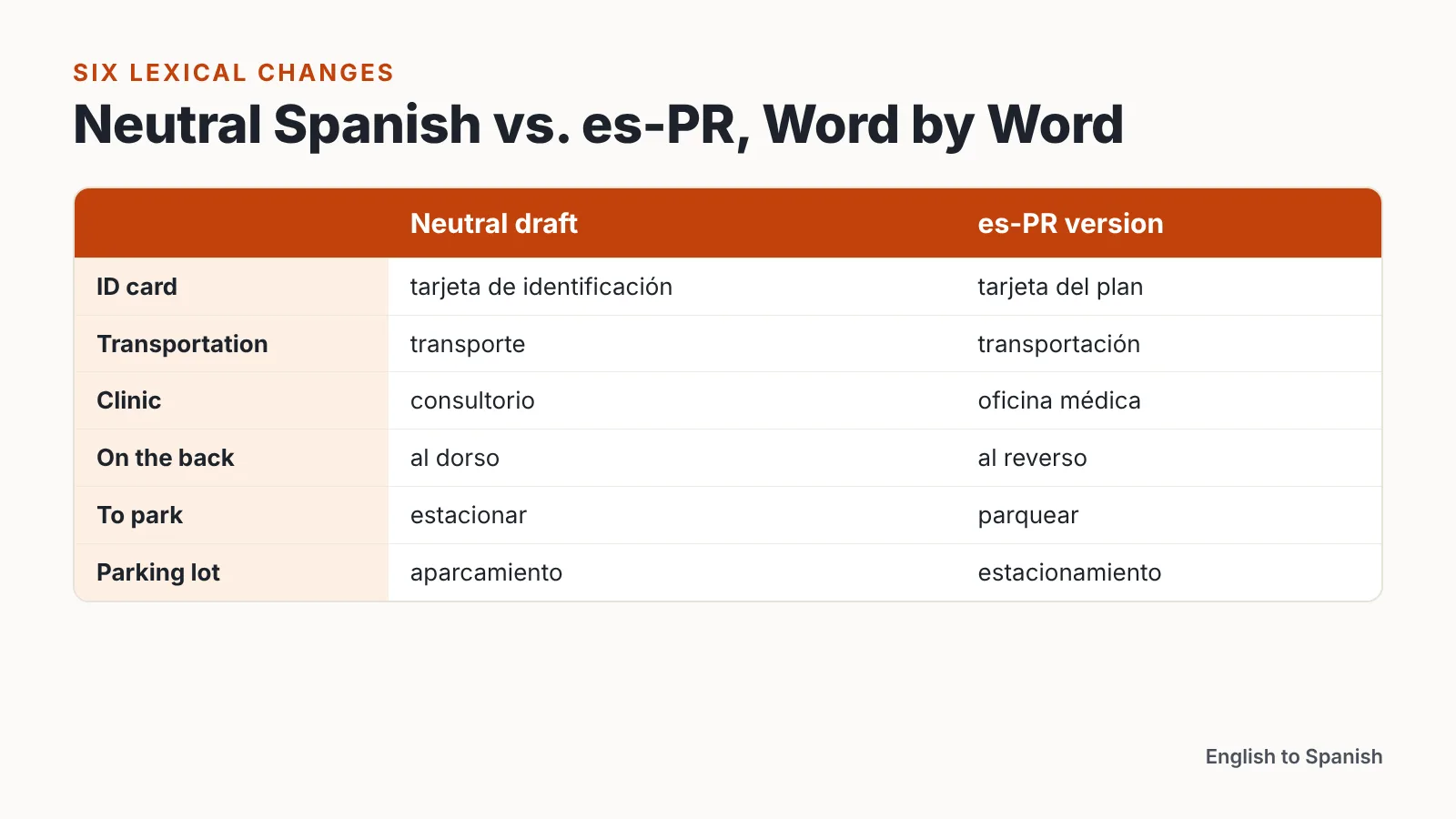
Neutral draft: "Su plan cubre un chequeo anual sin costo. Traiga su tarjeta de identificación a la cita. Si necesita transporte al consultorio, llame al número que aparece al dorso de su tarjeta. También puede estacionar en el aparcamiento detrás del edificio."
es-PR version: "Su plan cubre un chequeo anual sin costo alguno. Lleve su tarjeta del plan a la cita. Si necesita transportación a la oficina médica, llame al número que aparece al reverso de su tarjeta. También puede parquear en el estacionamiento detrás del edificio."
| Neutral | es-PR | Reason |
|---|---|---|
| traiga | lleve | Island deixis favors *llevar* when the reader moves toward the appointment |
| tarjeta de identificación | tarjeta del plan | What members actually call the card |
| transporte | transportación | Standard in formal island writing |
| consultorio | oficina médica | *Consultorio* reads South American here |
| al dorso | al reverso | Common usage in local service copy |
| estacionar / aparcamiento | parquear / estacionamiento | *Aparcamiento* is Peninsular; *parquear* is the island verb |
Six lexical changes, zero grammar changes. That ratio is the whole lesson of this page.
A Reproducible Procedure: Setting the es-PR Locale, Building a Term List, and Running a Native Review Pass
Seven steps, in this order, every time.
- Set the locale before anyone translates. Microsoft Learn documents Spanish (Puerto Rico) with its own locale identifier, 0x500a, which makes es-PR a selectable target in localization tooling rather than a sub-case of generic Spanish. Tag the XLIFF target and the CMS field.
- Clone, don’t start over. Copy your neutral es-419 termbase into an es-PR child base so you only maintain the differences.
- Harvest candidates from island sources. Pull vocabulary from Government of Puerto Rico agency pages, utility and pharmacy customer notices, and the island’s daily press.
- Tag every entry by register. Mark each term formal-OK, informal-only, or avoid-in-compliance-copy. *Parquear* passes; *pon* does not.
- Translate with the es-PR base enforced and flag each loanword decision inline for the reviewer.
- Run the native review pass. Brief the reviewer to use three labels only: wrong, foreign-sounding, right. Vague "I’d say it differently" comments burn your schedule.
- Lock approved terms and log rejected ones with a reason. The rejection log is what stops the same argument next quarter.
Budget the review pass as its own line item, not as proofreading. A reviewer who grew up on the island catches in twenty minutes what a style guide cannot describe in twenty pages.

How to Verify a Puerto Rican Term Before You Ship It
Never ship a term you heard once in a song. Put it through three checks and write down the result.
The reference lexicon for the variety, the *Tesoro lexicográfico del español de Puerto Rico* by María Vaquero and Amparo Morales, was published in 2005 by the Academia Puertorriqueña de la Lengua Española, according to the Asociación de Academias de la Lengua Española. Start there for anything that looks island-specific.
Check two: the dictionaries maintained by the Asociación de Academias de la Lengua Española, which tell you whether a term is shared across the Caribbean or confined to one island. That distinction matters when a client asks for "Caribbean Spanish" and means Puerto Rico, the Dominican Republic and Cuba at once.
Check three: formal local corpora. Search the term on Puerto Rico government agency pages and in service communications from banks, utilities and hospitals on the island.
The decision rule is simple. If a term appears in the Tesoro, is recognized by ASALE, and shows up in formal local writing, ship it; if it only lives in conversation and lyrics, keep it out of compliance copy and marketing headlines alike.
When Neutral Latin American Spanish Is the Right Call Instead
es-PR is not always the answer, and insisting on it can cost you money for no gain. Instituto Cervantes’ 2024 yearbook puts the global Spanish-speaking community at more than 600 million people, which is the scale a single national variety has to justify itself against.
That same Instituto Cervantes count breaks down into nearly 500 million native speakers, roughly 78 million with limited proficiency, and more than 24 million learners of Spanish. One Puerto Rico locale serves a slice of that; one neutral file serves most of it.
Choose neutral Latin American Spanish when:
- A single string file ships to multiple Spanish-speaking markets and you cannot fork it.
- The content is legal boilerplate reused across countries, where variation invites inconsistency claims.
- Your budget covers one translation and one review, not one per market.
- The text is technical documentation with internationally standardized terms.
Choose es-PR when:
- The audience is specifically island residents or recently arrived Puerto Rican communities stateside.
- The copy is emotional, service-facing or conversational: health outreach, retail promotions, customer support scripts, voiceover.
- A local competitor already speaks to those readers in their own vocabulary.
Quality Checklist and Common Mistakes to Avoid
Run this before you hand the file back.
- Locale tag set to es-PR, not es or es-419, in every system that touches the file.
- Zero *vosotros* forms anywhere in the text.
- Every loanword decision logged with a register tag.
- Food, transport and clothing nouns checked against the island list, not the Mexico list.
- One register per document: *usted* throughout for health and finance.
- Native reviewer sign-off recorded by name and date.
The most common failure is treating es-PR as es-MX with a few swaps. Mexican vocabulary — *camión*, *frijoles*, *carro de supermercado* — is the default output of most generic engines and the most frequent thing island reviewers strike.
The second failure is overcorrecting. Stuffing slang into a benefits notice reads like a stranger trying to sound local, and it damages trust faster than a flat neutral draft ever would.
The third is skipping the rejection log, which means relitigating *transporte* versus *transportación* with every new vendor.
This article is general information about language and localization practice, not legal, medical or financial advice; Puerto Rico’s Official Languages Act governs the island’s government, and insurance notice requirements vary by plan type and regulator.
Frequently asked questions
Is Puerto Rican Spanish a different language from standard Spanish?
No. It is a national variety of Spanish with the same grammar and conjugation system, differing mainly in vocabulary, pronunciation and loanword tolerance, which is why a neutral draft reads imported rather than incorrect to island readers.
Does Puerto Rico use Spanish or English in official documents?
Both. The Puerto Rico Official Languages Act, Act No. 1 of January 28, 1993, establishes Spanish and English as official languages of the island’s government and declares them usable interchangeably in government business.
Can I set es-PR as a target locale in my translation tools?
Yes. Microsoft Learn documents Spanish (Puerto Rico) with its own locale identifier, 0x500a, so es-PR is a selectable target in localization tooling rather than a sub-case of generic Spanish, and you should tag it from the start.
Which dictionary should I trust for Puerto Rican vocabulary?
Begin with the Tesoro lexicográfico del español de Puerto Rico by María Vaquero and Amparo Morales, published in 2005 by the Academia Puertorriqueña de la Lengua Española according to ASALE, then confirm the term appears in formal local writing.
When is neutral Latin American Spanish the better choice?
Use neutral Spanish when one file must serve several markets, when the content is cross-border legal boilerplate, or when the budget allows only one translation and one review pass for all Spanish-speaking audiences.
Sources
- Puerto Rico Official Languages Act, Act No. 1 of January 28, 1993 (Oficina de Gerencia y Presupuesto, Gobierno de Puerto Rico)
- Most Americans Speak Only English at Home or Speak English "Very Well" — U.S. Census Bureau
- El español en el mundo 2024 — Anuario del Instituto Cervantes (PDF)
- El español supera por primera vez los 600 millones de hablantes — Instituto Cervantes (nota de prensa)
- Language Identifiers and Locales — Microsoft Learn
- El Tesoro de Puerto Rico, en la Red — Asociación de Academias de la Lengua Española (ASALE)
AI tools helped write this guide. The English to Spanish Editorial Team published it after checking every figure against the sources linked above.