Most English speakers reach comfortable conversational Spanish at roughly 350–400 cumulative learning hours, the British Council’s published B1 marker for learners of English. Study five focused hours a week and that lands near 80 weeks; ten hours a week halves it.
How many hours to conversational Spanish? The short answer for English speakers
Two institutions publish hour counts for Spanish, and they answer different questions. One trains diplomats to negotiate. The other tracks classroom progress toward everyday exchanges.
The U.S. State Department’s Foreign Service Institute places Spanish in Category I, the group of languages closest to English, which the department lists at 24–30 weeks or 552–690 class hours; Spanish itself is listed at the top of that band, at 30 weeks or about 690 class hours. That number gets quoted everywhere as "how long Spanish takes," and it is almost always misread. The Foreign Service Institute’s hour estimates target an integrated score of 3 in Speaking and Listening on the Interagency Language Roundtable scale, a professional level well above casual conversation.
Conversation sits lower on the ladder. The British Council’s published guide to Cambridge levels puts A2 at 180–200 hours and B1 — the usual conversational threshold — at 350–400 cumulative hours, figures drawn from Cambridge exams for learners of English rather than of Spanish. Instituto Cervantes’s own Spanish course structure, by contrast, reaches B1 at about 300 cumulative taught hours. If your goal is ordering dinner, sorting out a hotel problem, and holding a twenty-minute chat about your job, B1 is your finish line, not the diplomat band.
Your personal number then moves with three variables: how much of each hour you spend talking, whether Spanish speakers are within reach of your daily life, and how ruthlessly you review. A retiree doing two focused hours a day will overtake a commuter doing fifteen distracted minutes. Hours are the unit, but only attentive hours count.
Step 1 — Define what "conversational" means on a real scale (CEFR A2–B1, ILR 2)
Time needed: 30 minutes. What you need: a quiet room and an honest mood.
"Conversational" is a feeling, not a level, which is why timelines built on it collapse. Pin your goal to a published scale instead. The Interagency Language Roundtable defines Speaking Level 2, Limited Working Proficiency, as being able to satisfy routine social demands and limited work requirements.
That description is the closest official match to what most learners picture when they say they want to "chat in Spanish." It is not fluency, and it is not survival phrases.
| Target level | What you can actually do | Published hour marker |
|---|---|---|
| CEFR A1 | Introduce yourself, order food, ask prices | Instituto Cervantes structures A1 as 60 taught hours |
| CEFR A2 | Handle short exchanges about familiar topics | British Council: 180–200 hours |
| CEFR B1 | Sustain a real conversation, explain, complain, tell a story | British Council: 350–400 cumulative hours |
| ILR 3 | Work professionally in Spanish | Foreign Service Institute: about 690 class hours (30 weeks) for Spanish |
Now write one sentence describing your finish line in plain terms. Something like: "I can talk with my partner’s mother for twenty minutes about family, work, and food without switching to English." Keep that sentence where you plan your week, because every hour estimate below depends on which row you chose.
Step 2 — Set your hour target from the FSI and CEFR benchmarks
Time needed: 20 minutes. What you need: your Step 1 sentence and a calculator.
Cambridge English estimates roughly 200 guided learning hours are needed to move from one CEFR level to the next. Guided is the operative word. These are structured, attentive hours with feedback, not podcasts playing while you fold laundry. Note too that those Cambridge bands describe learners of English; for Spanish, the Instituto Cervantes course structure arrives at B1 at about 300 cumulative hours, so 350–400 is the cautious end of the range.
Pick one target and commit to it for at least one full quarter:
- Travel-comfortable (A2): 180–200 hours, per the British Council’s level guide.
- Conversational (B1): 350–400 cumulative hours, or nearer 300 by the Instituto Cervantes course structure.
- Working proficiency (ILR 3): about 690 class hours over 30 weeks for Spanish, per the Foreign Service Institute.
Adjust the figure for your own starting point rather than for optimism. Two years of high school Spanish, a Portuguese-speaking grandparent, or a Latin background all shave real time off the front end. Zero exposure to any Romance language, a hearing difficulty, or a schedule that only allows late-night study all push the number up.
Write the target down as a single number. A vague plan to "study a lot this year" cannot be checked in March; a target of 380 hours can.

Step 3 — Turn your hour target into a weekly schedule and a finish date
Time needed: 15 minutes. What you need: a calendar app and a recurring event.
Divide your target by the hours you can genuinely protect each week. Using the British Council’s 350–400 hour figure for B1 as the denominator, the arithmetic is unforgiving and clarifying at once.
| Hours per week | Roughly how long to 400 hours |
|---|---|
| 3 | About two and a half years |
| 5 | About 80 weeks |
| 8 | About a year |
| 12 | About 33 weeks |
| 20 | About 20 weeks |
Choose the row you can survive in week nine, not the row that flatters you in week one. Ambitious schedules fail quietly, usually in the second month, and then the restart costs more hours than the shortfall did.
Block the time as fixed appointments with a start and an end. Two forty-five-minute blocks beat one ninety-minute block for most working adults, because attention fades before the timer does. Put the projected finish date in your calendar as an all-day event, and stop renegotiating it weekly.
Step 4 — Divide each week’s hours between input, speaking, and review
Time needed: ongoing. What you need: a tutor or exchange partner, a listening source, and a spaced-repetition deck.
Hours spent only on tapping through an app produce a lopsided learner who understands more than they can say. A 2024 Language Learning & Technology study of university students using Duolingo’s Spanish course found significant gains in all measured skills after about 27 hours of study, which tells you app hours are real hours — and also that they are one ingredient, not the meal.
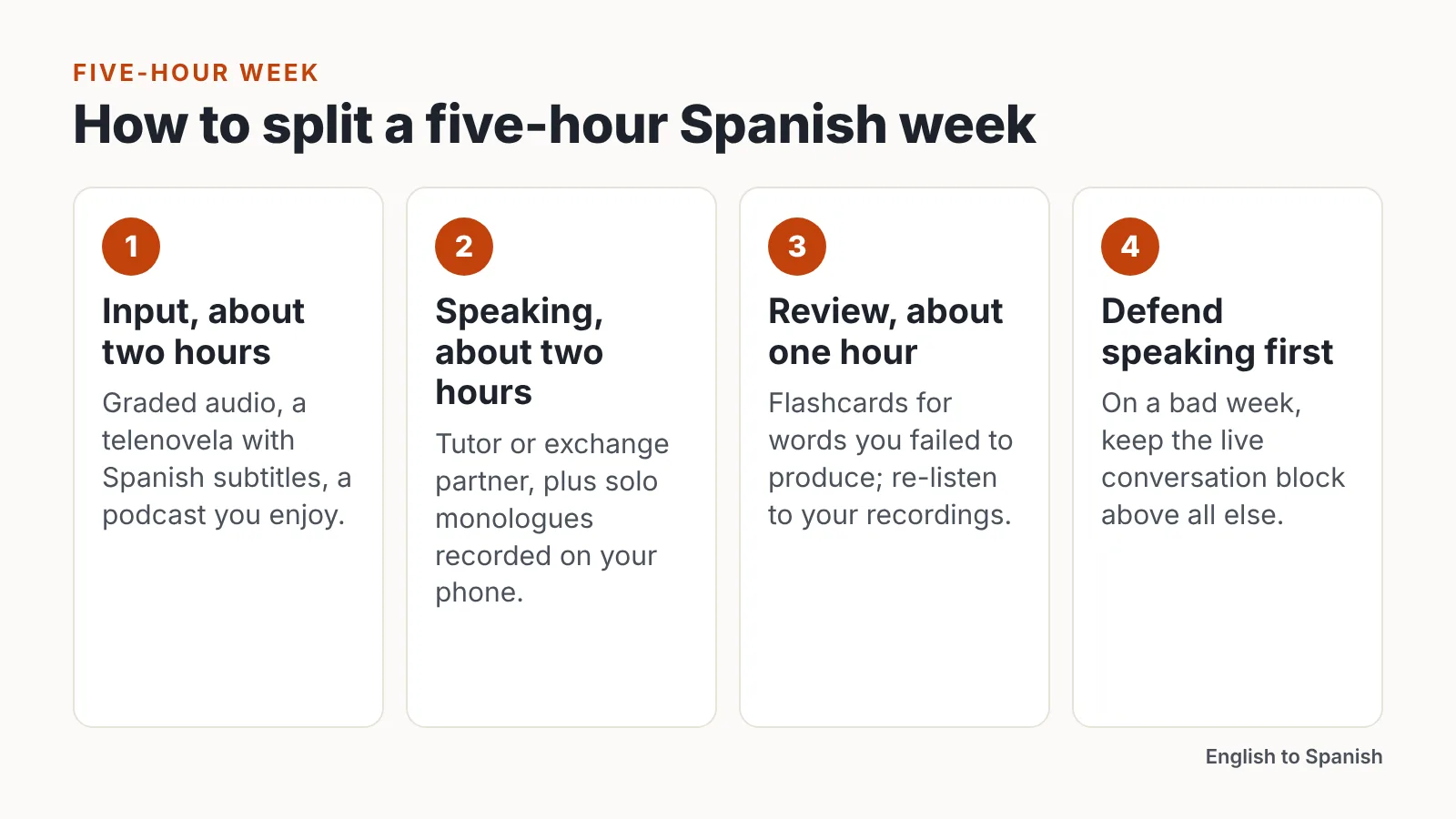
A workable split for a five-hour week:
- Input, about two hours: graded audio, a telenovela with Spanish subtitles, a podcast you would listen to in English anyway.
- Speaking, about two hours: live conversation with a tutor or exchange partner, plus solo monologues recorded on your phone.
- Review, about one hour: flashcards for words you personally failed to produce, and a re-listen of your own recordings.
Speaking hours are the expensive ones, and they are the ones people cut first. Protect them. If you only defend one block on a bad week, defend the live conversation, because it is the only activity that trains retrieval under time pressure.
Step 5 — Re-test your level every 8–12 weeks and adjust the forecast
Time needed: about 90 minutes per check. What you need: a phone recorder and a tutor willing to assess bluntly.
Run the same three tests each quarter so the results compare. Record a three-minute unscripted monologue about your week. Take a free CEFR placement test from a reputable school. Ask a tutor for a level estimate at the end of a paid lesson.
Then compare your logged hours against your projection. If you have burned 120 hours and still sit at A1, the problem is usually the mix from Step 4, not your talent.
Instituto Cervantes reported that in 2024 Spanish speakers worldwide passed 600 million for the first time, so finding someone to test yourself against is a logistics problem rather than a scarcity problem. Community centers, church groups, restaurant kitchens, and tutoring marketplaces all work.
Update the finish date honestly after each check. Moving the date because life got busier is planning; ignoring the gap for a year is how a 400-hour goal becomes a five-year hobby.
Your conversational-Spanish timeline checklist
Run this list once before you start, then again at every quarterly re-test. It takes about ten minutes and catches most of the drift.
- [ ] I wrote a one-sentence definition of my finish line and tied it to a published level (A2, B1, or ILR 2).
- [ ] I chose a single hour target: 180–200 hours for A2 or 350–400 for B1, per the British Council’s level guide for learners of English.
- [ ] I know my weekly hours and the resulting finish date, and both live in my calendar.
- [ ] Live speaking has its own protected block, booked with a specific person at a specific time.
- [ ] I log hours somewhere, weekly, including the messy fifteen-minute sessions.
- [ ] My review deck contains words I failed to produce in conversation, not a pre-made list of 5,000 nouns.
- [ ] I have a re-test date on the calendar within the next twelve weeks.
- [ ] I can name the last three things I said in Spanish to a human being.
If four or more boxes stay empty two weeks in a row, shrink the plan rather than abandoning it. Three defended hours a week beats a heroic ten-hour plan that survives one month.
Common mistakes that quietly double your hours
The most expensive failure is the beginner loop: restarting A1 material every January, forever. You rebuild the same present tense, feel competent for three weeks, stall at the subjunctive, and quit. Avoid it by keeping a dated log of hours and refusing to repeat any unit you can already pass — start each restart from your last verified level, not from zero.
Other time sinks show up again and again:
- Quoting the wrong benchmark. The Foreign Service Institute’s 30 weeks, or roughly 690 class hours, for Spanish describe professional proficiency, so measuring casual goals against it guarantees you feel behind.
- Counting passive exposure as study. Spanish radio during your commute is worth having, but it should not be entered in the same column as tutored speaking time.
- Delaying speech until you "feel ready." Every month you wait adds hours later, since comprehension without production hardens into a habit.
- Collecting resources instead of finishing one. Three half-finished courses teach less than one completed A2 course.
- Skipping review for weeks. Relearning forgotten vocabulary is the single most avoidable hour cost in the whole plan.
Pick one mistake from this list that you recognize, fix it this week, and leave the rest alone. Compounding fixes fail for the same reason compounding schedules do.
Frequently asked questions
How many hours does it take to learn conversational Spanish?
Plan for roughly 350–400 cumulative hours, since the British Council’s guide to Cambridge levels places B1 — the usual conversational threshold — at that range for learners of English, with A2 reached earlier at 180–200 hours; the Instituto Cervantes course structure reaches B1 at about 300 hours.
Is the Foreign Service Institute’s 30-week estimate for Spanish realistic for me?
The Foreign Service Institute lists Spanish at 30 weeks, about 690 class hours, at the top of its Category I band of 24–30 weeks or 552–690 class hours, but that schedule is full-time intensive instruction aimed at professional working proficiency, not evening study for conversation.
Can I reach conversational Spanish with an app alone?
Apps build real knowledge — a 2024 Language Learning & Technology study of university students using Duolingo’s Spanish course found significant gains in all measured skills after about 27 hours — but conversation also needs live speaking practice under time pressure.
How long does each CEFR level take on its own?
Cambridge English estimates roughly 200 guided learning hours are needed to move from one CEFR level to the next, and Instituto Cervantes structures its own Spanish courses as 60 taught hours for A1 and 120 hours for A2.
How do I know when I’ve actually reached a conversational level?
Test against a definition instead of a feeling: the Interagency Language Roundtable describes Speaking Level 2 as satisfying routine social demands and limited work requirements, which is a checkable standard you can verify with a tutor every 8–12 weeks.
Sources
- Foreign Language Training – United States Department of State
- Skill Level Descriptions for Speaking – Interagency Language Roundtable
- Our levels and the CEFR | British Council
- Guided learning hours – Cambridge English Support Site
- Cursos generales de español – Instituto Cervantes de Rabat
- The effectiveness of Duolingo in developing receptive and productive language knowledge and proficiency (Smith, Jiang & Peters, 2024)
- El español supera por primera vez los 600 millones de hablantes – Instituto Cervantes
AI tools helped write this guide. The English to Spanish Editorial Team published it after checking every figure against the sources linked above.